
The basics of the risks and tax of crypto-asset trading
Many people want to check, before or after starting with crypto-assets, what risks are involved and how tax works. This article organises the main risks involved in crypto-asset trading, and the basics of tax, on the basis of information published by public bodies such as the Financial Services Agency and the National Tax Agency. It does not recommend any particular judgement; its purpose is for you to check accurately the facts that form the premise of trading.
Two premises are confirmed at the outset. The first is that crypto-assets are not legal tender (法定通貨). The Financial Services Agency explains of crypto-assets that they are not legal tender and that their prices can fluctuate, and they are not of a nature under which either profit or principal is guaranteed. The second is that the part of this article dealing with tax is a general explanation of the rules, and is neither tax advice nor investment advice. Nor does it indicate that anything saves tax or is advantageous. Tax rules may change through amendments to the law, and the premise is that the calculation of a specific amount of tax, and the treatment of an individual case, are confirmed with the tax office (税務署), a tax accountant (税理士), or the latest information from the National Tax Agency. Note that the content of this article is based on official information confirmed as at June 2026. Because the rules and the tax rules may be amended, please confirm the latest information in official information from bodies such as the Financial Services Agency and the National Tax Agency.
The mechanics of crypto-assets (the difference between the exchange 取引所 and the dealer service 販売所, the flow of opening an account, and so on) are organised separately in The basics of crypto-asset trading — the difference between the exchange (取引所) and the dealer service (販売所), how they work, and the flow of a purchase. This article is positioned as organising the risks and the tax that lie beyond that.
The main risks of crypto-asset trading
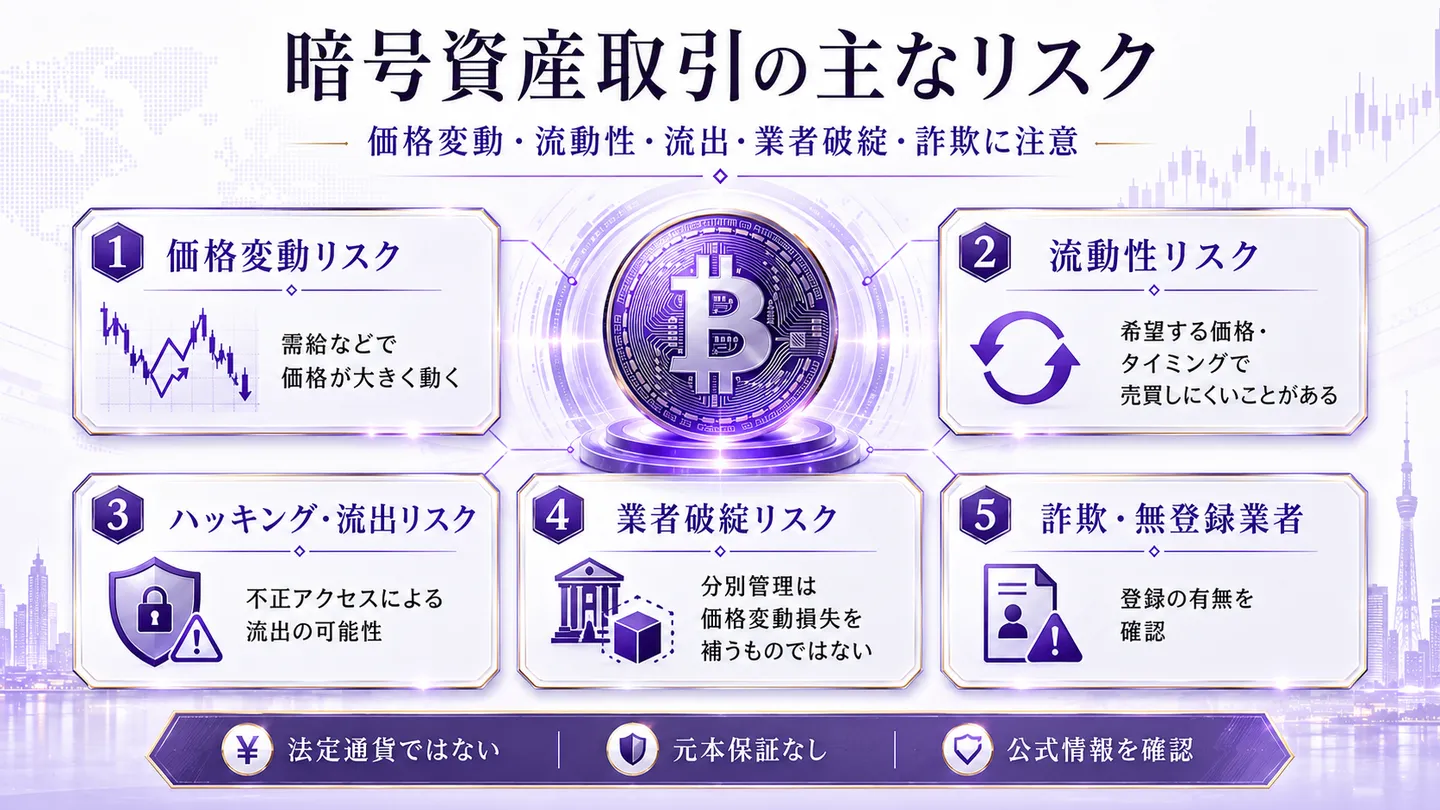
Crypto-asset trading involves several main risks. This section organises them on the basis of public information, in the order of price fluctuation, liquidity, outflow (hacking), the failure of an operator, and fraud or unregistered operators.
Price fluctuation risk
The prices of crypto-assets can fluctuate greatly in response to supply and demand and other factors. The Financial Services Agency explains of crypto-assets that their prices can fluctuate and that they are not legal tender. Crypto-assets do not come with a guarantee of value by any particular issuer, their prices can move greatly over a short period in response to supply and demand and other factors, and neither profit nor principal is guaranteed. It is necessary to grasp the premise that price fluctuation can give rise to a loss that leaves you with less than the funds you invested.
Liquidity risk
Liquidity risk is the risk that, depending on market conditions, it may become difficult for a purchase or a sale to be executed at the price or the timing you want. Depending on the kinds of crypto-assets handled and on market conditions at the time, situations can arise in which you cannot sell as you intend when you want to sell, or in which you can trade only at a price different from the one you assumed.
Hacking and outflow risk
The risk that crypto-assets flow out as a result of unauthorised access and the like has been pointed out. On 令和6年9月26日 (26 September 2024) the Financial Services Agency published 「暗号資産の流出リスクへの対応等に関する注意喚起及び自主点検要請」, calling on the industry and on operators to address the risk of outflows. Users too, it is considered, need to understand the position on the premise that this risk of outflow exists.
The risk of an operator failing (segregated management, and organising why losses are not made good)
Registered crypto-asset exchange service providers are subject to frameworks for the protection of users, such as segregated management (分別管理), under which the assets entrusted by users are managed separately from the operator’s own assets. This is an institutional framework whose purposes include preserving users’ assets in cases such as the failure of the operator.
Here it is important to understand the concepts separately. These frameworks for the protection of users are systems for preserving assets; they do not make good losses arising from price fluctuation (the profit or loss on an investment). Care is needed on the point that the relationship is not one in which the existence of a framework for the protection of users means that you will not lose money. Please organise the systems concerning the preservation of assets, and the profit or loss arising from market movements, as separate things.
Caution regarding fraud and unregistered operators
Around crypto-assets, fraudulent solicitation and trouble involving operators that have not obtained registration have been reported. The Financial Services Agency calls for caution, explaining that enquiries concerning crypto-assets and fraudulent coins are increasing and asking people to be careful of fraud and malicious business practices.
To conduct a crypto-asset exchange service as a business in Japan, registration for the crypto-asset exchange service business (暗号資産交換業) is required. The Financial Services Agency explains that, in the case of unregistered operators, there is a high likelihood that arrangements for protecting investors and others are not in place, and trouble such as being unable to withdraw funds, or losing contact with the operator, has been reported. Whether an operator you are considering using has obtained registration can be checked in the list of registered operators published by the Financial Services Agency, and in its information on unregistered operators and on operators subject to warnings. Note that, rather than deciding uniformly that operators located overseas are fraudulent or dangerous, it is important to check whether they are registered and to judge in the light of warnings from bodies such as the Financial Services Agency.
When you are in difficulty or feel uneasy, using a consultation desk is also something to consider. The Financial Services Agency’s 金融サービス利用者相談室 (its consultation office for users of financial services; 0570-016811, weekdays from 10:00 to 17:00), the 消費者ホットライン (the consumer hotline; 188) and JVCEA (一般社団法人 日本暗号資産等取引業協会; 03-3222-1061) are among those presented as consultation desks.
An outline of leverage trading (暗号資産証拠金取引) and the points of caution
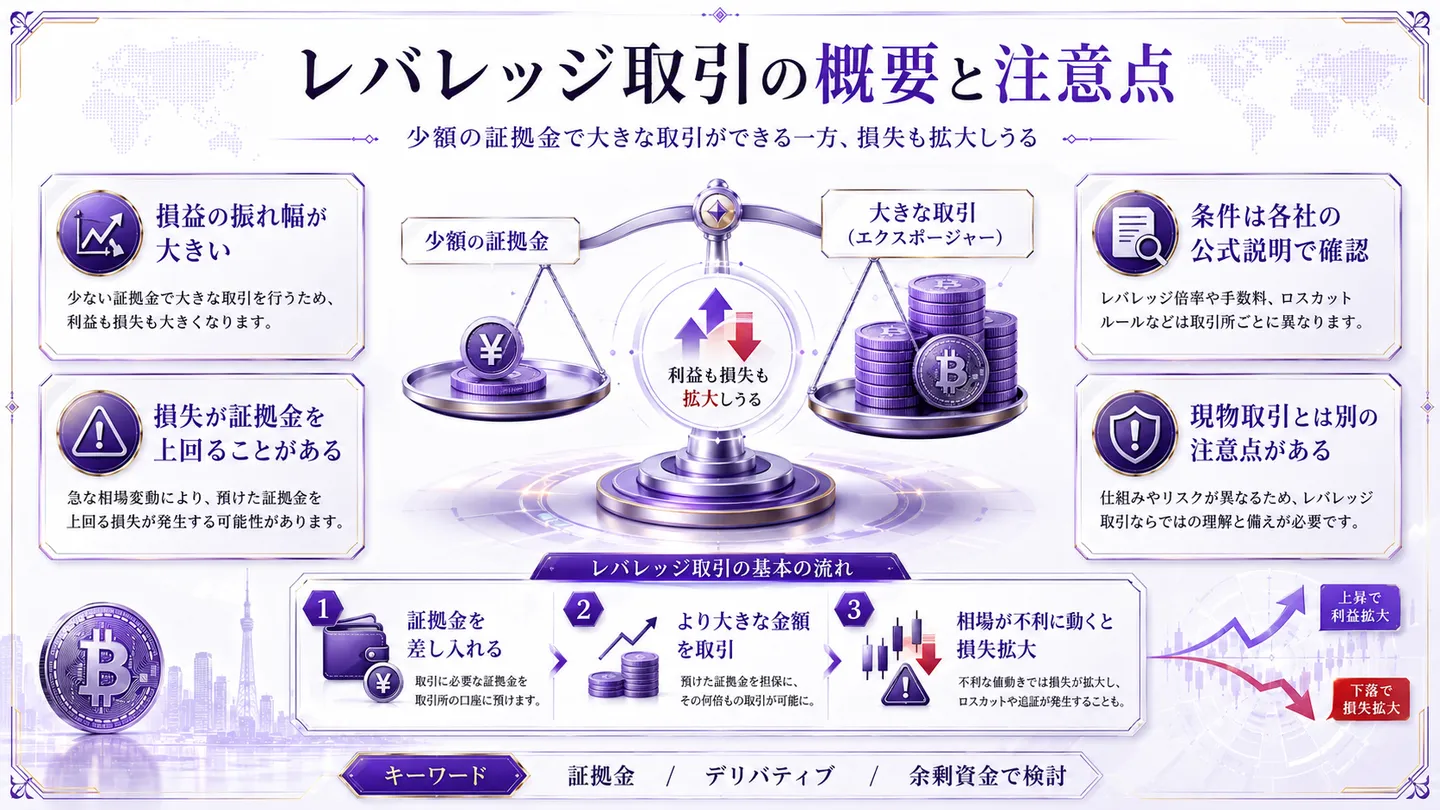
Besides spot trading, in which the crypto-asset itself is bought and sold, crypto-assets also involve leverage trading (レバレッジ取引, also called 暗号資産証拠金取引, crypto-asset margin trading, or derivative transactions), which is conducted by depositing margin. This is a mechanism under which a larger amount can be traded with a small amount of margin.
What is worth grasping here is that leverage (レバレッジ) magnifies movements in both directions of profit and loss. While a large amount can be traded with a small amount of funds, if the market moves unfavourably the loss also becomes larger, and the loss can exceed the margin that was deposited. This article goes no further than indicating that leverage trading exists and the point of caution that losses can expand; it does not go into the details of the upper limits on specific multiples or of the conditions. Whether to engage in leverage trading, and what its conditions are, are matters to be confirmed, as a premise, in each company’s official explanations and in information from JVCEA. Note that, in the treatment of tax as well, crypto-asset margin trading differs in some respects from FX (foreign exchange margin trading, 外国為替証拠金取引), so please also check the tax section that follows.
The basics of tax (the general rule: 雑所得 / aggregate taxation)
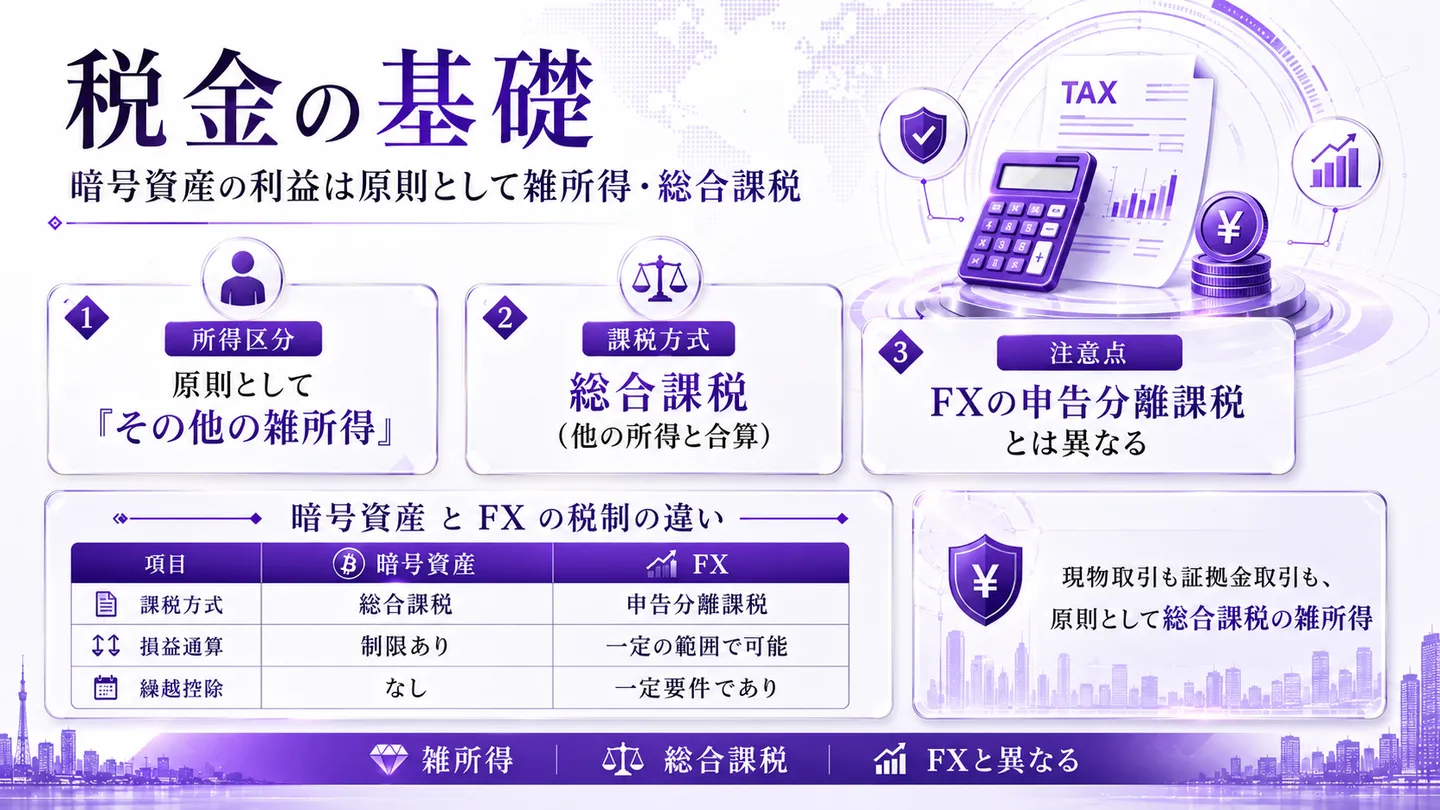
From here, the basics of the tax that applies to crypto-asset trading are organised. To repeat, this section is a general explanation of the rules; it is neither tax advice nor investment advice. The rules may be amended, and the premise is that the calculation of a specific amount of tax, and the treatment of an individual case, are confirmed with the tax office, a tax accountant, or the latest information from the National Tax Agency.
The income category is, as a general rule, 「その他の雑所得」
The National Tax Agency explains that a profit arising from selling or using crypto-assets falls, as a general rule, within 「その他の雑所得」 (other miscellaneous income), except where it arises incidentally to an act that is the source of one of the various categories of income such as 事業所得 (business income). In other words, where an ordinary individual obtains a profit from trading in crypto-assets, the basic organisation is that this profit is, as a general rule, treated as 雑所得 (miscellaneous income), and specifically as 「その他の雑所得」.
However, the National Tax Agency also sets out an organisation under which, where the amount of revenue relating to crypto-asset trading for the year exceeds 3 million yen (300万円), the income is classified, as a general rule, as 事業所得 if books and records of the trading are kept, and, as a general rule, as 「業務に係る雑所得」 (miscellaneous income from a business-related activity) if they are not. Accordingly, it is accurate to understand the income category as follows: as a general rule it is 「その他の雑所得」, but the category can differ depending on matters such as the amount of revenue, whether books and records are kept, and the actual state of the trading. Because which of these applies depends on individual circumstances, the premise is that the specific category is confirmed in the latest information from the National Tax Agency, or with the tax office or a tax accountant.
Aggregate taxation, and the restrictions on offsetting gains and losses
A profit on crypto-assets that falls, as a general rule, within 雑所得 is subject to aggregate taxation (総合課税). Aggregate taxation is a method under which the income is aggregated with other income such as employment income (給与所得) and then taxed at progressive rates, under which the rate rises as income grows larger.
What calls for particular care here is the difference from the tax rules for FX. A profit on FX (both over-the-counter FX, 店頭FX, and exchange-traded FX, 取引所FX) is treated as a futures transaction and the like under the Financial Instruments and Exchange Act and made subject to separate self-assessment taxation (申告分離課税), being taxed at a fixed rate, whereas a profit on crypto-assets is, as a general rule, not subject to this separate self-assessment taxation but treated as 雑所得 under aggregate taxation. Because the two differ in their method of taxation, it is wrong to apply the tax rate and the mechanism for FX to crypto-assets as they stand.
There are also restrictions on the offsetting of gains and losses (損益通算), that is, on setting a loss against other income. Where trading in crypto-assets is classified within 雑所得, a loss arising in that calculation cannot, as a general rule, be deducted from other income such as employment income. Further, while FX has a special measure (loss carry-forward, 繰越控除) under which, where certain requirements are met, a loss can be carried forward to the following year and beyond as 「先物取引に係る雑所得等」 (miscellaneous income and the like arising from futures transactions), this special measure does not apply to profits on crypto-assets. On this point too, the tax rules for FX and for crypto-assets differ.
The Japanese tax return and the calculation (総平均法 and 移動平均法)
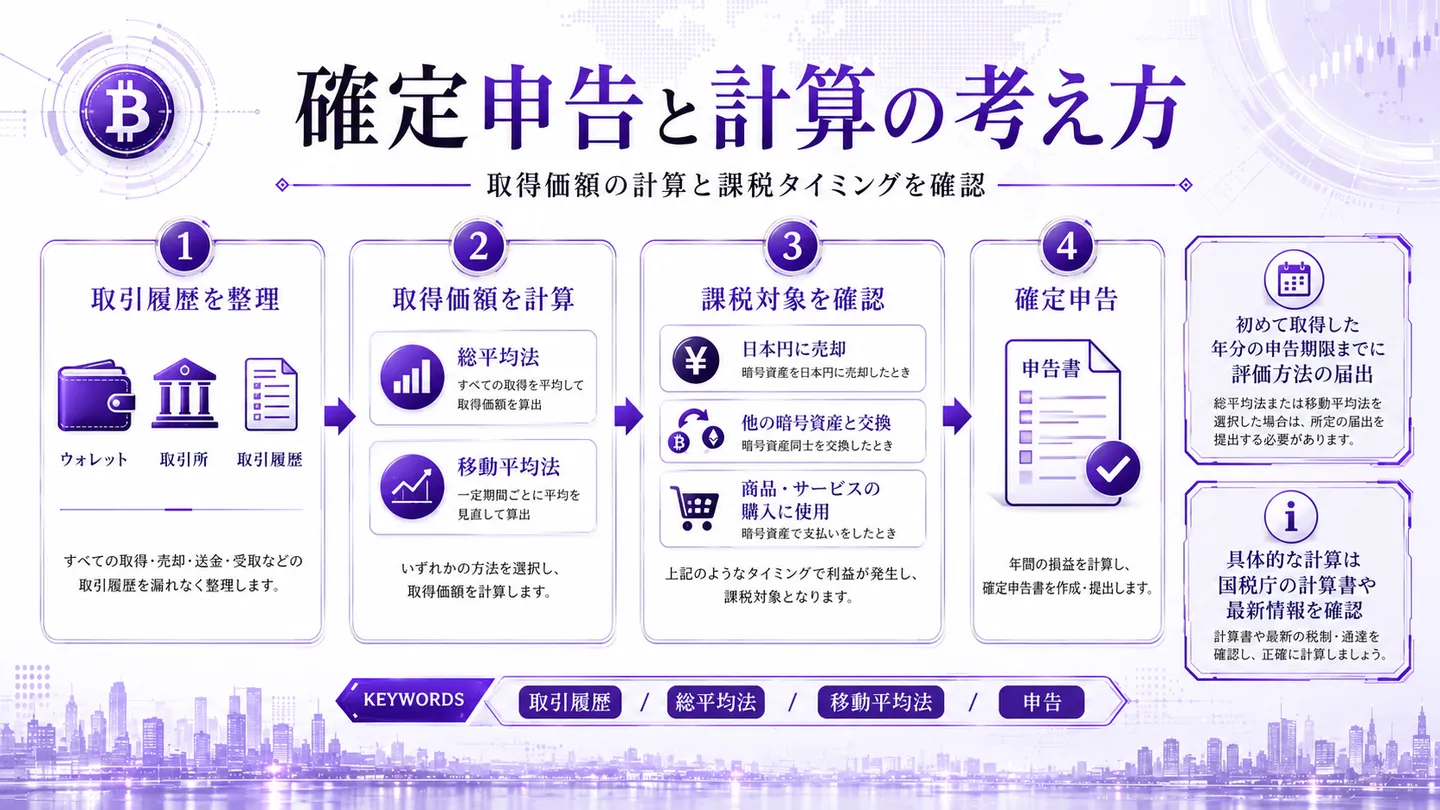
Where a profit on crypto-assets meets certain requirements, a Japanese tax return (確定申告) becomes necessary. In filing, the acquisition cost of the crypto-assets has to be calculated, and the National Tax Agency gives 総平均法 (the total average method) or 移動平均法 (the moving average method) as the methods for that calculation. A notification of the valuation method (評価方法の届出) is to be made by the deadline for the Japanese tax return for the year in which crypto-assets were first acquired, and where no notification is made, the method of calculation prescribed by law applies. As to the details of the calculation, the use of such things as the calculation sheets for crypto-assets that the National Tax Agency provides is presented. Because this article goes no further than an outline, the premise is that the specific steps of the calculation, and whether it is required, are confirmed in the latest information from the National Tax Agency, or with the tax office or a tax accountant.
The point that margin trading (derivatives) is also subject to aggregate taxation
Care is also needed as to the treatment of tax for the leverage trading touched on earlier (crypto-asset margin trading, derivative transactions in crypto-assets). Futures transactions and the like under the Financial Instruments and Exchange Act, such as FX, are made subject to separate self-assessment taxation, but crypto-asset margin trading is excluded from the scope of this separate self-assessment taxation, and is, as a general rule, declared as 雑所得 under aggregate taxation. In other words, it is necessary to grasp that, for crypto-assets, both spot trading and margin trading are, as a general rule, organised as 雑所得 under aggregate taxation, and that this differs from the separate self-assessment taxation that applies to FX.
There is also a point about the timing of taxation that is easily misunderstood. It tends to be thought that tax arises only when crypto-assets are converted into Japanese yen, but the National Tax Agency sets out an organisation under which, when crypto-assets are used as well (exchanged for other crypto-assets, or used to purchase goods or services, and so on), the transaction falls within the scope of taxation if a profit arises at that point. The premise is that the detailed treatment is confirmed in the latest information from the National Tax Agency.
Terms organised
The main terms covered in this article are organised below.
- Price fluctuation risk: the risk that profit or loss changes as the price of a crypto-asset fluctuates. Neither profit nor principal is guaranteed (Financial Services Agency).
- Outflow (hacking) risk: the risk that crypto-assets flow out as a result of unauthorised access and the like. The Financial Services Agency published a warning on 26 September 2024.
- Segregated management (分別管理): a framework under which the assets entrusted by users are managed separately from the operator’s own assets. It is a system for preserving assets, and does not make good losses arising from price fluctuation.
- Unregistered operators: operators carrying on business without having obtained registration for the crypto-asset exchange service business. There is said to be a high likelihood that arrangements for the protection of investors are not in place, and trouble has been reported.
- Leverage trading (レバレッジ取引, 暗号資産証拠金取引): a mechanism for trading a larger amount by depositing margin. It magnifies movements in both directions of profit and loss, and the loss can exceed the margin.
- 雑所得 (miscellaneous income) / aggregate taxation (総合課税): a profit on crypto-assets falls, as a general rule, within 「その他の雑所得」 and is subject to aggregate taxation (progressive taxation under which the income is aggregated with other income) (National Tax Agency). This differs from the separate self-assessment taxation that applies to FX.
Points worth checking
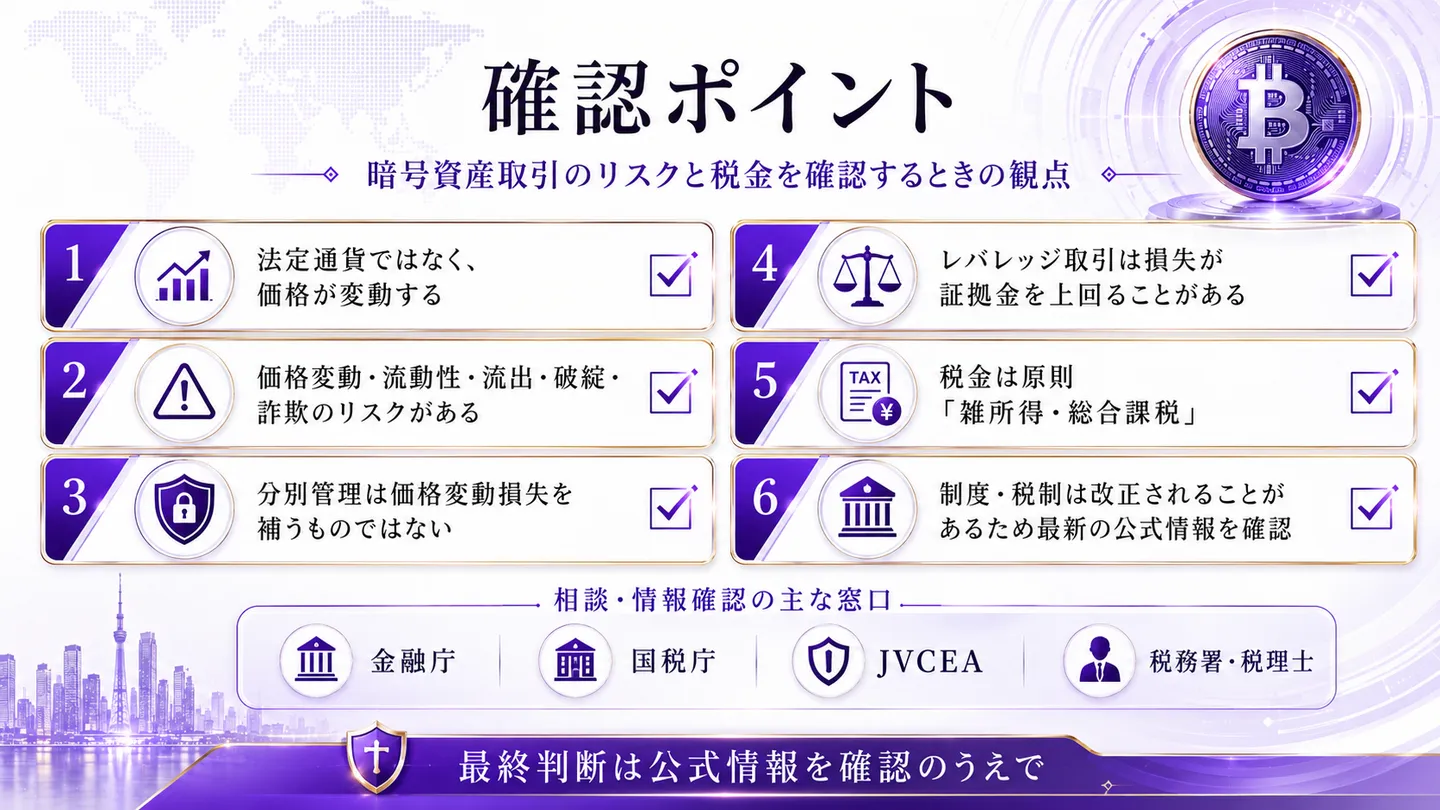
Finally, the points worth bearing in mind when checking the risks and the tax of crypto-asset trading are summarised.
- Crypto-assets are not legal tender, and their prices fluctuate. Neither profit nor principal is guaranteed (Financial Services Agency).
- Besides price fluctuation, there are risks such as liquidity, outflow (hacking), the failure of an operator, and fraud or unregistered operators.
- Frameworks for the protection of users (such as segregated management) are systems for preserving assets; they do not make good losses arising from price fluctuation.
- In leverage trading, the loss can exceed the margin.
- Tax is, as a general rule, 「その他の雑所得」 and aggregate taxation. This differs from the separate self-assessment taxation that applies to FX, and there are restrictions on the offsetting of gains and losses and on carrying losses forward as well. Margin trading is also subject to aggregate taxation.
- The rules and the tax rules may be amended. Check the latest information in official information from bodies such as the Financial Services Agency and the National Tax Agency. Check the calculation of a specific amount of tax with the tax office or a tax accountant.
Frequently checked questions
Is the tax on profits from crypto-assets the same as for FX?
It differs. A profit on FX (foreign exchange margin trading) is treated as a futures transaction and the like under the Financial Instruments and Exchange Act and made subject to separate self-assessment taxation, whereas a profit on crypto-assets falls, as a general rule, within 「その他の雑所得」 and is subject to aggregate taxation (progressive taxation under which the income is aggregated with other income). Further, the special measure for carrying losses forward that FX has does not apply to crypto-assets. It is wrong to apply the tax rate and the mechanism for FX to crypto-assets as they stand. For the specific treatment, please check the latest information from the National Tax Agency, or confirm with the tax office or a tax accountant.
How does tax work for crypto-asset margin trading (leverage trading)?
Crypto-asset margin trading (derivative transactions) is excluded from the scope of the separate self-assessment taxation that applies to FX, and is, as a general rule, declared as 雑所得 under aggregate taxation. In other words, for crypto-assets both spot trading and margin trading are, as a general rule, organised as 雑所得 under aggregate taxation, and this differs from the separate self-assessment taxation that applies to FX. The premise is that the detailed treatment is confirmed in the latest information from the National Tax Agency, or with the tax office or a tax accountant.
Are crypto-assets taxed only when they are converted into Japanese yen?
That is not necessarily so. The National Tax Agency sets out an organisation under which, when crypto-assets are used as well (exchanged for other crypto-assets, or used to purchase goods or services, and so on), the transaction falls within the scope of taxation if a profit arises at that point. Thinking that only conversion into Japanese yen is subject to tax amounts to a misunderstanding. For the detailed treatment, and for whether it is required in your own case, please check the latest information from the National Tax Agency, or confirm with the tax office or a tax accountant.
If there is a framework for the protection of users, am I protected even when I lose money on crypto-assets?
You are not necessarily protected. Registered crypto-asset exchange service providers are subject to frameworks for the protection of users, such as segregated management, but these are systems whose purposes include preserving users’ assets in cases such as the failure of the operator; they do not make good losses arising from price fluctuation (the profit or loss on an investment). Please organise the systems concerning the preservation of assets, and the profit or loss arising from market movements, as separate things.
Is it all right to use crypto-asset exchange service providers located overseas?
To conduct a crypto-asset exchange service as a business in Japan, registration for the crypto-asset exchange service business is required. The Financial Services Agency calls for caution on the ground that, in the case of unregistered operators, there is a high likelihood that arrangements for the protection of investors are not in place, and trouble with unregistered operators has also been reported. Rather than deciding uniformly that they are dangerous, it is considered desirable to check whether the operator you are considering using has obtained registration in Japan — in the list of registered operators published by the Financial Services Agency and in its information on unregistered operators — and to judge in the light of the warnings.
In closing
Crypto-asset trading involves points worth checking, such as the risks of price fluctuation, outflow, the failure of an operator and unregistered operators, and a treatment of tax that differs from FX (as a general rule, 雑所得 and aggregate taxation). This article has organised these in line with public information; it neither recommends any particular transaction nor recommends avoiding one. The part dealing with tax is, moreover, a general explanation of the rules; it is neither tax advice nor investment advice.
On the premise that crypto-assets are not legal tender and that their prices fluctuate, the basic approach is to consider investment at your own responsibility and within the range of surplus funds. The premise is that the details of each risk, and the latest rules, tax rules and warnings, are confirmed in information published by public bodies such as the Financial Services Agency, the National Tax Agency, JVCEA and the Consumer Affairs Agency, and in each company’s official information. For the calculation of a specific amount of tax, and for the treatment of an individual case, please confirm with the tax office, a tax accountant, or the latest information from the National Tax Agency. The final decision on opening an account or trading should be made by the reader after checking official information.
The mechanics of crypto-assets (the difference between 取引所 and 販売所, the flow of opening an account, and so on) are organised separately in the following article.
Official information referred to
- Financial Services Agency, 「暗号資産(仮想通貨)に関する情報・利用者のみなさまへ」 (https://www.fsa.go.jp/policy/virtual_currency/index.html)
- Financial Services Agency, 「暗号資産の流出リスクへの対応等に関する注意喚起及び自主点検要請」 (26 September 2024) (https://www.fsa.go.jp/news/r6/sonota/20240926/20240926-2.html)
- Financial Services Agency, 「無登録業者との取引は要注意!!」 (https://www.fsa.go.jp/ordinary/chuui/highrisk.html)
- National Tax Agency, タックスアンサー No.1524 「ビットコインを使用することにより利益が生じた場合の課税関係」 (https://www.nta.go.jp/taxes/shiraberu/taxanswer/shotoku/1524.htm)
- National Tax Agency, 「暗号資産等に関する税務上の取扱いについて(FAQ)」 (last revised 令和7年12月 (December 2025)) (https://www.nta.go.jp/publication/pamph/pdf/virtual_currency_faq_03.pdf)
- National Tax Agency, 「暗号資産等に関する税務上の取扱い及び計算書について」 (https://www.nta.go.jp/publication/pamph/shotoku/kakuteishinkokukankei/kasoutuka/)
This article has been prepared on the basis of official information confirmed as at June 2026. Because the rules and the tax rules relating to crypto-assets may be amended, please confirm the latest information in official information from bodies such as the Financial Services Agency, the National Tax Agency and JVCEA, and in each company’s official explanations. For the calculation of a specific amount of tax, and for the treatment of an individual case, please confirm with the tax office, a tax accountant, or the latest information from the National Tax Agency.
Always check the latest trading conditions, fees and campaigns on each company’s official site. The information on this page is as at the time it was written.