
How to use an FX demo account, and moving to a live account
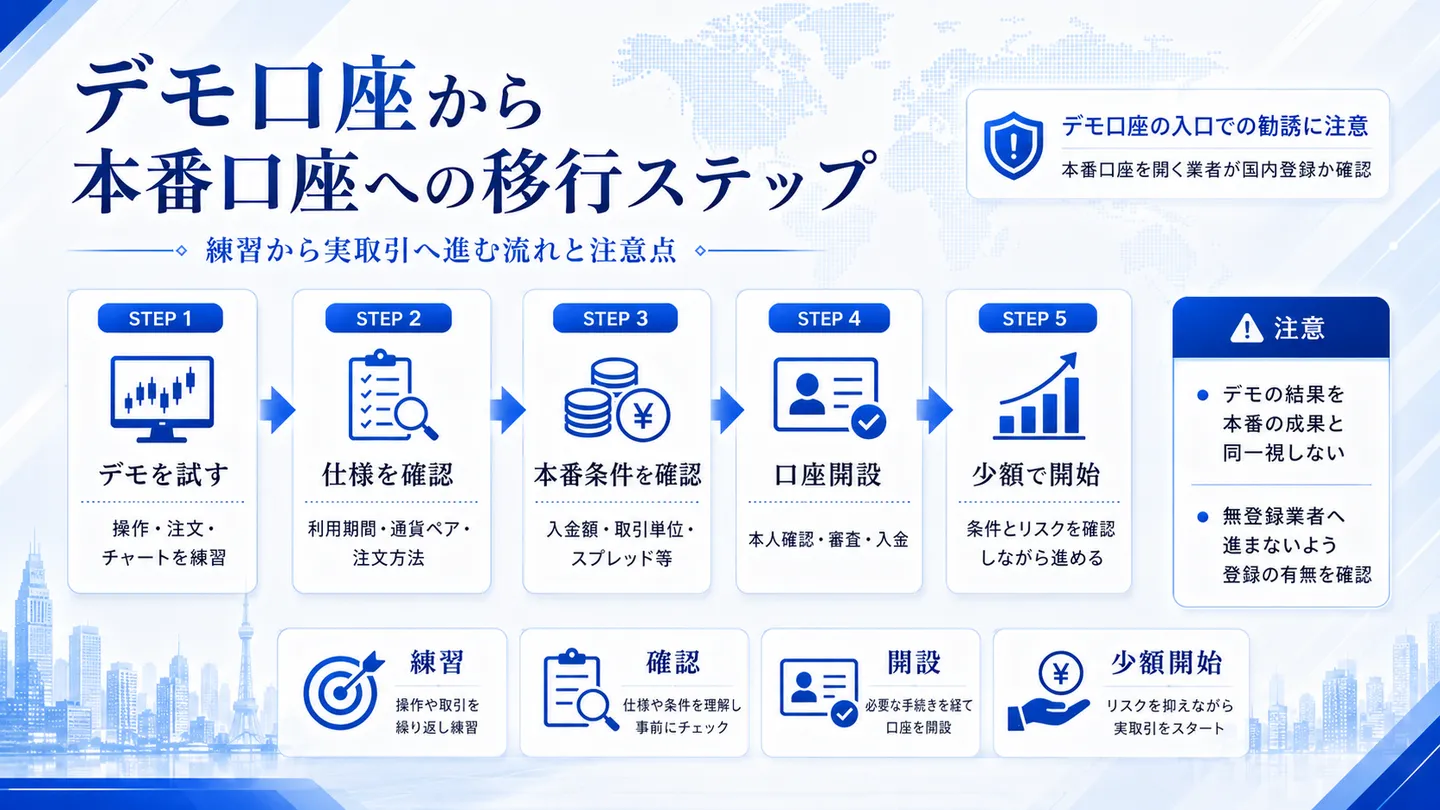
Before starting FX (foreign exchange margin trading, 外国為替証拠金取引), many people are likely to think that trading with real money straight away is worrying, and that they would like to practise first. What is used at that point is a demo account (デモ口座, an account for experiencing trading with virtual funds). This article organises, on the basis of information published by public bodies, what can and cannot be checked with a demo account, the main differences between a demo and a live account, and the points worth checking before moving to a live account. Its purpose is to organise the premises for judging for oneself what a demo account can be used for, and how far.
A short answer to the question comes first. A demo account is an environment for checking the operation of a trading tool, the mechanics of orders and how the market moves, without using one’s own funds. On the other hand, a demo differs from a live account in certain respects, and in particular results that went well in a demo do not necessarily translate into the outcome of actual trading. It is desirable to use a demo on the premise that it is a place for checking operation and mechanics, and not a place that guarantees the outcome of actual trading. The following organises matters one by one on that premise.
| Term | What it refers to | Roughly speaking |
|---|---|---|
| Demo account (デモ口座) | An account for experiencing trading with virtual funds | An environment for checking operation and mechanics without using one's own money |
| Live account (本番口座/ライブ口座) | An account for trading with actual funds | The real trading account, in which actual profit and loss arise |
| Virtual funds (仮想資金) | The practice funds that are in a demo account from the outset | A balance for practice, which is not actual money |
What a demo account is — an environment for checking operation and mechanics with virtual funds
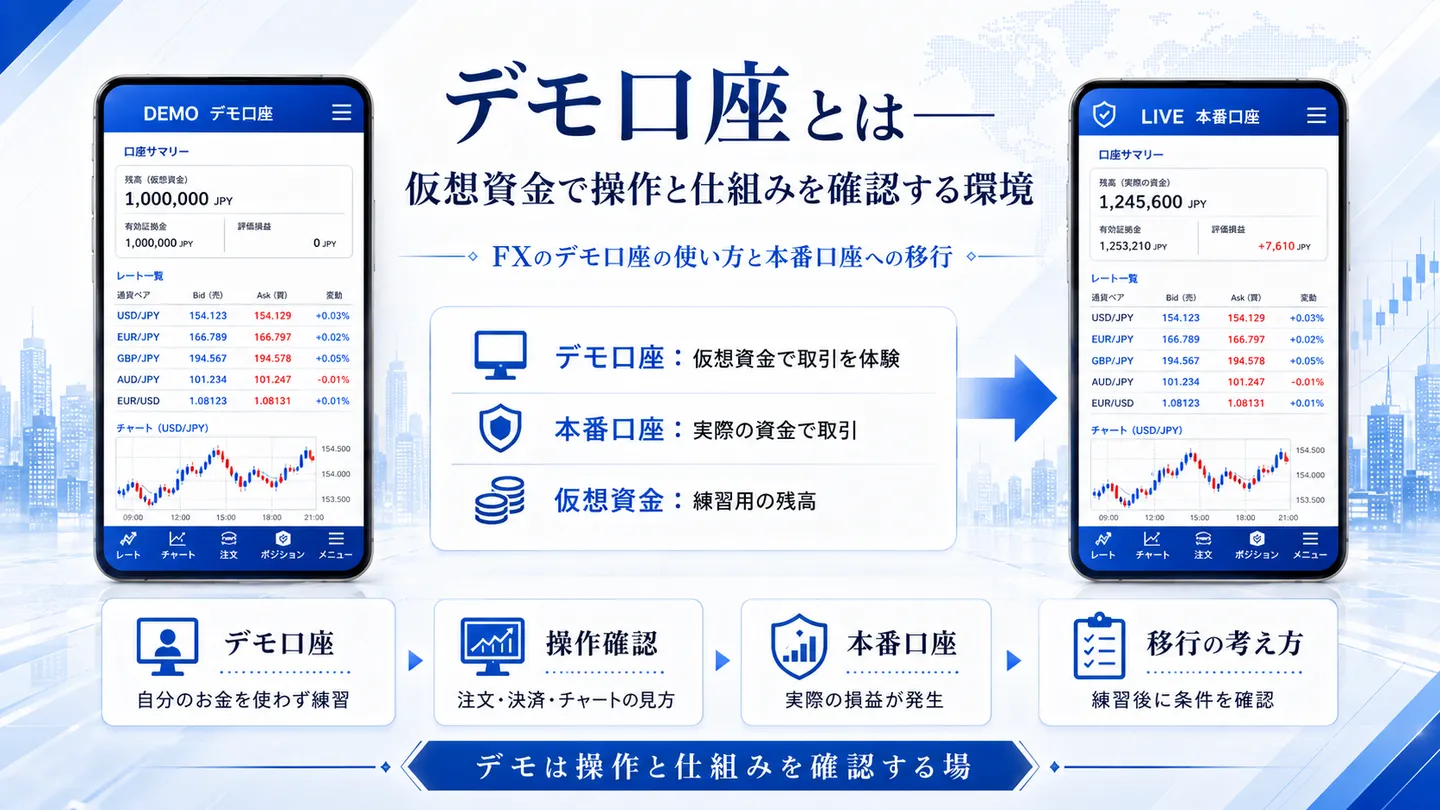
A demo account (デモ口座, an account for experiencing trading with virtual funds) is an environment in which FX trading can be experienced using virtual funds prepared in advance, rather than actual money. Unlike a live account (本番口座/ライブ口座, an account for trading with actual funds), profit and loss do not arise as actual money.
The main purpose of using a demo account can be organised as checking the operation of the trading tool and the mechanics of trading, without using one’s own funds. A series of steps — operating the order screen, how to read charts, how to place orders (market (成行), limit (指値), stop (逆指値) and so on) and how to settle — can be confirmed while actually moving one’s hands.
The amount of virtual funds, the period for which a demo account can be used, the currency pairs available and so on differ by company. This article does not give specific figures such as the amount of virtual funds or the period of use. The premise is that the actual specifications are confirmed in the official explanations of the company one uses (or is considering).
- The amount of virtual funds and the period for which it can be used (these differ by company).
- Whether the currency pairs available and the order methods that can be used in the demo cover the same range as in a live account.
- Whether the trading conditions in the demo (such as how the spread is displayed) are shown on the same premises as in a live account.
What can and cannot be done with a demo account
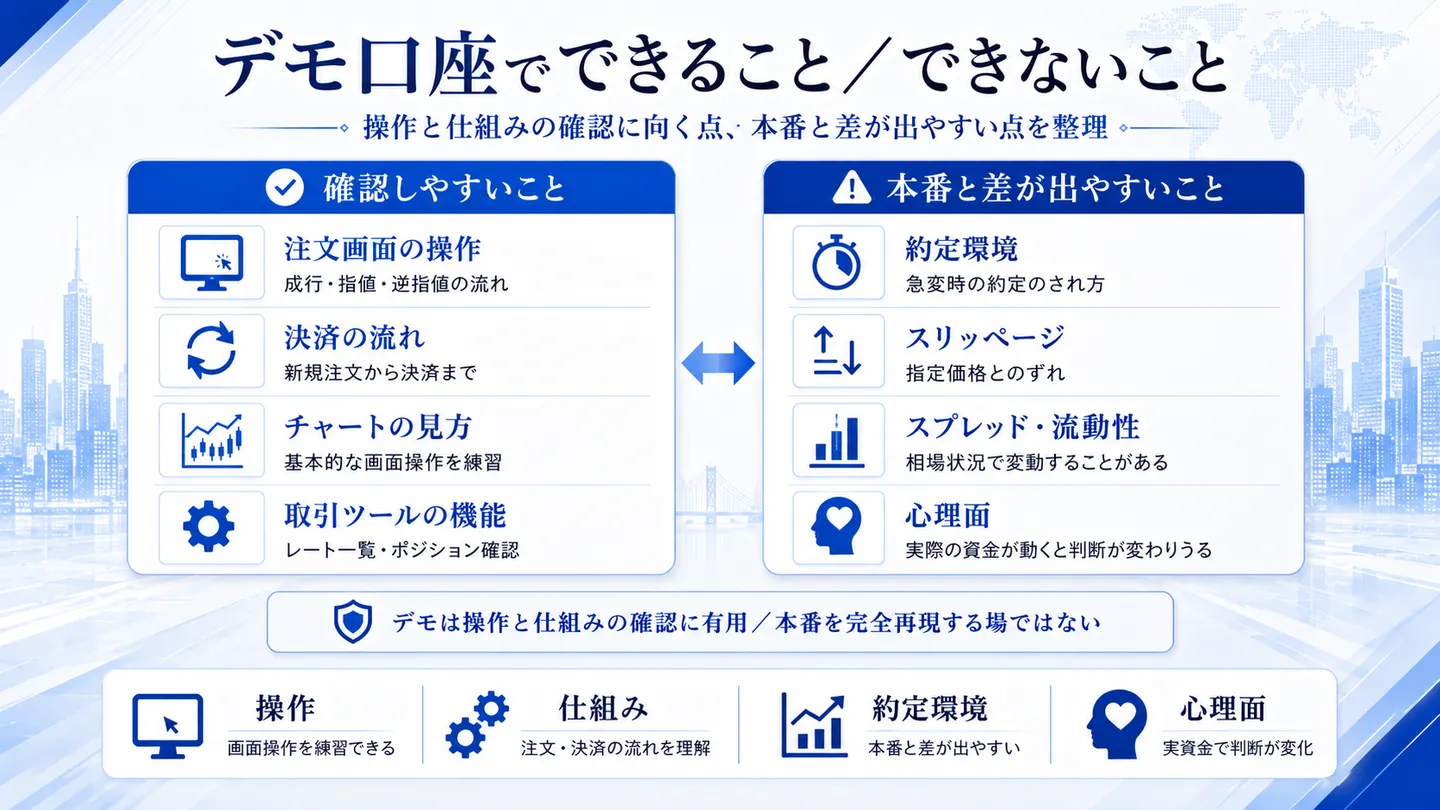
Organising separately what can be done with a demo account and what cannot (or what differs from a live account) makes it easier to avoid overconfidence.
What can mainly be checked with a demo account is the part that corresponds to understanding operation and mechanics. On the other hand, because a demo is a practice environment, there are also parts that are not readily reproduced in the same way as in a live account. In particular, the execution environment discussed below, and the psychological side arising from actual money being at stake, are considered difficult to experience in a demo as they are in a live account.
| Category | What is mainly easy to check | What tends to differ from a live account |
|---|---|---|
| Operation and mechanics | Operating the order screen, order methods, the flow of settlement, how to read charts | — |
| Execution environment | The general flow from placing an order through to execution (約定) | How orders are executed when the market moves suddenly, slippage, fluctuation in the spread, the effect of liquidity |
| The psychological side | — | The effect on judgement of actual funds increasing and decreasing |
What is worth grasping here is that, while a demo account is suited to the purpose of checking operation and mechanics, it is not something that reproduces exactly the same environment as a live account. Because there are differences in the execution environment and on the psychological side, it is desirable to hold the premise that judging actual trading on the basis of experience in a demo alone is difficult.
The main differences between a demo and a live account
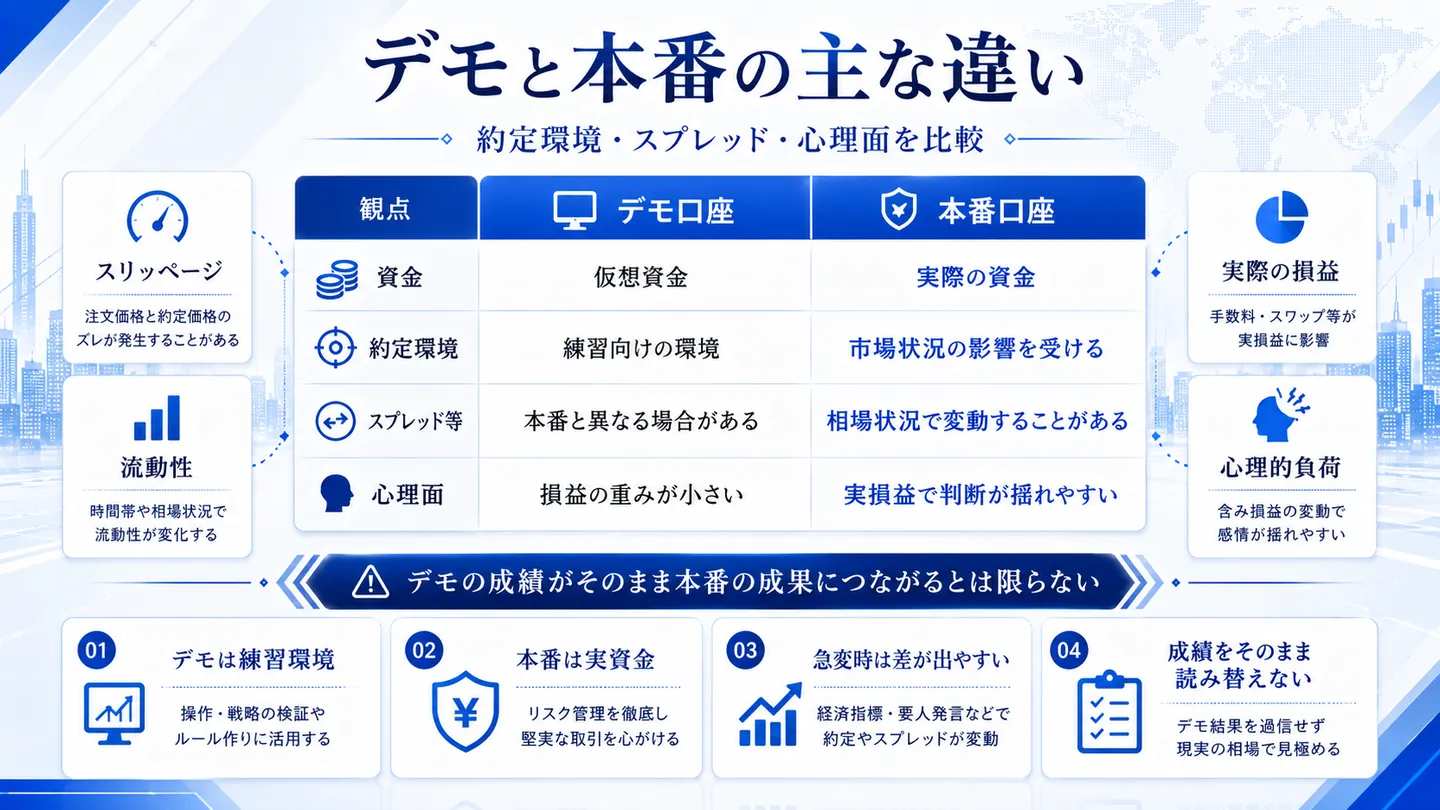
There are considered to be several differences between a demo and a live account. Knowing the differences forms the premise for not placing excessive confidence in results achieved in a demo.
First, there is the difference in the execution environment. In actual trading, where the market fluctuates sharply, the price ordered and the price at which the trade is actually executed may diverge (this is slippage). In addition, the spread displayed (the difference between the selling price and the buying price) is not necessarily constant at all times, and it may widen depending on the state of the market. In its comprehensive guidelines for the supervision of financial instruments business operators (監督指針), the Financial Services Agency refers to matters such as explanations concerning spreads and execution in accordance with the state of trading, the response where the market moves suddenly, and matters relating to カバー取引 (the transactions by which a company covers the positions it takes) and liquidity. Such movements of the actual market are not necessarily reproduced in a demo as they are in a live account.
Second, there is the difference on the psychological side. Because a demo uses virtual funds, profit and loss do not increase or decrease as actual money. In a live account one’s own funds are at stake, so judgement and how a situation feels may change even in the same situation. There is the aspect that, even if one could operate calmly in a demo, one cannot be sure of acting in the same way in a live account.
How orders are executed when the market moves suddenly, slippage, fluctuation in the spread, the effect of liquidity and the like are parts that are not readily reproduced in a demo as they are in a live account. There are also differences on the psychological side arising from actual funds being at stake. It is desirable to take a demo and a live account on the premise that they are different environments.
Results in a demo do not translate directly into the outcome of actual trading
The most important point in this article is organised separately. Even if results in a demo account were good, that does not necessarily translate into the outcome of actual trading.
The reason is as organised in the previous chapter. The execution environment differs between a demo and a live account, and how orders are executed when the market moves suddenly, slippage, fluctuation in the spread, the effect of liquidity and the like are not readily reproduced in a demo as they are in a live account. In addition, there is the difference on the psychological side arising from actual funds being at stake. Because of these differences, the figures from a demo cannot be applied as they are to actual trading.
As a further premise, FX is trading in which a profit may arise and a loss may also arise. The Financial Services Agency explains that FX is trading in which losses exceeding the margin may arise and in which neither principal nor profit is guaranteed, and that where the market fluctuates sharply a loss exceeding the amount of the margin may arise. It is necessary to grasp both sides: that even if a profit was arising in a demo, a profit does not necessarily arise in the same way in actual trading, and that a loss may also arise.
That a profit was arising in a demo does not mean that the same result will follow in a live account. Besides the differences in the execution environment and on the psychological side, FX is in any event trading in which a loss may arise. It is desirable to use a demo on the premise that it is a place for checking operation and mechanics, and not a place that guarantees the outcome of actual trading.
A demo account is considered a useful environment for checking operation and mechanics. On the other hand, reading its results across as an indication of how matters will go in a live account too can lead to overconfidence. The premise is an attitude that treats a demo as no more than a practice environment, and thinks of it separately from the results of actual trading.
Points worth checking before moving to a live account
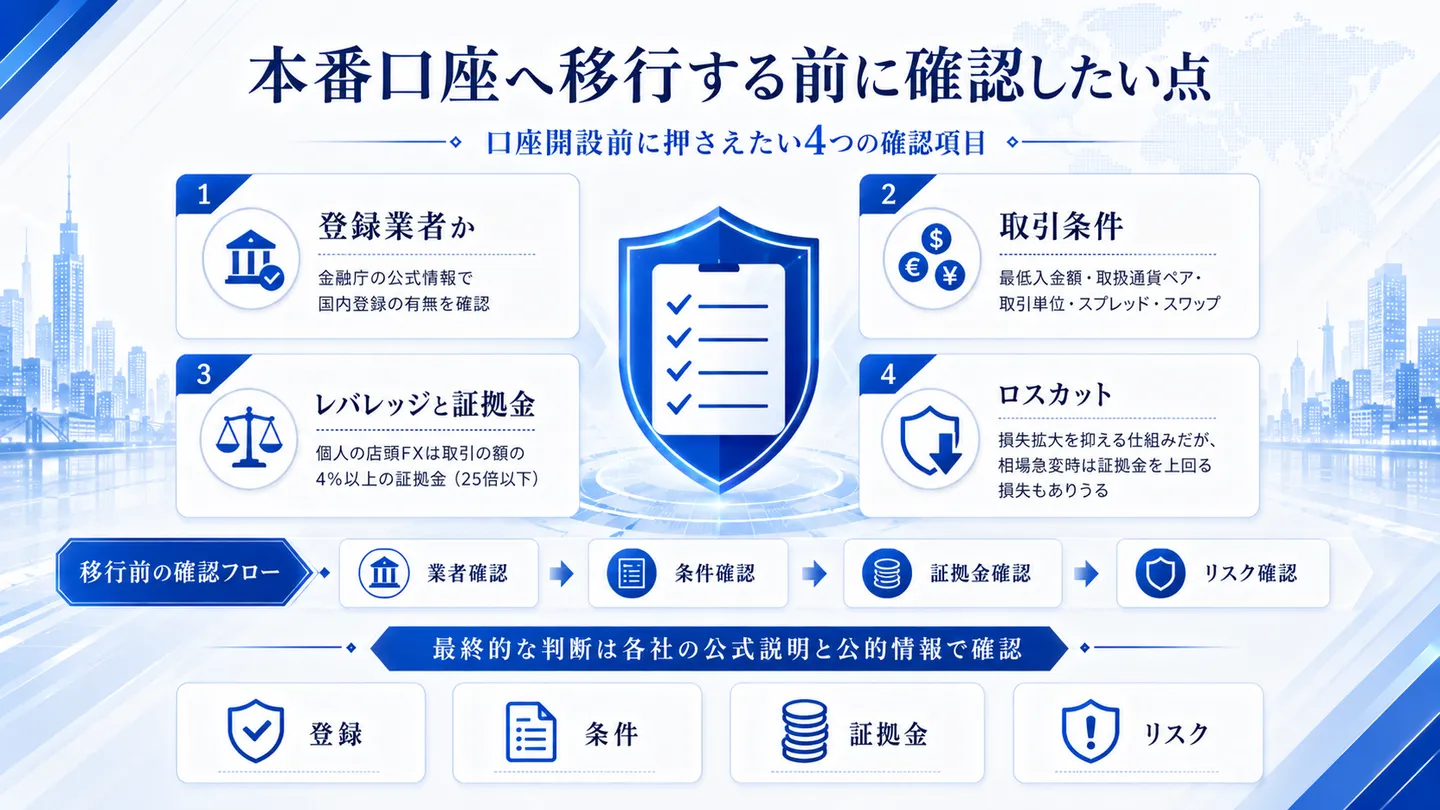
The following organises the points worth checking where, after confirming operation and mechanics in a demo, one moves to a live account (an account for trading with actual funds). Because the conditions for all of them differ by company, the premise is that they are confirmed in each company’s official explanations.
First, checking whether the company is a registered operator. As discussed below, there are also cases of solicitation by unregistered operators from the entrance that a demo provides, so it is desirable to check in the Financial Services Agency’s official information whether the company with which one opens a live account is registered in Japan.
Second, checking the trading conditions. Conditions bearing on actual trading — the minimum deposit amount, the currency pairs available, the trading unit, the approach to spreads, the handling of swap points and so on — differ by company. Care is also needed on the point that the conditions in a demo and in a live account are not necessarily the same.
Third, checking leverage and margin. Where an individual conducts over-the-counter FX (店頭FX) transactions, the regulations of the Financial Services Agency and The Financial Futures Association of Japan require margin of at least 4% of the trade amount (the amount of the transaction, that is, the notional principal (想定元本)) to be deposited and maintained (converted into leverage, this corresponds to 25 times or less; the regulation has been in force since 1 August 2011). While leverage (レバレッジ) is a mechanism that allows trading in a large amount with a small amount of margin, care is needed on the point that fluctuations in either direction, profit or loss, also become larger.
Fourth, checking the loss cut (ロスカット, a mechanism that compulsorily terminates trading at a certain level of loss). A loss cut is a mechanism for restraining the expansion of losses, but where the market fluctuates sharply it may not be completed at the level anticipated, and a loss exceeding the amount of the margin may arise. The premise is not to think that losses can be completely prevented because a loss cut exists.
- Whether the company is a registered operator: check in the Financial Services Agency's official information whether it is registered in Japan.
- Trading conditions: the minimum deposit amount, the currency pairs available, the trading unit, the spread and the handling of swaps (confirm in each company's official information).
- Leverage and margin: for over-the-counter FX by an individual, margin of at least 4% of the trade amount (25 times or less, in force since 1 August 2011). Fluctuations in either direction, profit or loss, become larger.
- Loss cut: a mechanism for restraining the expansion of losses, but where the market moves suddenly a loss exceeding the margin may arise.
The overall picture of the items worth checking when opening an account is also organised in Points to check before opening an FX account for the first time.
Be careful about solicitation at the entrance that a demo account provides
Because a demo account can be tried free of charge and without difficulty, it is a mechanism that is often presented as an entrance. At that entrance, there are also cases of receiving solicitation from operators that are not registered in Japan.
The Financial Services Agency urges caution with regard to transactions with unregistered operators. Operators registered in Japan are required to have an institutional framework bearing on the protection of customer assets, including arrangements for managing margin received from customers separately from the operator’s own assets. With unregistered operators, by contrast, there is the possibility that investor protection arrangements equivalent to those of registered operators cannot be confirmed. Care is needed on the point that these do not make good losses arising in trading (profit and loss arising from market fluctuation), and are an institutional framework concerning the handling of customer assets in situations such as the failure of an operator.
Even where the invitation is to start with a demo, it is desirable to check for oneself whether the operator with which one subsequently opens a live account is registered in Japan. Whether it is registered in Japan can be checked in the Financial Services Agency's official information. Whether or not an operator is registered bears on differences in the institutional framework for the protection of customer assets (this does not guarantee profit or loss in trading).
Key terms
The main terms covered in this article are organised below.
- Demo account (デモ口座): an account for experiencing trading with virtual funds. It is an environment for checking operation and mechanics without using one’s own funds. The amount of virtual funds, the period and the currency pairs differ by company.
- Live account (本番口座/ライブ口座): an account for trading with actual funds. Actual profit and loss arise.
- Slippage: the divergence between the price ordered and the price at which a trade is actually executed. It may arise in situations such as a sudden movement in the market.
- Spread: the difference between the selling price and the buying price. It may widen depending on the state of the market.
- Leverage (レバレッジ): a mechanism that allows trading in a large amount with a small amount of margin. Fluctuations in either direction, profit or loss, become larger. For over-the-counter FX by an individual, margin of at least 4% of the trade amount (25 times or less, in force since 1 August 2011).
- Loss cut (ロスカット): a mechanism that compulsorily terminates trading at a certain level of loss. It is a mechanism intended to restrain the expansion of losses, but where the market moves suddenly a loss exceeding the margin may arise.
Common questions
Can a demo account be used indefinitely?
This differs by company. In some cases a period of use is fixed, and in others it can continue to be used as long as one holds a live account. Because the amount of virtual funds and the currency pairs available also differ by company, it is necessary to confirm these in the official explanations of the company one uses (or is considering).
If one can win in a demo, can one win in actual trading too?
Results in a demo do not necessarily translate into the outcome of actual trading. The execution environment differs between a demo and a live account — how orders are executed when the market moves suddenly, slippage, fluctuation in the spread, the effect of liquidity — and there is also the difference on the psychological side arising from actual funds being at stake. In addition, FX is in any event trading in which a loss may arise. The Financial Services Agency likewise explains that FX is trading in which losses exceeding the margin may arise, and that where the market fluctuates sharply a loss exceeding the amount of the margin may arise. The premise is not to equate results in a demo with results in actual trading.
Are the trading conditions the same in a demo and in a live account?
They are not necessarily the same. The display of spreads, the currency pairs available, the order methods and so on may differ between a demo and a live account. Before moving to a live account, it is desirable to confirm the actual trading conditions in each company’s official explanations.
Is there a cost to using a demo account?
Generally, demo accounts are said often to be provided free of charge, but the conditions on which they are provided differ by company. The premise is that costs and conditions of use are likewise confirmed in each company’s official explanations.
How does one move from a demo account to a live account?
The procedure differs by company. Generally, the flow is to apply to open a live account, go through identity verification and a review, and begin trading after depositing funds. Because the specific steps, and conditions such as the minimum deposit amount, differ from company to company, it is necessary to confirm them in each company’s official explanations.
Summary
An FX demo account is an environment for checking the operation of a trading tool, the mechanics of orders and how the market moves, using virtual funds and without using one’s own funds. While it is suited to checking operation and mechanics, there are parts that are not readily reproduced in a demo as they are in a live account: the execution environment, such as how orders are executed when the market moves suddenly, slippage, fluctuation in the spread and the effect of liquidity, and the psychological side arising from actual funds being at stake. For that reason, even if results in a demo were good, they do not necessarily translate into the outcome of actual trading. FX is in any event trading in which both a profit and a loss may arise, and it is desirable to use a demo on the premise that it is a place for checking operation and mechanics and not a place that guarantees the outcome of actual trading. When moving to a live account, the premise is to confirm matters such as whether the company is a registered operator, the trading conditions, leverage and margin, and how the loss cut works, in each company’s official explanations, and to make the final judgement oneself, having also confirmed official information from bodies such as the Financial Services Agency and The Financial Futures Association of Japan.
Official information referred to
- Financial Services Agency, 「いわゆる外国為替証拠金取引について」 (https://www.fsa.go.jp/ordinary/iwagai/)
- Financial Services Agency, 「無登録業者との取引は要注意!!」 (https://www.fsa.go.jp/ordinary/chuui/highrisk.html)
- Financial Services Agency, 「金融商品取引業者等向けの総合的な監督指針(第一種金融商品取引業)」 (https://www.fsa.go.jp/common/law/guide/kinyushohin/04a.html)
- The Financial Futures Association of Japan (一般社団法人 金融先物取引業協会), 「個人顧客を相手方とするFX取引に係る証拠金規制」 (https://www.ffaj.or.jp/regulation/customers/)
- The Financial Futures Association of Japan (一般社団法人 金融先物取引業協会), 「FX取引の規制について」 (https://www.ffaj.or.jp/regulation/)
This article has been prepared on the basis of official information confirmed as at 8 June 2026. Because the specifications of a demo account (the amount of virtual funds, the period of use, the currency pairs available and so on) and the trading conditions of a live account (the minimum deposit amount, spreads, loss-cut levels and so on) differ by company and by point in time, please confirm the actual details in each company’s official explanations and in the official information listed above.
Always check the latest trading conditions, fees and campaigns on each company’s official site. The information on this page is as at the time it was written.