
How to read an investment trust prospectus (where the investment policy, the risks and the costs are set out)
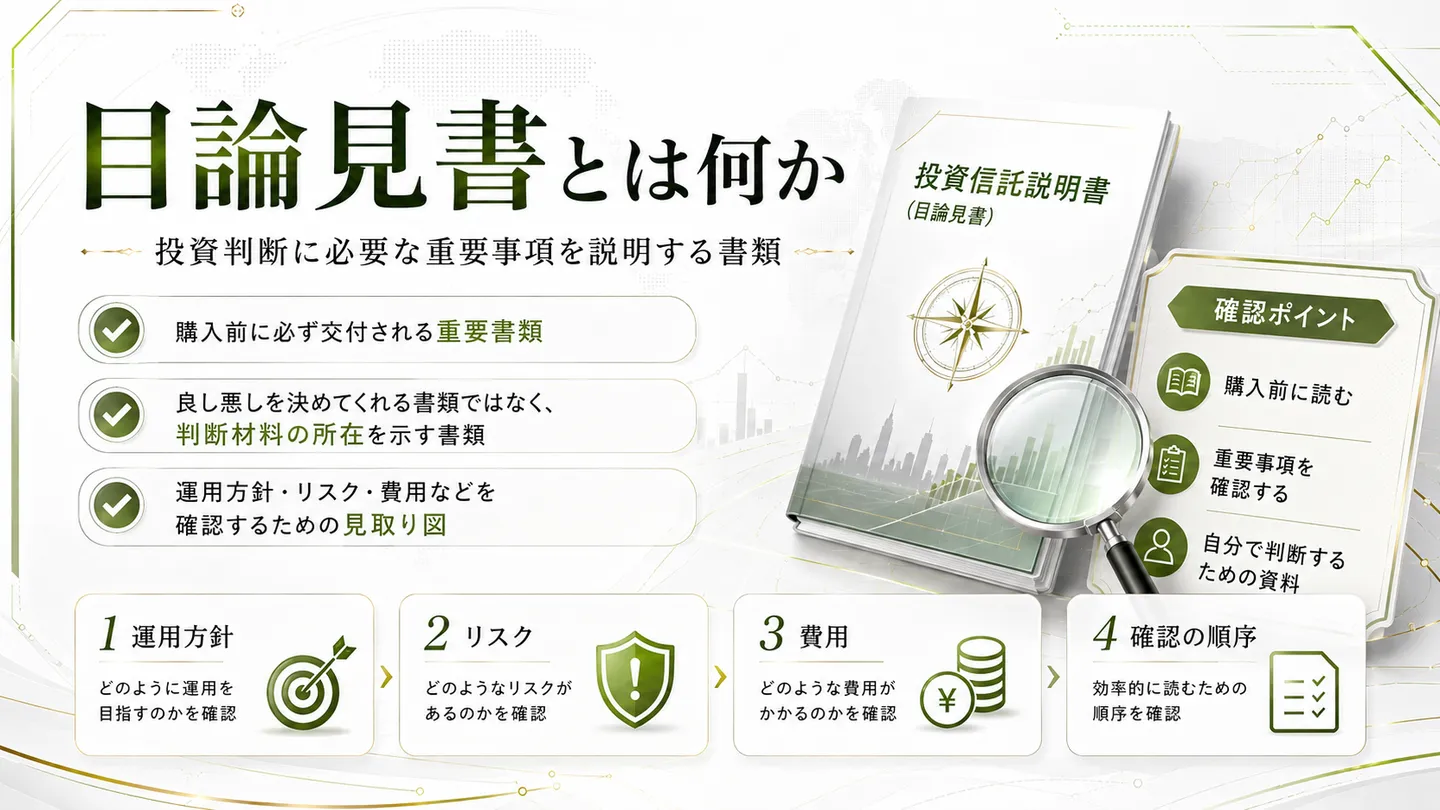
Before you buy an investment trust (投資信託), you are always handed a document called a prospectus (目論見書, read mokuromisho; its formal name is 投資信託説明書), which explains the important matters needed for an investment decision. When this prospectus is handed over, a good many people are left at a loss as to where in it each thing is set out, and in what order to read and take in what.
This article organises, neutrally and on the basis of official information, where in the prospectus the investment policy, the risks and the costs are set out, and in what order to check what. It is intended to be read not as an answer to which fund you should choose, but as an outline map for checking which part of the document to look at in order to judge for yourself.
Let me answer the question briefly at the outset. What is always handed over before purchase is the 交付目論見書 (the prospectus that must be delivered to the investor), and what you can request and receive when you want more detailed information is the 請求目論見書 (the prospectus delivered on request). The 交付目論見書 is made up of four items — ファンドの目的・特色 (the fund’s objectives and features), 投資のリスク (the risks of investing), 運用実績 (the record of past performance) and 手続・手数料等 (procedures, fees and the like) — and the items set out and the order in which they are set out are standardised. Because of that, by looking at the same section according to the aspect you want to check, you can compare several funds on the same items. The specific substance of the investment policy, the risks and the costs set out in each section differs from fund to fund, so it is a premise that these are ultimately to be checked in the prospectus of each fund and in the official information of each company.
What the prospectus is a document for
A prospectus (投資信託説明書) is a document explaining the important matters needed for an investment decision about the investment trust you are proposing to buy. 一般社団法人 資産運用業協会 (the industry association for the asset management business in Japan) explains, with regard to this document, that it is handed to the investor without fail before an investment trust is purchased.
The prospectus is, in other words, a document that brings together the information needed in order to judge — what the fund in question aims at, what risks it bears, what costs arise. It would be well to organise it in one’s mind as a document that does not tell you which funds are good, but that shows you where the material for judging for yourself is to be found.
- The prospectus is a document explaining the important matters needed for an investment decision.
- It is handed to the investor without fail before an investment trust is purchased.
- It is a document showing where the material for judgement is to be found; it is not a document that decides for you whether a fund is good or bad.
The two prospectuses (the 交付目論見書 and the 請求目論見書)
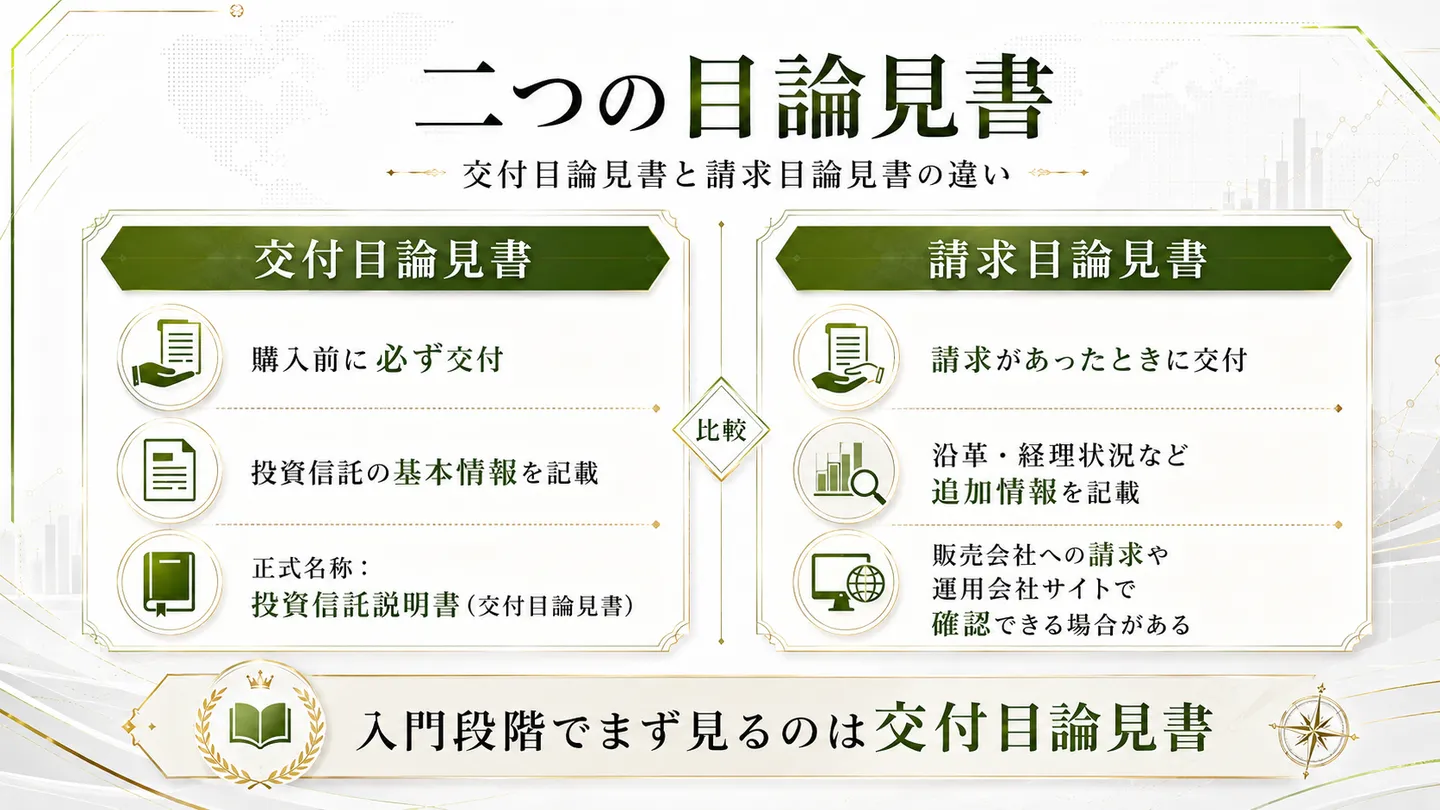
There are two kinds of prospectus: the 交付目論見書 and the 請求目論見書. They differ in the timing at which they are handed over and in the range of information set out in them.
According to 資産運用業協会, the 交付目論見書 is the prospectus that must be delivered to the investor without fail, and it sets out the basic information on the investment trust. The formal name of the document is 投資信託説明書(交付目論見書). The 請求目論見書, on the other hand, is the prospectus that must be delivered when a request is made by the investor, and it sets out additional information such as the fund’s history and its accounting position.
The difference between the two also rests on the law (the Financial Instruments and Exchange Act (金融商品取引法), Article 15 and related provisions). The 交付目論見書 is handed over without fail before purchase, and the 請求目論見書 is delivered when the investor requests it. The 請求目論見書 can be requested from the distributor, and in some cases it can also be viewed on the management company’s website.
| Kind | When it is handed over | Information set out |
|---|---|---|
| 投資信託説明書(交付目論見書) | Delivered to the investor without fail before purchase | The basic information on the investment trust (objectives and features / risks / record of past performance / procedures, fees and the like) |
| 請求目論見書 | Delivered when a request is made by the investor | Additional information such as the fund's history and its accounting position |
The one you will come to look through first at the introductory stage is the 交付目論見書, which is handed over without fail before purchase. In what follows, we check where each thing is set out in this 交付目論見書.
The four items of the 交付目論見書 (where each thing is set out)
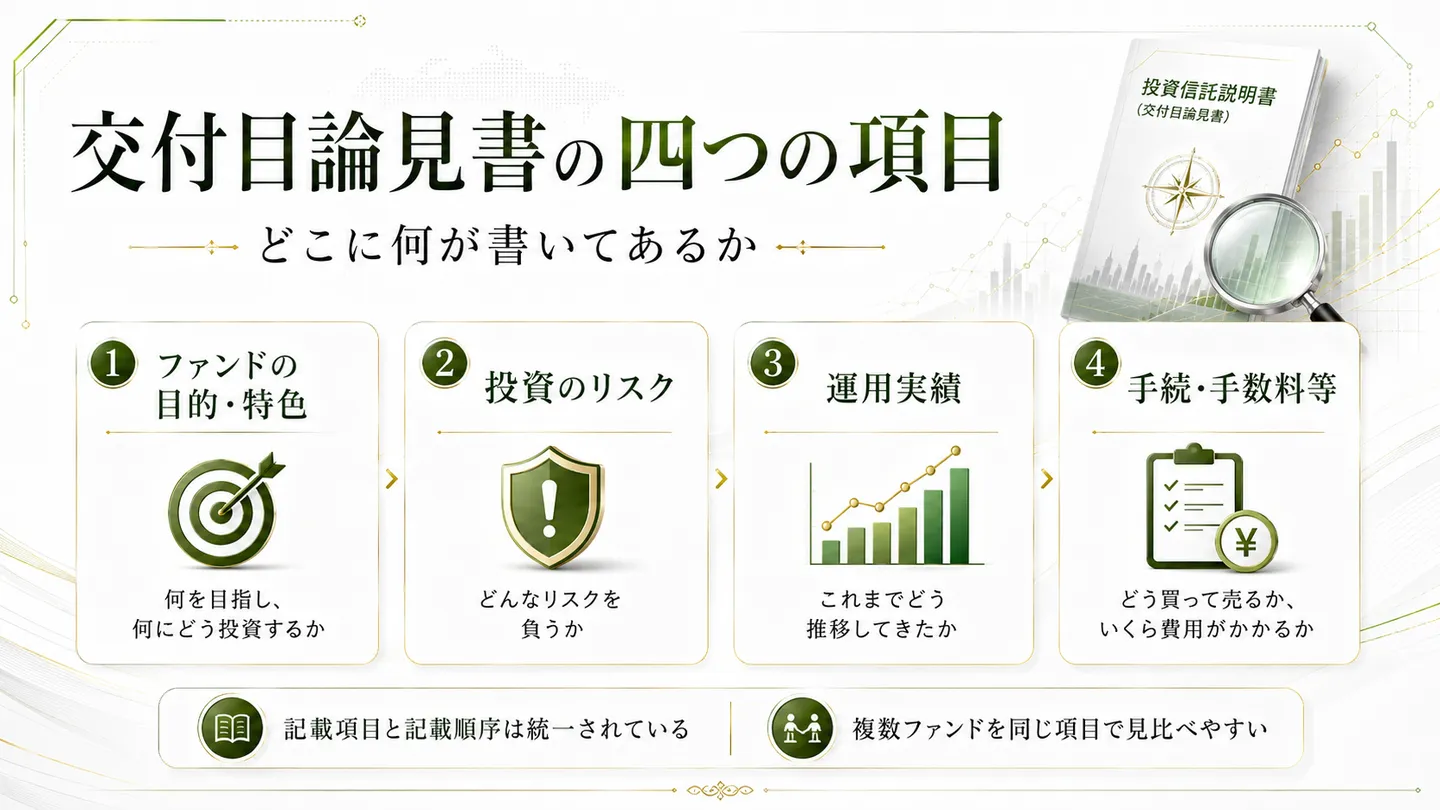
The 交付目論見書 is made up of the following four items. They are in the order in which 資産運用業協会 sets them out.
- ファンドの目的・特色 (the fund’s objectives and features)
- 投資のリスク (the risks of investing)
- 運用実績 (the record of past performance)
- 手続・手数料等 (procedures, fees and the like)
What matters here is the point that 資産運用業協会 explains that these items set out, and the order in which they are set out, are all standardised. Because the items and the order are standardised, the same kinds of information are carried in the same places in the 交付目論見書 of any fund.
Organised as a matter of where things are located in the document, what is set out in each section is as follows.
| Item (the association's formal name) | What is set out | The aspect you want to check |
|---|---|---|
| ファンドの目的・特色 | What the fund aims at, and what it invests in and how (the investment policy, the index it aims to track, the main investment objects, the policy on distributions and so on) | What kind of policy the fund is managed on |
| 投資のリスク | The substance of the risks the fund bears (these differ according to what it invests in) | What risks are borne |
| 運用実績 | The movement of the net asset value (基準価額) and of net assets (純資産) to date, the record of distributions and so on | How it has moved to date |
| 手続・手数料等 | The procedures for purchase and redemption, and the costs that arise on the fund (購入時手数料 (the fee charged at the time of purchase), the trust fee (信託報酬), 信託財産留保額 (an amount retained in the trust assets) and so on) | How to buy and sell, and what costs arise |
The substance set out in each section — the rates of the costs, the kinds of risk, the category of investment policy (index-tracking, actively managed and so on), for example — differs from fund to fund. The approach to the kinds of risk and to the categories of cost themselves is organised in “Basics to check before starting with investment trusts”, which we hope you will also see. This article puts its weight on first getting a grip on the structure of the document, that is on which section sets out what.
Points to note when reading the 運用実績 section
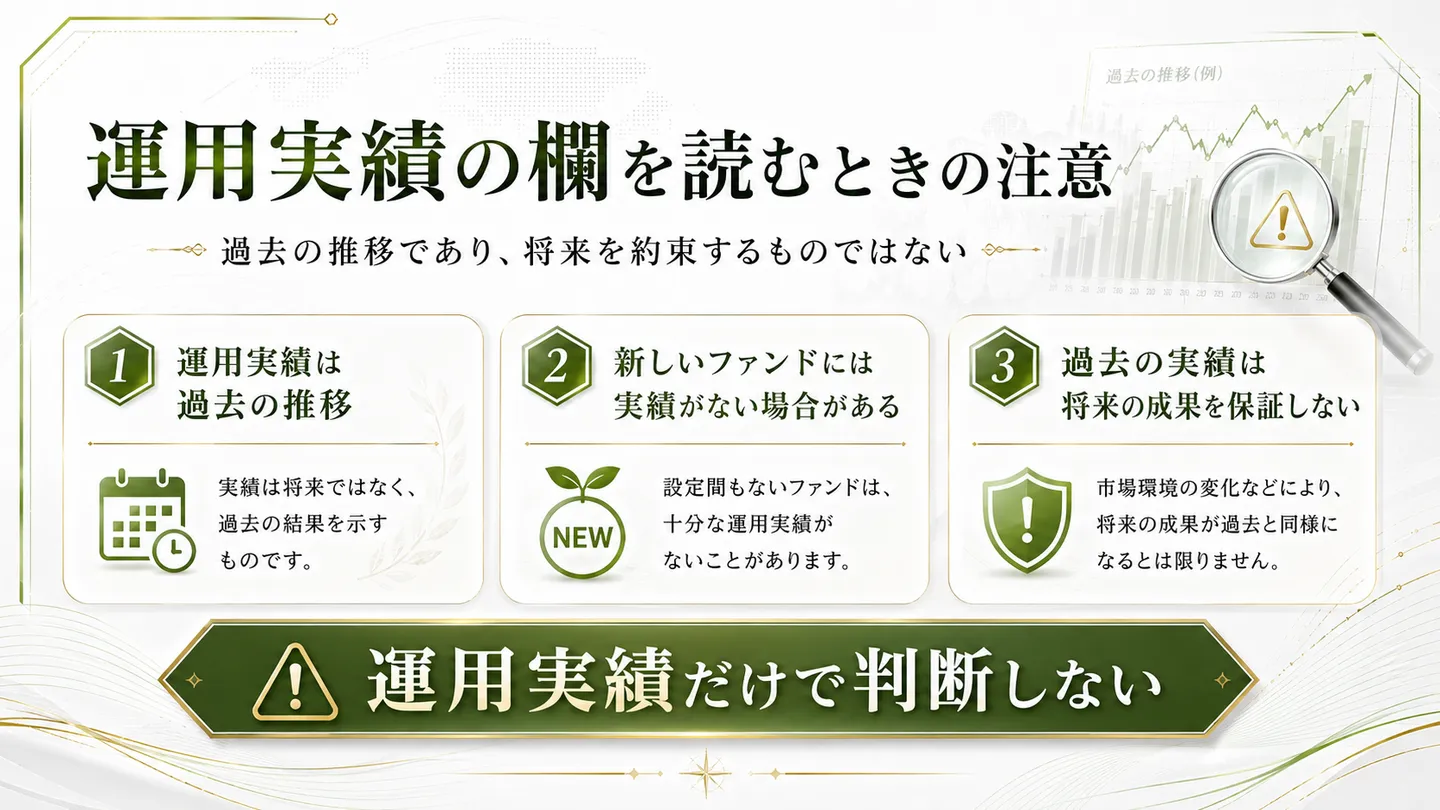
Of the four items, the 運用実績 section is one that needs care in the way it is read.
The record of past performance shows no more than the movement in the past. A fund that has only recently been set up may as yet have no record at all. And even where the record of past performance has been good, that does not promise future investment results.
- The record of past performance shows the movement in the past.
- A fund that has only recently been set up may as yet have no record.
- A past record of performance does not promise future investment results.
In what order to read it (choosing the section by the aspect you want to check)
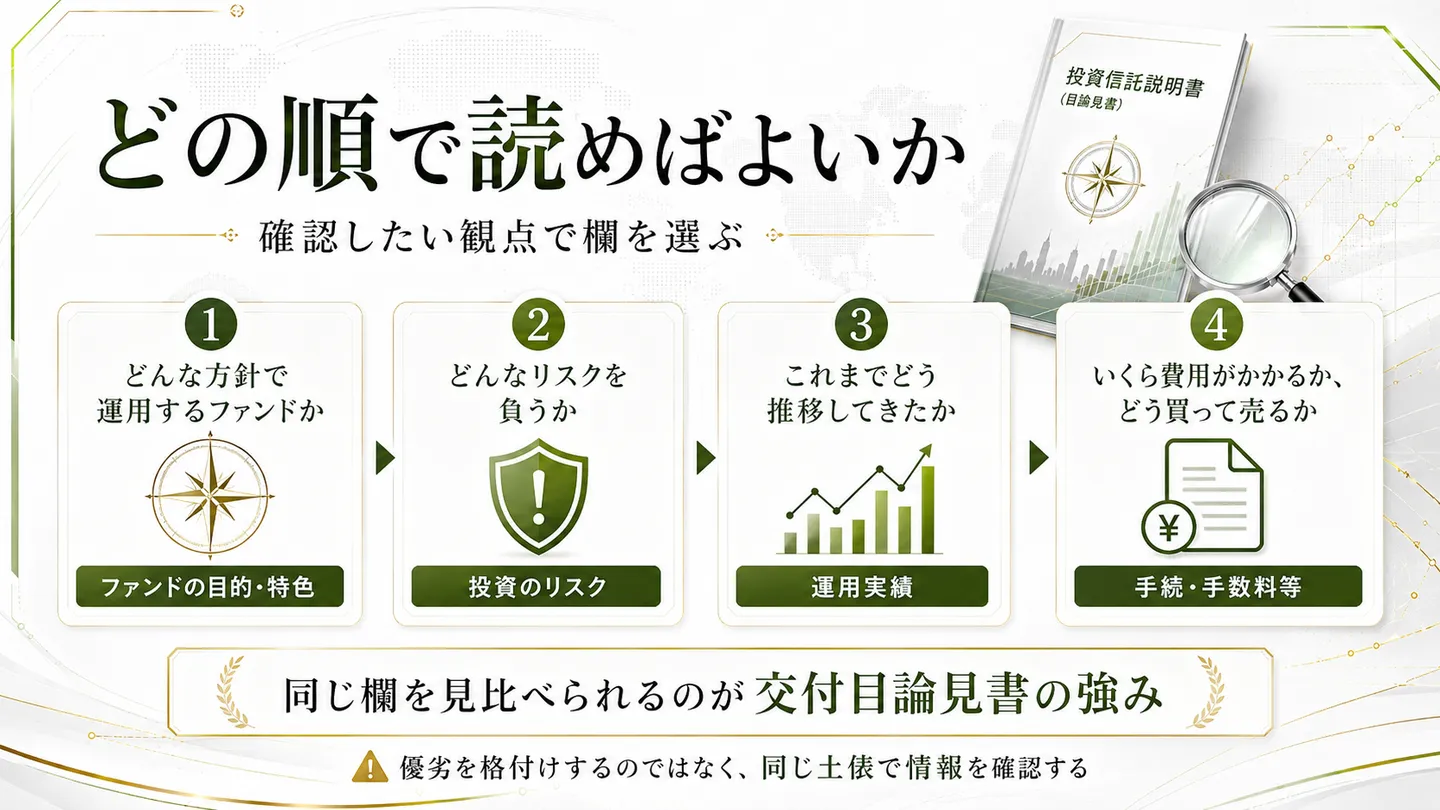
The 交付目論見書 is a document to look through before buying. Because the items set out and their order are standardised, you can decide which section to look at according to what you want to check.
- When you want to know what kind of policy the fund is managed on → ファンドの目的・特色
- When you want to know what risks are borne → 投資のリスク
- When you want to know how it has moved to date → 運用実績 (noting that this is the movement in the past and does not promise the future)
- When you want to know what costs arise and how to buy and sell → 手続・手数料等
This property of allowing the same sections to be compared is not there in order to rank which fund is superior. Because the items set out and their order are standardised, several funds can be compared on the same items and in the same places, and it would be well to organise this in one’s mind as a fact about the structure of the document. It means being able to check information on the same footing, not judging which is better or worse.
After purchase, checking with the 運用報告書
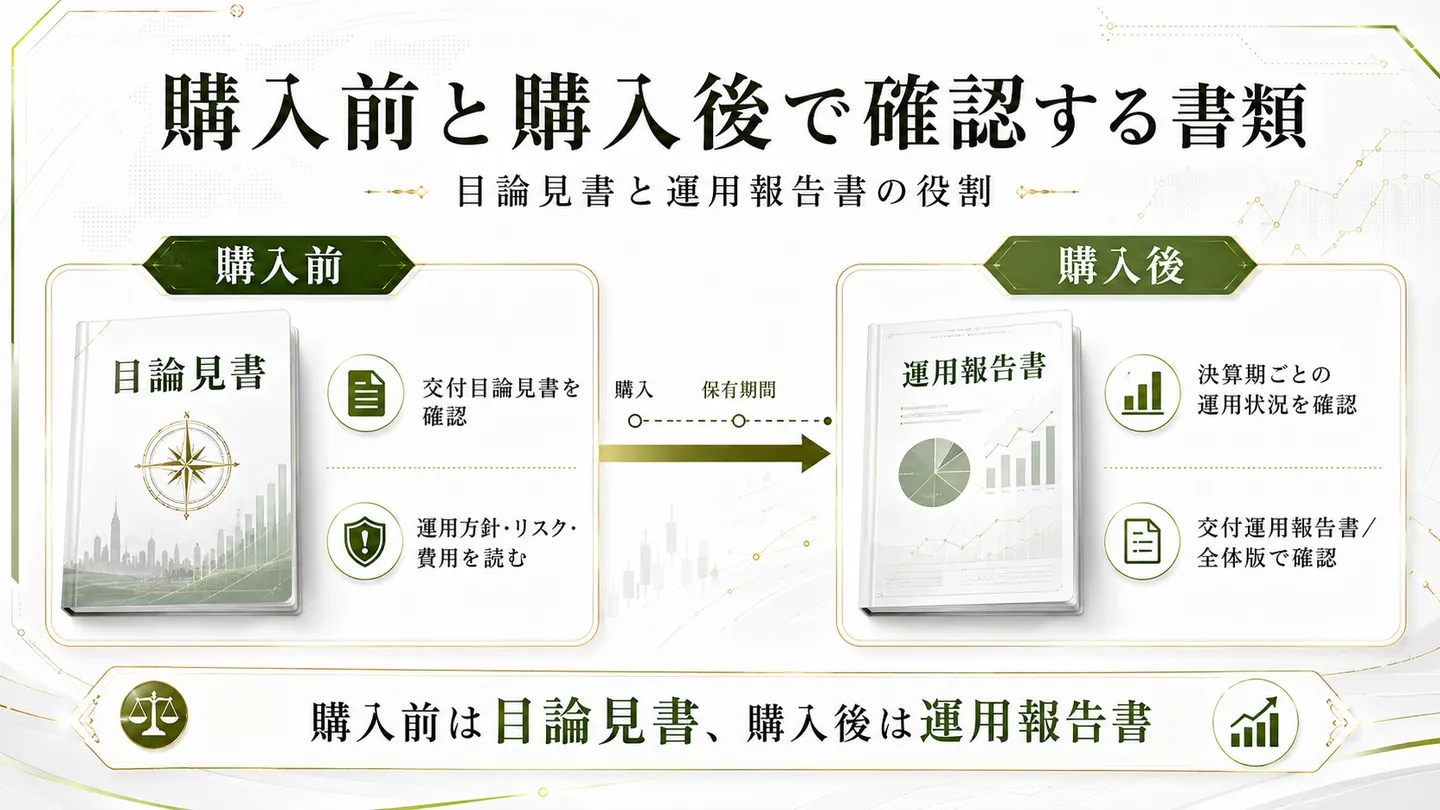
The prospectus we have looked at so far is mainly a document to be checked before purchase. The state of the fund’s management after purchase is checked, by contrast, in the 運用報告書 (the report on the fund’s management), which is prepared and sent for each accounting period.
Within the 運用報告書 there are the 交付運用報告書, which is delivered to beneficiaries (受益者) without fail, and the more detailed 運用報告書(全体版). The 運用報告書(全体版) may be provided by electronic means, for instance by being posted on the management company’s website, and it is delivered if requested.
In other words, it can be organised as the documents to check being divided up: the prospectus before purchase, the 運用報告書 after purchase. As to how the 運用報告書 is to be read in detail, please check a separate article as the need arises.
Terms organised
Among the terms covered in this article, those worth checking for a first-time reader are organised below.
- Prospectus (目論見書, formally 投資信託説明書): a document explaining the important matters needed for an investment decision about the investment trust you are proposing to buy.
- 交付目論見書: the prospectus delivered to the investor without fail before an investment trust is purchased. The basic information on the investment trust is set out in it.
- 請求目論見書: the prospectus delivered when a request is made by the investor. Additional information such as the fund’s history and its accounting position is set out in it.
- 運用報告書: the document for checking the state of the fund’s management after purchase. It is prepared and sent for each accounting period.
Frequently checked questions
Is the prospectus always handed over?
The 交付目論見書 is a document delivered to the investor without fail before an investment trust is purchased. As a document explaining the important matters needed for an investment decision, looking through it before buying is treated as the basic approach. If you want more detailed information (the fund’s history, its accounting position and the like), you can request and receive the 請求目論見書.
How do the 交付目論見書 and the 請求目論見書 differ?
The 交付目論見書 is the prospectus handed over without fail before purchase, and the basic information on the investment trust is set out in it. The 請求目論見書 is the prospectus delivered when a request is made by the investor, and additional information such as the fund’s history and its accounting position is set out in it. The 請求目論見書 can be requested from the distributor, and in some cases it can also be viewed on the management company’s website.
Where are the investment policy, the risks and the costs each set out?
In the 交付目論見書, the investment policy is set out in ファンドの目的・特色, the risks in 投資のリスク and the costs in 手続・手数料等. Because these items set out and their order are standardised, you can check the content by looking at the same section according to the aspect you want to check.
Should I just choose a fund with a good record of performance?
This article does not recommend any particular fund. What is set out in the 運用実績 section is the movement in the past, and a fund that has only recently been set up may have no record at all. A past record of performance does not promise future investment results. The record of performance is no more than one of the four items, and the basic approach is to check the information in each section as material for judging for yourself.
Where can I obtain a prospectus?
The 交付目論見書 is handed over without fail before purchase. In addition, the websites of many management companies and distributors may carry the latest prospectus. For a fund you are interested in, you can check its prospectus in the official information of each company.
How to use this article, and the final check
This article has organised the structure of the document called the prospectus, and how to read it. We have checked the difference between the 交付目論見書 and the 請求目論見書, the four items of the 交付目論見書 (ファンドの目的・特色 / 投資のリスク / 運用実績 / 手続・手数料等), what is set out in each of those sections, and an outline map of which section to look at for which aspect.
The specific substance of the investment policy, the risks and the costs set out in a prospectus differs from fund to fund. For a fund you are interested in, the basic approach is to check the latest content in its prospectus and in the official information of each company. Final investment judgements should be made by readers themselves, after checking the official information.
Articles to read next
Having checked how to read a prospectus, please also see the following articles.
- Basics to check before starting with investment trusts (for the substance of the costs, the kinds of risk, the categories of investment policy and so on)
- Basic points to check before choosing a securities company
- Checking the procedures for redeeming an investment trust and receiving the proceeds
Official information referred to
- 一般社団法人 資産運用業協会, 「目論見書」 https://www.imaj.or.jp/study/investmenttrust/process/prospectus.html
- 一般社団法人 資産運用業協会, 「運用報告書」 https://www.imaj.or.jp/study/investmenttrust/process/report.html
- 金融商品取引法 (the Financial Instruments and Exchange Act, e-Gov 法令検索) https://laws.e-gov.go.jp/law/323AC0000000025
Always check the latest trading conditions, fees and campaigns on each company’s official site. The information on this page is as at the time it was written.