
Checking the basics of US ETFs: how to view the index tracked, the expense ratio and distributions
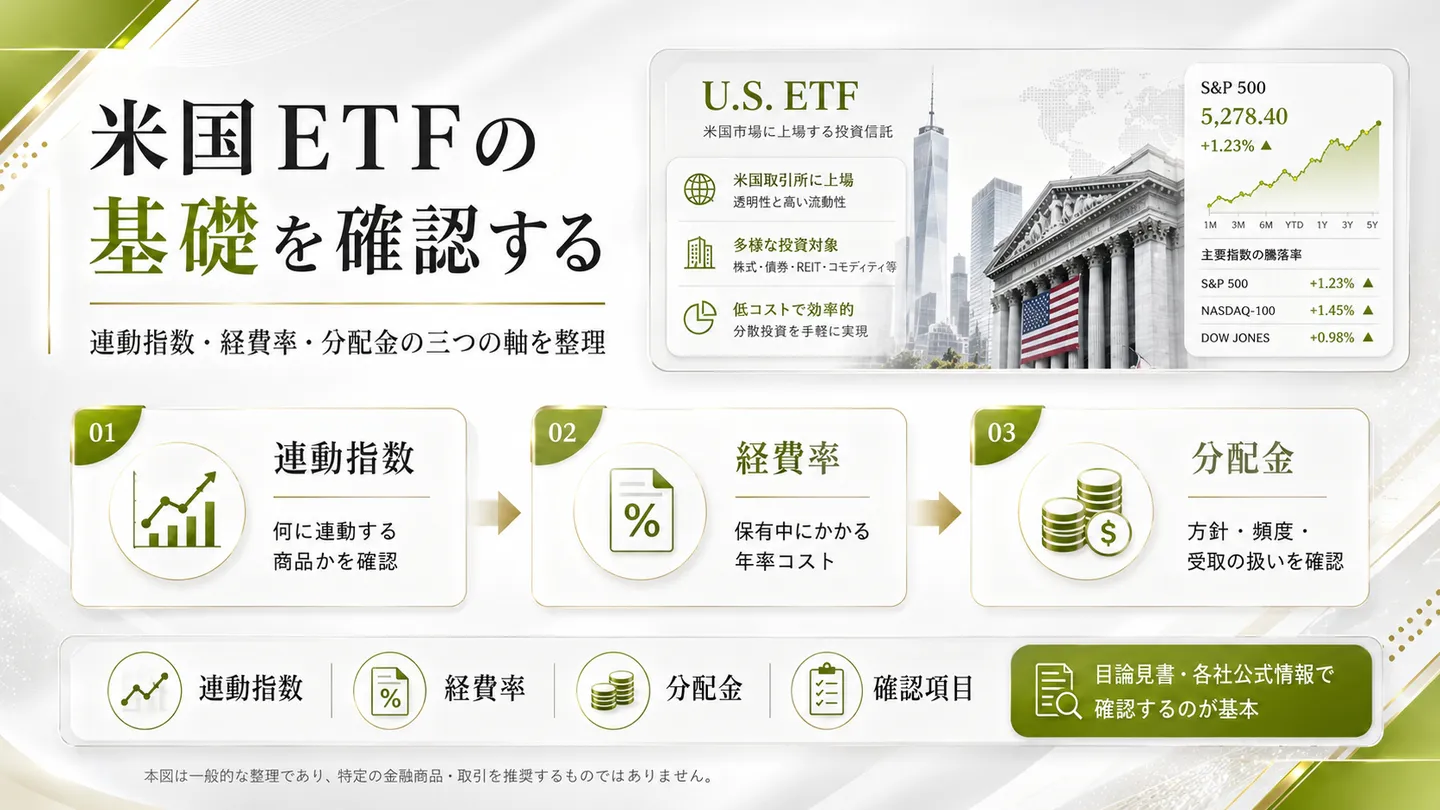
What you can check in this article
When looking at a US ETF (an exchange traded fund (上場投資信託) listed on a securities exchange (証券取引所) in the United States or a similar venue), the basic step is considered to be to check three axes in the prospectus (目論見書) and in the official information of each company: what the product aims to track (the index it tracks), how much cost is incurred while you hold it (the expense ratio), and what policy it has on distributions.
This article is not one that recommends particular securities. Its purpose is to organise neutrally the points you should confirm for yourself when you are about to come to an understanding of US ETFs. Because the mechanism of ETFs themselves, and the issues of US equity investment in general (foreign exchange, taxes and so on), are organised in separate articles, this article confines itself to the three ways of looking at things that are specific to US ETFs and that do not overlap with those.
The premises of this article (the basics of ETFs and the basics of US stocks are in separate articles)
To understand US ETFs there are two premises that form the foundation. This article does not repeat them; they are organised in the respective articles.
- The mechanism of ETFs themselves (what an ETF is, how it differs from an ordinary investment trust, the relationship between the market price and the net asset value (基準価額), and so on): see “Checking the basics of ETFs (exchange traded funds)”.
- The issues of US equity investment in general (the effect of foreign exchange, taxation in the local country, trading hours and so on): see “Basics to check before starting with US stocks (foreign equities)”.
What this article deals with is the part that corresponds to the intersection of those two, that is, the three axes to look at when holding and checking a US ETF.
The first axis: the index the fund aims to track
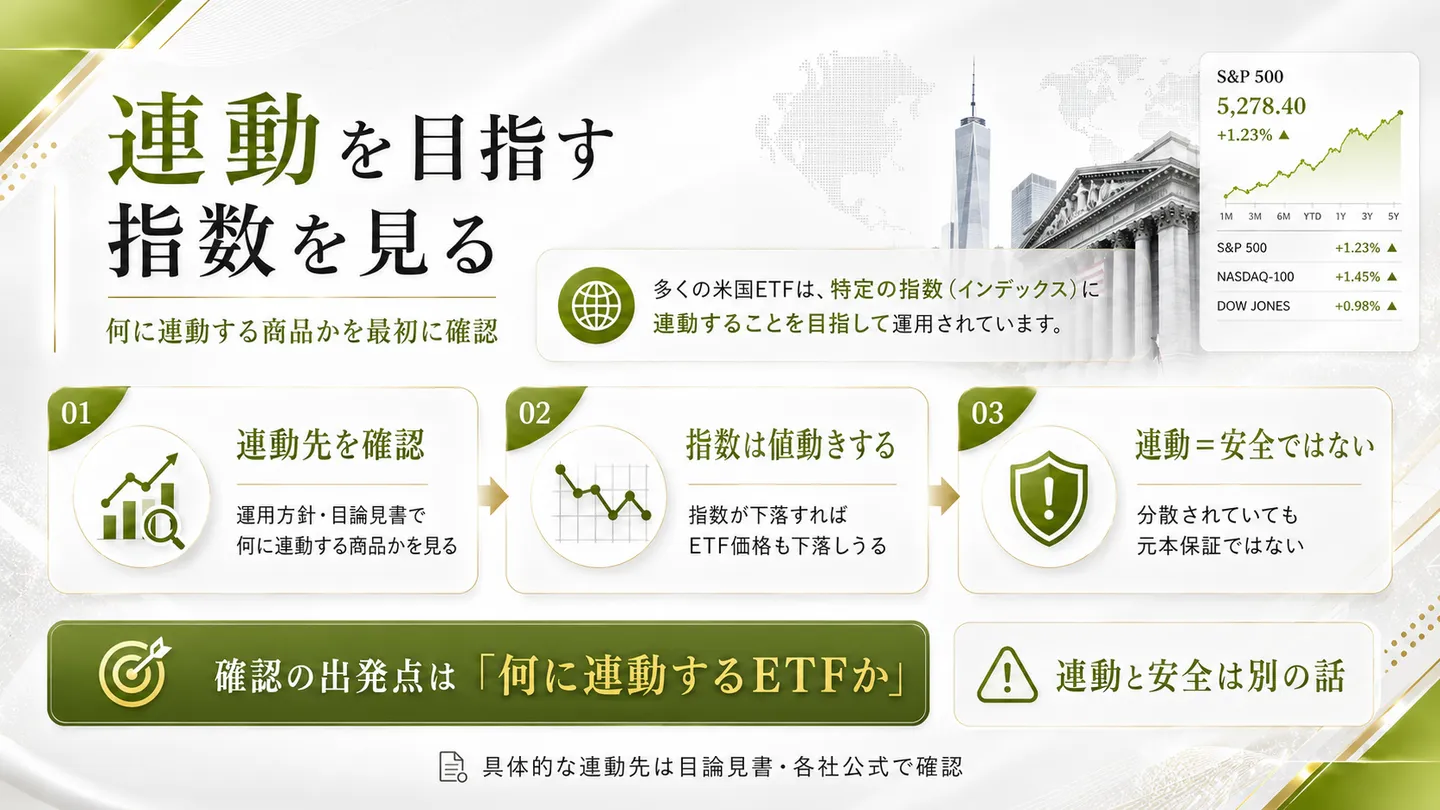
Many US ETFs are managed with the aim of tracking a particular indicator. The Investment Management Association of Japan describes an ETF as an investment trust (投資信託) that is listed on a securities exchange and aims to track an indicator typified by a share price index. The investor information of the US Securities and Exchange Commission (SEC), the securities authority of the United States, likewise sets out index funds as being managed with the aim of achieving broadly the same return as a particular index, before the deduction of fees.
What is worth checking
The starting point is to confirm, in the management policy and the prospectus, what the US ETF concerned aims to track. The indicator taken as the object of tracking differs from product to product, ranging from ones covering the United States as a whole to ones narrowed down to a particular sector or size.
It cannot be said that tracking an index makes a fund safe
What is readily misunderstood at the introductory stage is the reading that, because a fund tracks an index, it is safe. This is considered not to be appropriate.
Because the index that is the object of tracking itself moves in price, if the index falls the price of the US ETF falls as well. The SEC’s investor information cautions that, because the value of the securities a fund holds can fall, it is possible to lose some or all of the money invested. Even where investment is diversified across a number of securities, that does not mean that the principal is guaranteed.
Note that the mechanism of tracking itself (the relationship between the market price and the net asset value, discrepancies in tracking, and so on) is organised in “Checking the basics of ETFs (exchange traded funds)”.
The second axis: the expense ratio (the cost incurred while you hold the fund)
The second axis is the cost incurred continuously while you hold the fund.
The concept that corresponds to Japan’s trust fee (信託報酬)
With Japanese investment trusts, the cost incurred continuously while the fund is held is called the trust fee (信託報酬, also shown as 運用管理費用). The concept that corresponds to this is generally called the expense ratio in the United States. Because the scope of the two does not necessarily coincide completely, it is considered easier to organise matters here by understanding it as what corresponds to the annual rate of cost incurred while you hold the fund.
The SEC’s investor information defines the expense ratio as the proportion of average net assets that is used each year to meet a fund’s operating expenses, such as management fees and various other charges.
Where it can be checked
According to the SEC, this figure can be checked in the fees section of the prospectus. Such costs are also borne by investors in the form of a deduction from net assets (NAV). Where there is a US ETF you are interested in, it is worth checking its expense ratio (per year, 年率) in the fees section of the prospectus or of each company’s official information.
Note that the expense ratio incurred while you hold the fund, and the commission paid to a securities company when buying and selling, are separate things. Looking at the two separately helps you grasp the costs correctly.
A low expense ratio alone does not determine which product is superior
With the expense ratio too there is a point that is readily misunderstood. Judging whether one product is superior or inferior on the single point that its expense ratio is low is considered not to be appropriate.
The level of the expense ratio differs by product, by management company and by point in time, and there are differences even within the same grouping of US ETFs. A low cost is one aspect, but it does not by itself determine which product is superior. Because specific rates can change with the point in time, this article does not give figures; checking the prospectus and each company’s official information is the reliable course.
| Item to check | Where and what to look at |
|---|---|
| The index the fund aims to track | Check in the management policy and the prospectus what the product tracks |
| The expense ratio (the cost while holding) | Check the annual rate in the fees section of the prospectus (separate from trading commissions) |
| The policy on distributions | Check in official information the treatment of receipt and reinvestment, the frequency, and the foreign-currency issues |
The third axis: distributions (receipt and reinvestment, and the issues of foreign-currency denomination)
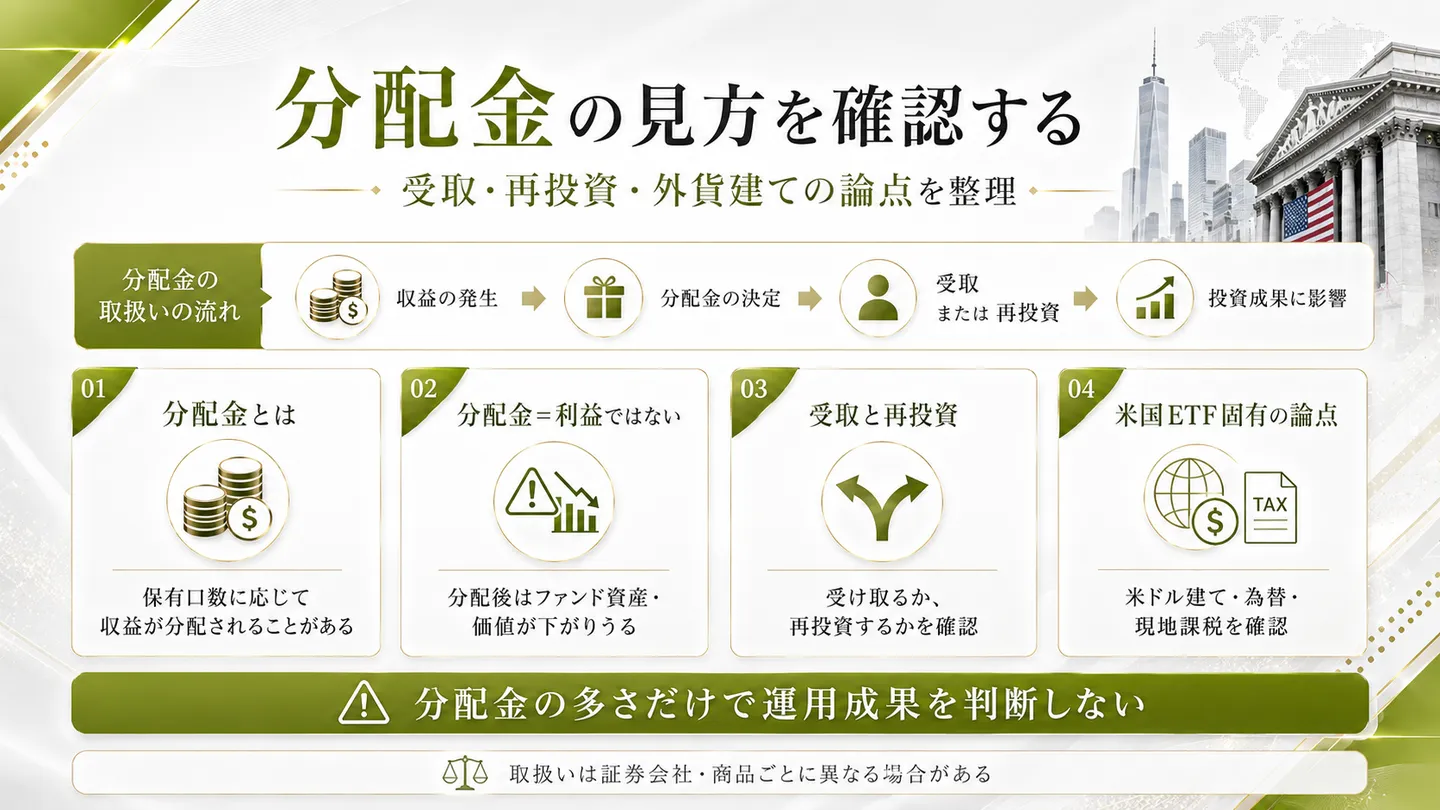
The third axis is distributions. The Investment Management Association of Japan describes a distribution as something by which the income an investment trust obtains by investing in shares and bonds and managing them is distributed to investors in proportion to the number of units (口数) held. With US ETFs too, income such as dividends and interest arising from the assets incorporated in the fund may be distributed.
A distribution being paid does not mean that a profit is being made
With distributions too there is the point most readily misunderstood at the introductory stage. The fact that a distribution is paid does not in itself mean that a profit is being made.
The Investment Management Association of Japan explains that a distribution is paid out of the trust assets of the investment trust, and that for this reason, when a distribution is paid, the total net assets and the net asset value fall. That is to say, a distribution is not something that comes down anew from outside the fund: it is paid out of the fund’s own assets, and the net asset value (the value of the net assets) falls by that amount. If the price falls, loss of principal can also occur. It is important not to judge whether the results of the management are good or bad from the size of the distribution alone.
The frequency and the policy differ from product to product
The policy on paying distributions varies from one investment trust to another. The Investment Management Association of Japan likewise explains that the frequency of payment differs by product, ranging from monthly to once a year. Because US ETFs too differ in policy from product to product, this is a matter to be checked in official information.
Receipt and reinvestment
With a distribution there is the option of receiving it and the option of investing it again in the same product or similar (reinvesting it). Here too it is important not to think of reinvestment by associating it with an outcome in which assets grow through compounding. Even if you reinvest, there remains a possibility of loss of principal.
Note that with US ETFs bought and sold in Japan, distributions may not be reinvested automatically, and it is in some cases said to be usual to reinvest manually after receiving them. However, because the treatment differs by securities company and by product, checking the actual treatment in official information is the reliable course.
The issues specific to US ETFs: foreign-currency denomination and taxation in the local country
Because distributions on a US ETF are paid in US dollars, they are affected by foreign exchange when converted into yen. In addition, as with dividends on foreign equities (外国株式), they may be subject to withholding at source (源泉徴収) in the local country (the United States); the point that, together with taxation on the Japanese side, the issue of a mechanism for adjusting double taxation (the foreign tax credit, 外国税額控除) may be added is likewise a feature specific to US ETFs.
This article does not go deeply into the details of foreign exchange and of the tax system; they are organised in “Basics to check before starting with US stocks (foreign equities)”. Because the treatment for tax purposes also varies with your own circumstances, confirmation with official information or with a professional may ultimately be necessary.
Points to check: three questions when looking at a US ETF
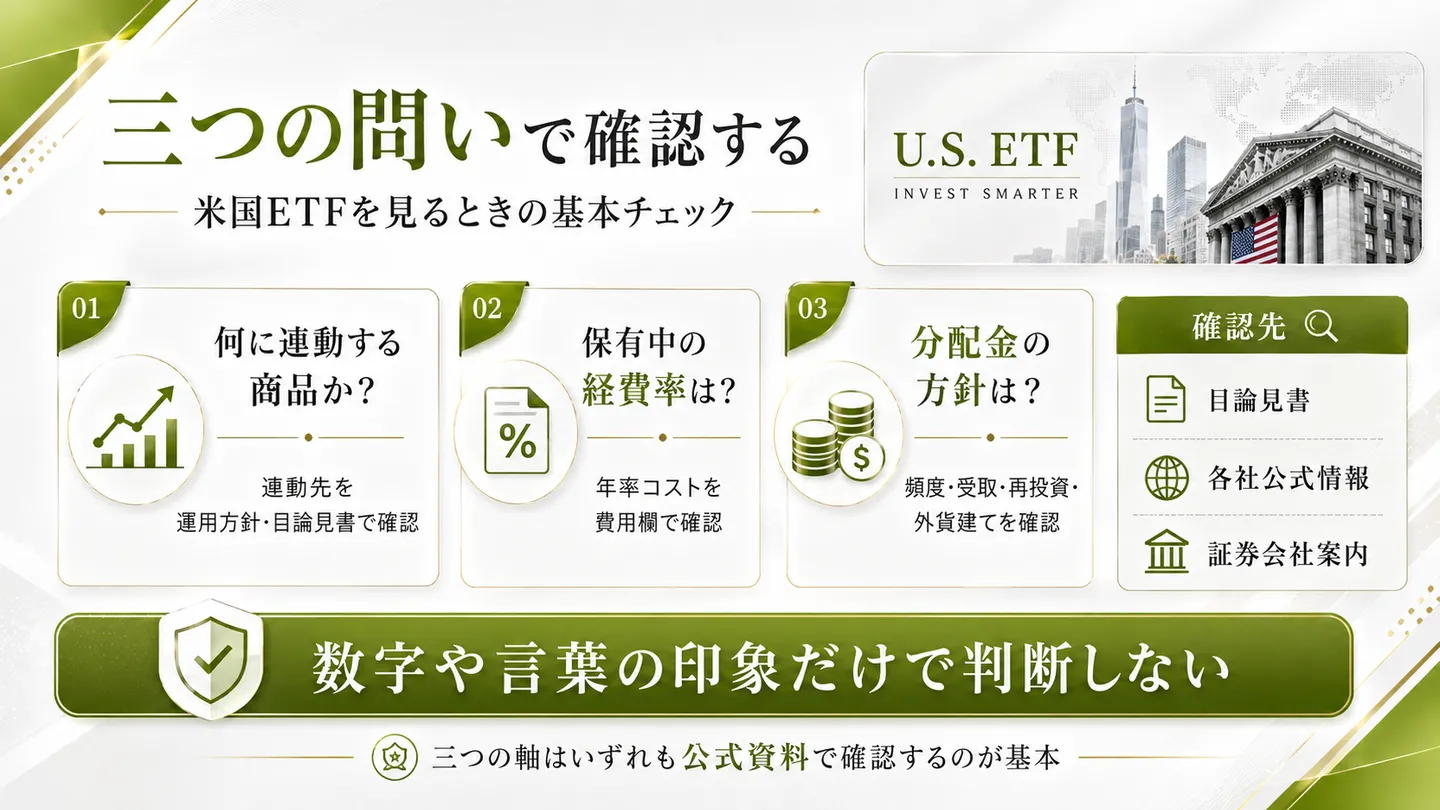
The content so far is organised below as three questions for checking.
- What does the product aim to track? — Check the index tracked in the management policy and the prospectus. Because the index itself moves in price, tracking does not equal safety.
- How much is the expense ratio while you hold it? — Check the annual rate in the fees section of the prospectus. A low expense ratio alone does not determine which product is superior.
- What is the policy on distributions? — Check the treatment of receipt and reinvestment, the frequency, and the issues of foreign-currency denomination and local taxation. A distribution does not equal a profit.
Frequently checked questions (FAQ)
Is a US ETF safe because it tracks an index?
Taking it as safe is considered not to be appropriate. Because the index that is the object of tracking itself moves in price, if the index falls the price of the US ETF falls as well. Even where investment is diversified, the principal is not guaranteed.
Is a US ETF with a lower expense ratio better?
Judging superiority or inferiority on the single point that the expense ratio is low is not appropriate. The level of the expense ratio differs by product, by management company and by point in time, and there are differences even among US ETFs. A low cost is one aspect, but it does not by itself determine which is superior. Checking specific rates in the prospectus and each company’s official information is the reliable course.
Is a US ETF with larger distributions better?
The fact that a distribution is paid does not in itself mean that a profit is being made. A distribution is paid out of the fund’s assets, and the net asset value falls by the amount paid. It is important not to judge whether the results of the management are good or bad from the size of the distributions alone.
How should I check the tax and the foreign exchange on distributions?
Distributions on a US ETF are denominated in US dollars, and the feature is that issues such as withholding at source in the local country and the adjustment of double taxation (the foreign tax credit) may be added. The details are organised in “Basics to check before starting with US stocks (foreign equities)”, and in addition, depending on your own circumstances, confirmation with official information or with a professional may be necessary.
I would like to know about specific US ETFs
This article is intended as a neutral organisation of information, and it does not recommend particular securities. The form envisaged is that you check the three axes of the index tracked, the expense ratio and distributions in each company’s official information and in the prospectus, and reach your own judgement.
Summary
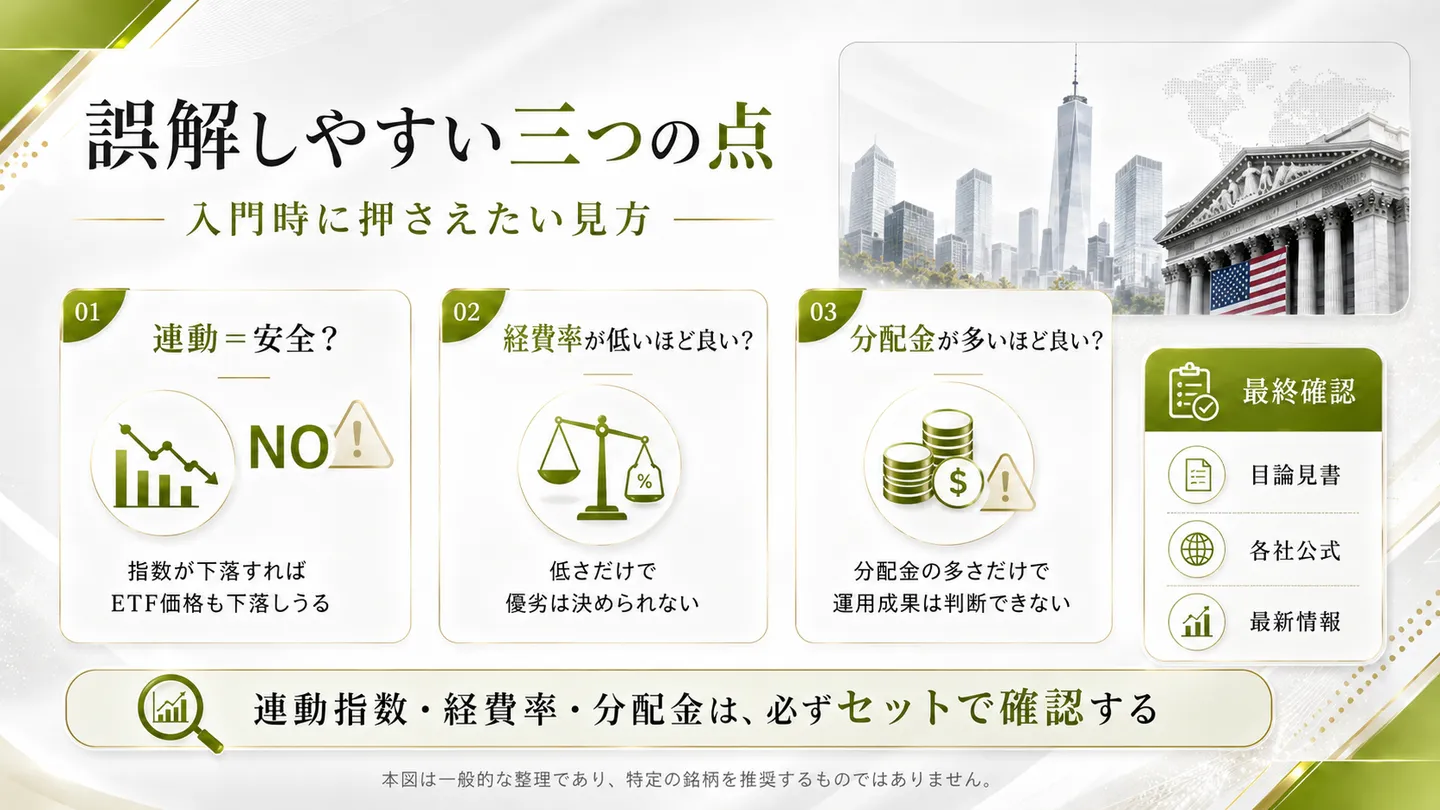
When coming to understand US ETFs, the basic step is considered to be to check three axes — what the product aims to track, the expense ratio while you hold it, and the policy on distributions — in the prospectus and in each company’s official information.
On that basis, it is worth having a grasp of the three points readily misunderstood at the introductory stage: that tracking does not equal safety; that a low expense ratio alone does not determine which product is superior; and that a distribution being paid does not mean that a profit is being made. All of them are viewpoints that help you avoid judging on the impression given by figures or words alone.
The index tracked, the expense ratio and the policy on distributions are all, as a basic matter, to be checked in official documents such as the prospectus. For the latest information and for specific figures, please check each company’s official information and the prospectus.
Official information referred to
- Investment Management Association of Japan, 「ETFの仕組み」 (how an ETF works) https://www.imaj.or.jp/study/investmenttrust/type/etf-scheme.html
- Investment Management Association of Japan, 「基準価額と分配金」 (the net asset value and distributions) https://www.imaj.or.jp/study/investmenttrust/about/navdividends.html
- US Securities and Exchange Commission (SEC / Investor.gov), “Expense Ratio” (glossary) https://www.investor.gov/introduction-investing/investing-basics/glossary/expense-ratio
- US Securities and Exchange Commission (SEC / Investor.gov), “Mutual Funds and Exchange-Traded Funds (ETFs)” https://www.investor.gov/introduction-investing/investing-basics/investment-products/mutual-funds-and-exchange-traded-2
- US Securities and Exchange Commission (SEC / Investor.gov), “Index Fund” (glossary) https://www.investor.gov/introduction-investing/investing-basics/glossary/index-fund
Related articles
- Checking the basics of ETFs (exchange traded funds)
- Basics to check before starting with US stocks (foreign equities)
- Basic points to check before choosing a securities company
Always check the latest trading conditions, fees and campaigns on each company’s official site. The information on this page is as at the time it was written.