
Checking how US stock dividends are received (record date, ex-dividend date, payment date, yen or foreign currency)
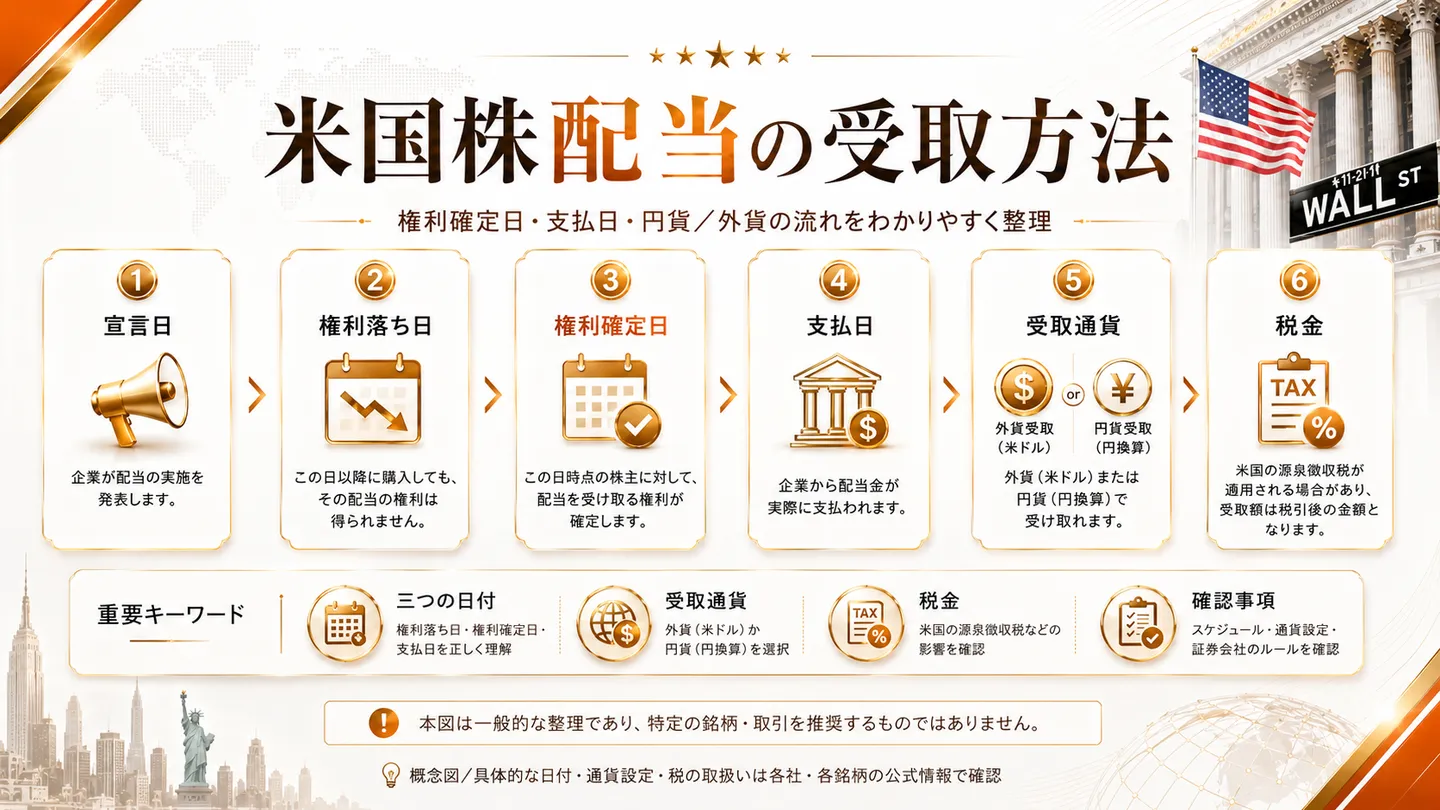
To receive a dividend on a US stock, keeping two things in mind makes the flow easier to organise: the order of the three dates (the record date, the ex-dividend date and the payment date), and the currency in which the dividend is received (yen or foreign currency). At the same time, whether a dividend is paid and how large it is are determined by the state of the company’s profits, and a dividend is not something that is promised to be received without fail. There are also cases in which a dividend is omitted or reduced.
This article narrows the focus to the practical steps and the schedule through to actually receiving a dividend on a US stock, and organises them neutrally on the basis of official information from the US Securities and Exchange Commission (SEC). It does not set out which high-dividend stocks are good; it is intended to be read as a map for checking in what order, and in which currency, a dividend is received. Because the specific dates and the settings for the currency of receipt differ depending on the company and the stock and on the securities company, they should ultimately be confirmed in the official information published by each company.
Note that the mechanics of dividends themselves (the premise that dividends may be omitted or reduced, the methods of receipt and tax rates) are organised in Checking the basics of dividends, and the overall picture of taxes on US stocks (local withholding tax and the foreign tax credit, 外国税額控除) and of settlement currencies and currency exchange fees is organised in Basics to check before starting with US stocks (foreign equities). Building on those, this article narrows the focus to the order in which a US stock dividend is received and the currency of receipt.
The three dates for receiving a US stock dividend
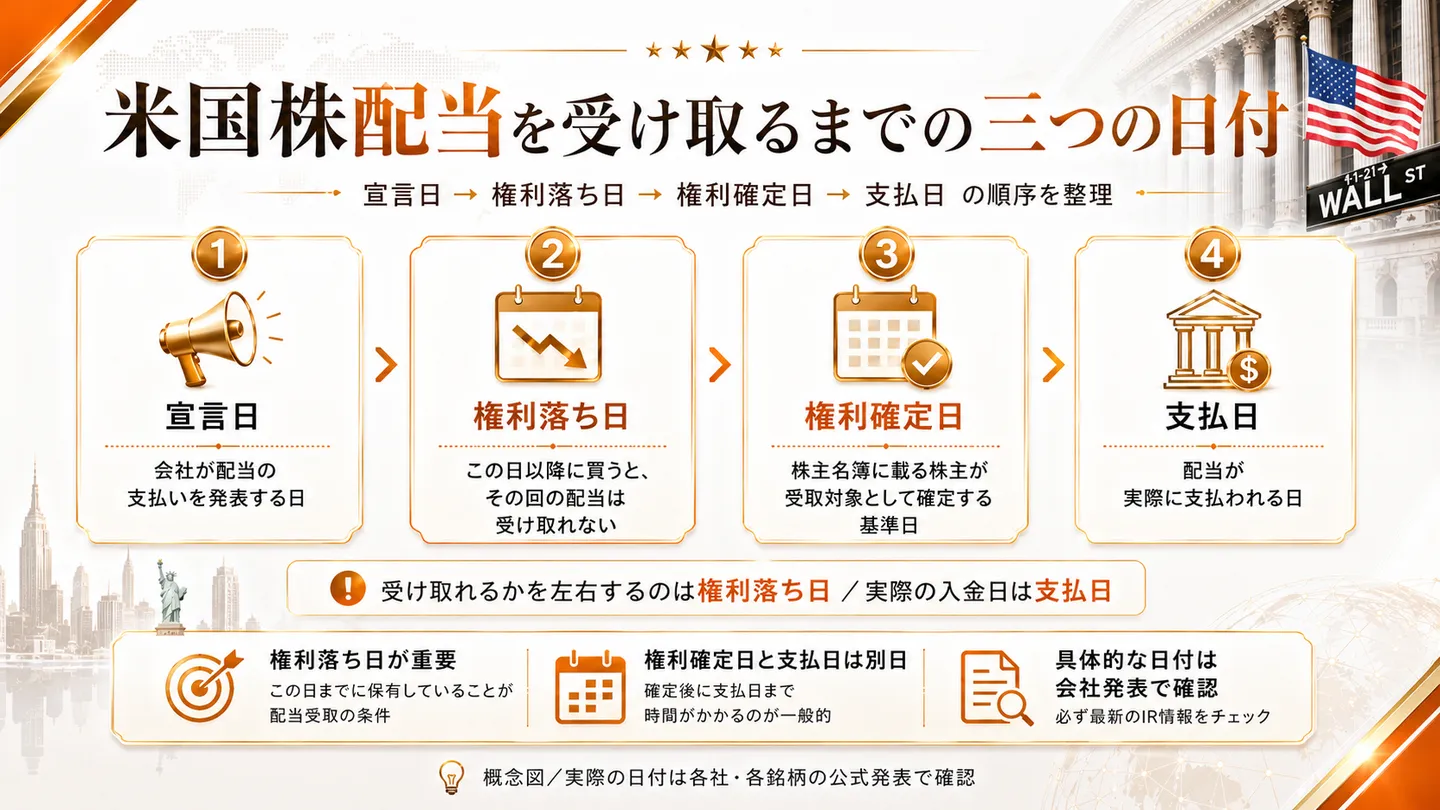
Several dates are involved in the process of receiving a dividend on a US stock. Organised on the basis of the investor-facing explanations of the US Securities and Exchange Commission (SEC) at investor.gov, the process from the announcement of a dividend through to its payment broadly proceeds in the following order.
| Date | Japanese name | Meaning |
|---|---|---|
| Declaration date | 宣言日 | The day on which the company declares (announces) the payment of a dividend. |
| Ex-dividend date | 権利落ち日 | The day from which a person who buys does not receive the dividend for that round. |
| Record date | 権利確定日 | The base date on which shareholders entered in the company's shareholder register at that point are entitled to receive the dividend. |
| Payment date | 支払日 | The day on which the dividend is actually paid to shareholders. |
Of these, what determines whether the dividend is received are the ex-dividend date and the record date, while the day on which the money actually arrives is the payment date. Below, taking into account that the ex-dividend date is set by reference to the record date, the meaning of each is checked starting with the record date (the order following the passage of time is described later).
Record date (権利確定日)
The record date (権利確定日, also referred to as 基準日, the base date) is the day on which being entered as a shareholder in the company’s shareholder register is the condition for receiving the dividend. The SEC’s explanation likewise describes the record date as the date on which an investor must be recorded as a shareholder on the company’s books in order to receive the dividend.
In paying a dividend, a company has to determine as at which point in time the shareholders to be paid are identified, and it is the record date that serves as that reference.
Ex-dividend date (権利落ち日)
The ex-dividend date (権利落ち日, also the ex-date) is the day on which entitlement to the dividend for that round is divided. In general, a person who buys the shares on or after the ex-dividend date does not receive the dividend for that round. Conversely, where the shares were bought before the ex-dividend date and are held, the dividend for that round is received.
In the SEC’s explanation, the ex-dividend date is organised as being normally set on the same day as the record date, or, where the record date is not a business day, one business day before it.
What determines by when shares have to be bought in order to receive the dividend is the ex-dividend date rather than the record date itself. Buying on or after the ex-dividend date is considered not to make one eligible for the dividend for that round. Because the specific dates differ according to each company's announcements, confirming them in the official announcements for the stocks held is the basic approach.
Payment date (支払日)
The payment date (支払日, also the payable date) is the day on which the dividend is actually paid to shareholders. The dividend is paid on this day to the shareholders registered in the shareholder register as at the record date.
The record date (the day on which the shareholders entitled to receive are determined) and the payment date (the day on which payment is actually made) are different days, and it is usual for a certain period to elapse between the entitlement being fixed and payment being made. That interval, too, differs from company to company.
The order of the dates and by when to buy
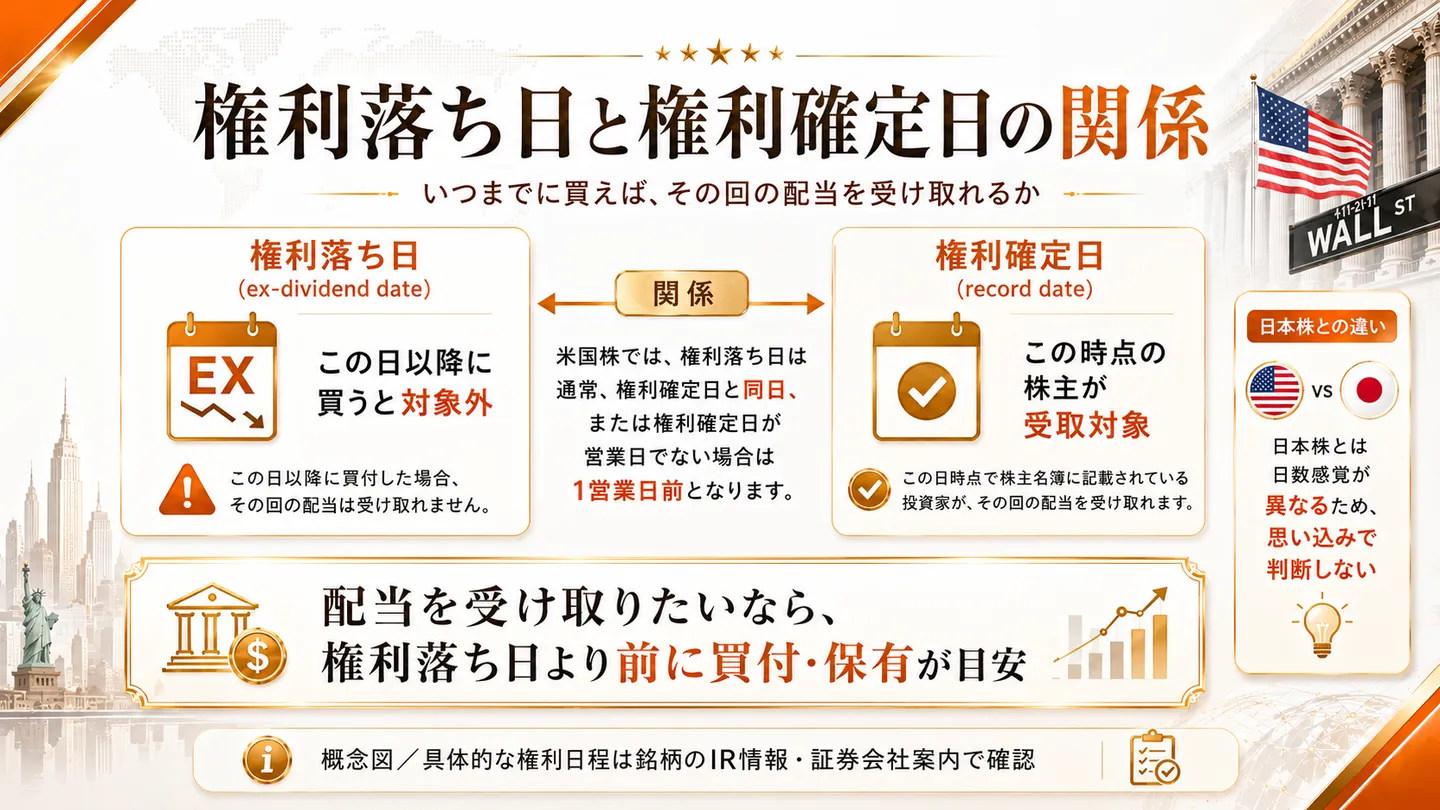
Arranging the three dates covered so far in the order of the passage of time gives the following.
- Declaration date: the company announces the payment of a dividend.
- Ex-dividend date: buying on or after this day means the dividend for that round is not received. To receive it, the shares have to have been bought and held before this day.
- Record date: the shareholders entered in the shareholder register are fixed as those entitled to receive.
- Payment date: the dividend is actually paid to the shareholders so determined.
In other words, where one wishes to receive the dividend for a given round, the general guide can be organised as having completed the purchase and holding the shares before the ex-dividend date.
Here, a brief word on the difference from Japanese stocks. With Japanese stocks, because of the number of days from the trade to settlement (T+2), the last day on which the entitlement is acquired (権利付最終日) falls several business days before the record date. US stocks, by contrast, have moved to a framework in which settlement of shares takes place on the business day following the trade (so-called T+1), and in the SEC’s explanation the ex-dividend date is organised as normally being set on the same day as the record date (or, where the record date is not a business day, one business day before it). The details of the last day with entitlement for Japanese stocks and of settlement periods are covered in Checking the basics of dividends and are therefore not repeated here.
The specific dates, and the handling for each individual stock, differ according to the company's announcements and to the treatment by the securities company used. This article organises the order of the mechanism; it does not indicate when to buy any particular stock. Whether one is in fact eligible for the dividend for a given round is basically to be confirmed in the official announcements (IR information) for the stock held and in the guidance provided by the securities company used.
Choosing the currency of receipt (yen or foreign currency)
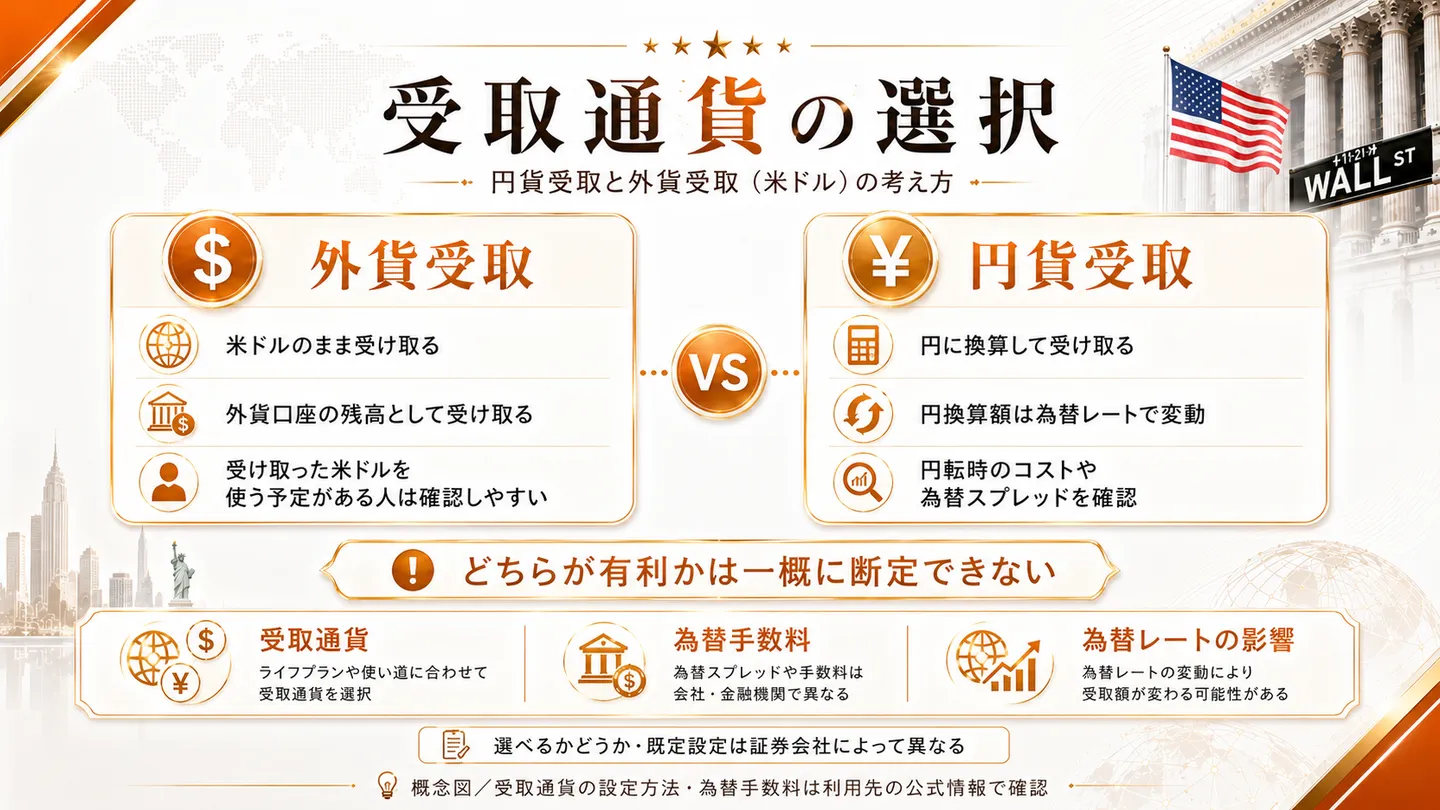
Dividends on US stocks are paid in US dollars. On that basis, there are generally two concepts as to the currency in which they are received in a Japanese securities account.
| Currency of receipt | How receipt is conceived |
|---|---|
| Foreign-currency receipt (外貨受取) | Received in US dollars as they are, in a foreign currency account (a foreign-currency-denominated balance). |
| Yen-based receipt (円貨受取) | Received in yen, after the US dollars have been converted into yen. |
Which of these can be chosen, and which is the default treatment, differ depending on the securities company used. Depending on the company, there are considered to be cases in which a choice can be made and cases in which the treatment is fixed.
Where the dividend is received after conversion into yen, a currency exchange fee for exchanging between yen and US dollars is involved, commonly reflected as an FX spread (為替スプレッド), a cost arising as the difference between the selling rate and the buying rate. In addition, the amount after conversion into yen increases or decreases according to the exchange rate at that point in time. Foreign exchange can work either favourably or unfavourably for the yen-converted amount received; it is not fixed in one direction or the other.
Which of foreign-currency receipt and yen-based receipt is more advantageous changes according to movements in the exchange rate and according to each company's currency exchange fees and treatment, so it cannot be asserted in a blanket manner. Whether there is a plan to use the US dollars received, and how one thinks about the timing of converting back into yen, are among the matters that are considered to change the view depending on one's own circumstances. The options for the currency of receipt, how it is set and the treatment of currency exchange fees are basically to be confirmed in the official information published by the securities company used.
Note that the overall picture of settlement currencies and currency exchange fees (the concepts of yen-based settlement and foreign-currency settlement, 円貨決済/外貨決済) is organised in Basics to check before starting with US stocks (foreign equities), which may also be consulted as a reference.
The flow through to receipt (in practice)
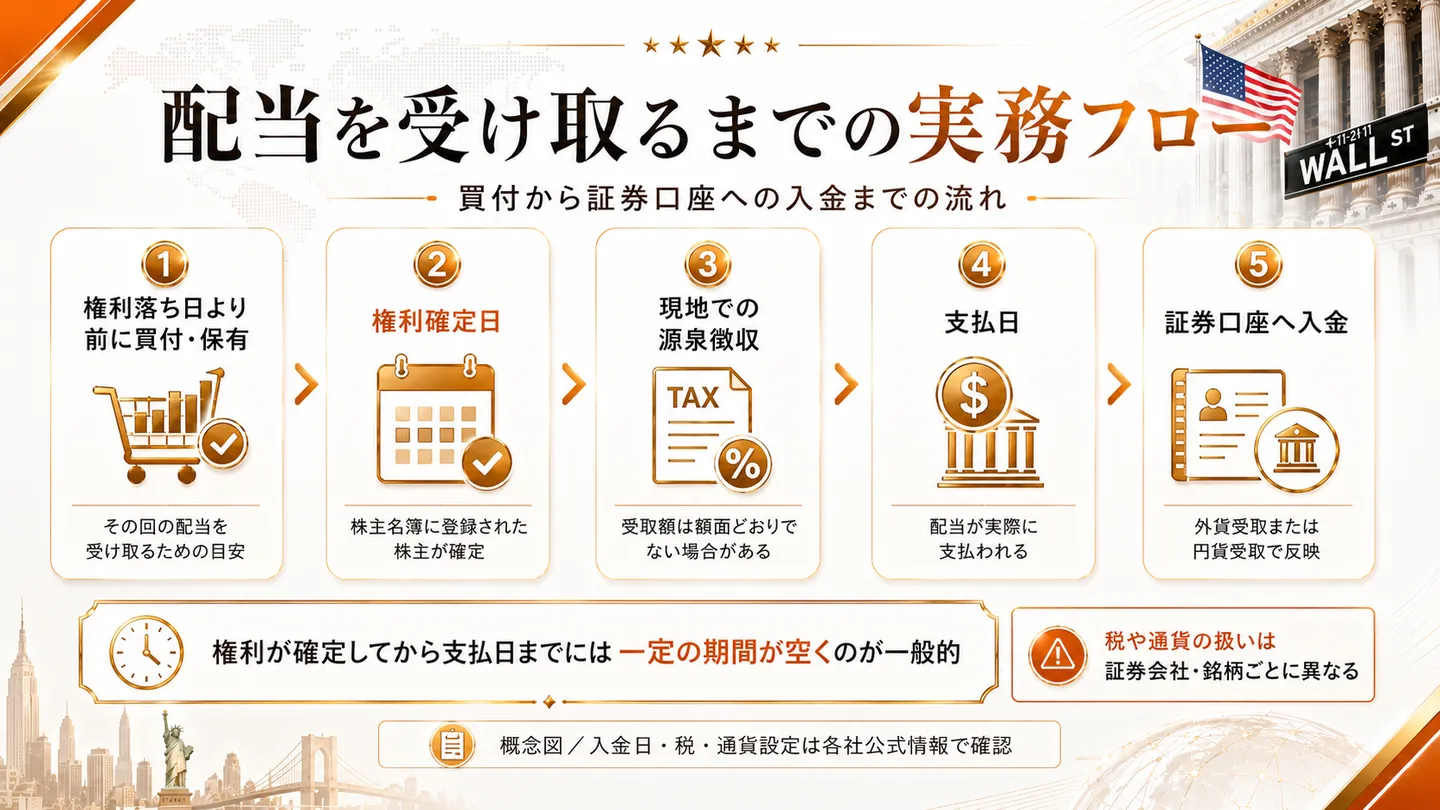
Arranging the content covered so far as the flow through to receiving a dividend, it can broadly be organised as follows.
- Buying and holding before the ex-dividend date: in order to receive the dividend for that round, it is considered necessary to have bought and to be holding the shares before the ex-dividend date.
- Registration in the shareholder register on the record date: the shareholders entered in the shareholder register as at the record date are fixed as those entitled to receive.
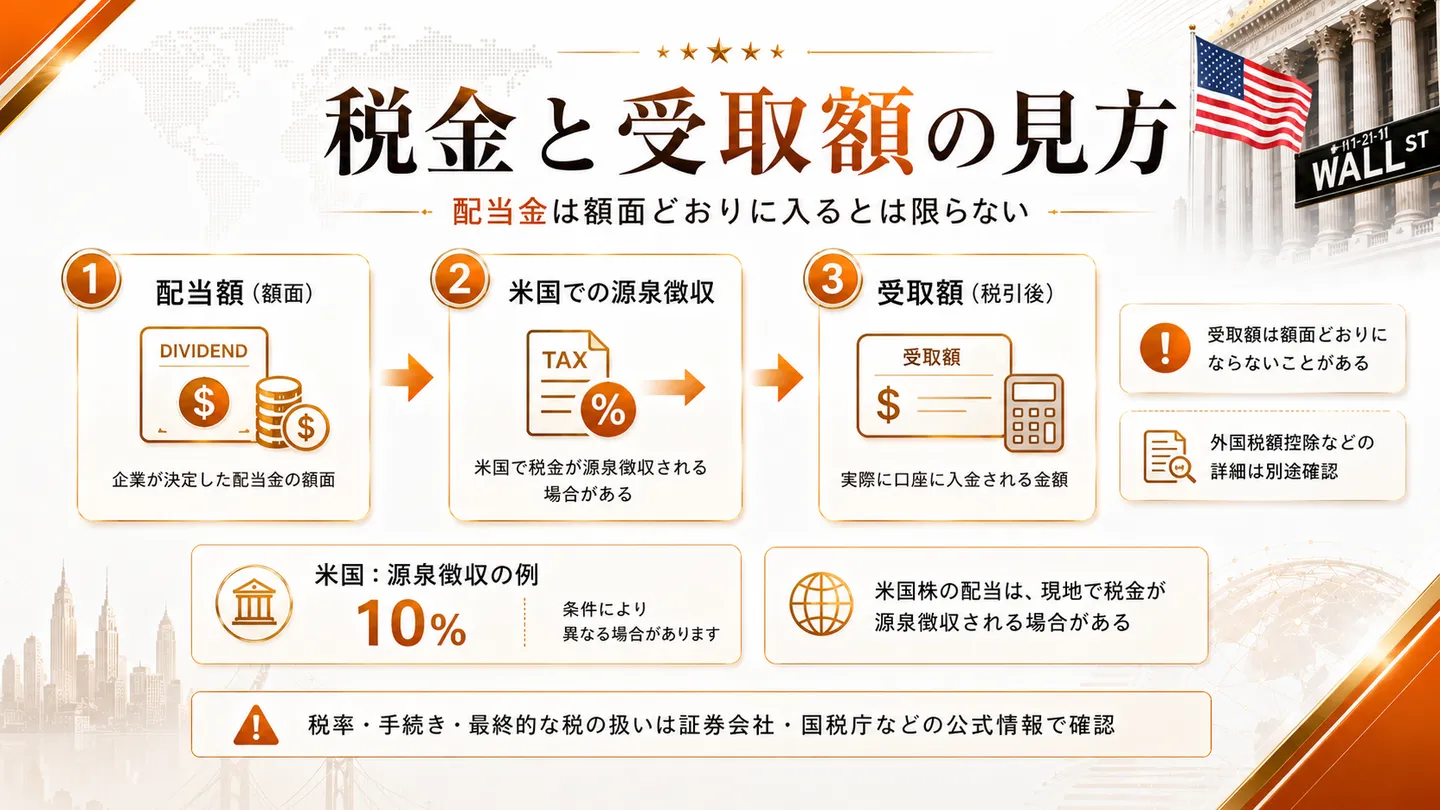
- Withholding of tax in the local country: with dividends on US stocks, tax may be withheld at source in the local country. The amount received may not be the full stated amount.
- Payment into the securities account on the payment date: on the payment date, the dividend is paid into the securities account either in foreign currency or converted into yen. The treatment of the currency of receipt differs from company to company.
Of these, tax issues such as withholding in the local country, and the foreign tax credit, which adjusts double taxation between Japan and the local country, are separate matters that come into play after receipt. The details of these are not pursued in depth in this article and are left to Basics to check before starting with US stocks (foreign equities). Only the point that the amount received may not be the full stated amount is confirmed here as a premise.
Terms organised
Among the terms covered in this article, those worth checking for first-time readers are organised below. The English names are ones that may be encountered when checking dividend information for US stocks.
- Declaration date (宣言日): the day on which the company declares (announces) the payment of a dividend.
- Record date (権利確定日, 基準日): the base date on which shareholders entered in the shareholder register at that point are entitled to receive the dividend.
- Ex-dividend date (権利落ち日, ex-date): the day from which buying means the dividend for that round is not received. To receive it, the shares have to have been bought and held before this day.
- Payment date (支払日, payable date): the day on which the dividend is actually paid to shareholders.
- Yen-based receipt / foreign-currency receipt (円貨受取/外貨受取): the classification of whether a dividend paid in US dollars is received after conversion into yen or received in US dollars as it is. The treatment differs from company to company.
- FX spread (為替スプレッド): the cost arising as the difference between the selling rate and the buying rate when exchanging between yen and a foreign currency. It is involved when the dividend is received converted into yen.
Frequently checked questions
By when do I have to buy in order to receive a US stock dividend?
To receive the dividend for a given round, it is generally considered necessary to have bought and to be holding the shares before the ex-dividend date. Where the shares are bought on or after the ex-dividend date, one is not eligible for the dividend for that round. Because the specific dates differ according to each company’s announcements, please confirm them in the official announcements (IR information) for the stock being considered and in the guidance provided by the securities company used.
What is the difference between the record date and the ex-dividend date?
The record date is the base date on which shareholders entered in the shareholder register at that point are entitled to receive the dividend. The ex-dividend date is the day on which entitlement to the dividend for that round is divided, and in the SEC’s explanation it is organised as being normally set on the same day as the record date, or, where the record date is not a business day, one business day before it. What determines by when shares have to be bought is the ex-dividend date.
Do US stock dividends come in dollars or in yen?
Dividends on US stocks are paid in US dollars. Whether they are received in a Japanese securities account in US dollars as they are (foreign-currency receipt) or converted into yen (yen-based receipt) is treated differently depending on the securities company used. Where they are converted into yen, a currency exchange fee is involved and the yen-converted amount increases or decreases according to the exchange rate. Because which is more advantageous changes according to the circumstances, please confirm the options for the currency of receipt in the official information published by the securities company used.
When is the payment date?
The payment date is the day on which the dividend is actually paid to shareholders. The record date (the day on which the shareholders entitled to receive are determined) and the payment date are different days, and it is usual for a certain period to elapse between the entitlement being fixed and payment being made. Because that interval differs from company to company, please confirm the specific payment date in the company’s official announcements.
Is tax charged on US stock dividends?
With dividends on US stocks, tax may be withheld at source in the local country, and the amount received may not be the full stated amount. The tax treatment, including the foreign tax credit, which adjusts double taxation between the local country and Japan, is organised in Basics to check before starting with US stocks (foreign equities). For specific calculations and procedures, please confirm the official information published by the National Tax Agency and the guidance provided by the securities company used.
Summary
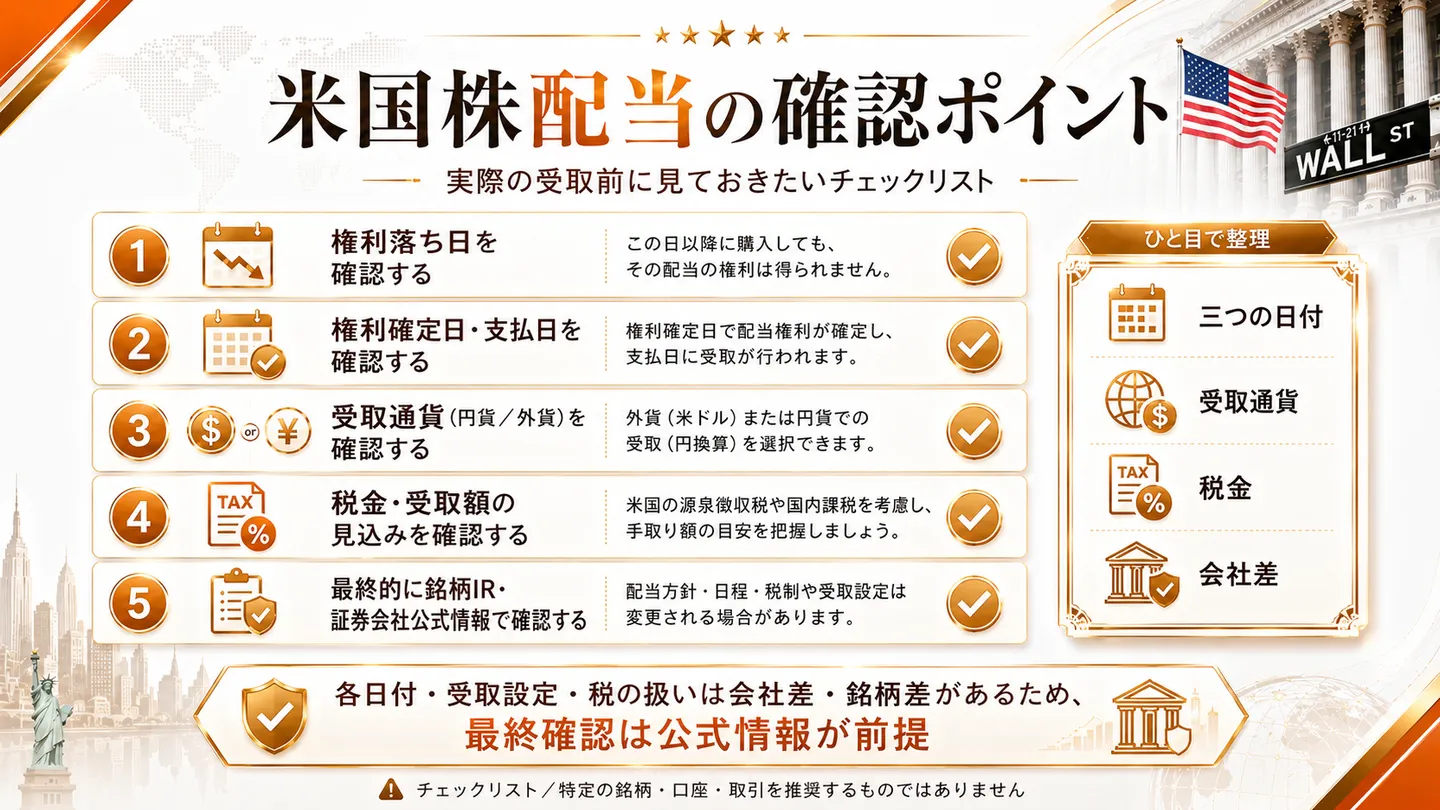
This article has organised the practical steps through to receiving a dividend on a US stock. From the announcement of a dividend through to its payment, the process proceeds in the order declaration date → ex-dividend date → record date → payment date, and the general guide for receiving the dividend for a given round is to have bought and to be holding the shares before the ex-dividend date. Receipt is in US dollars, and there is a distinction between receiving those dollars as they are and receiving them converted into yen; conversion into yen involves a currency exchange fee and movements in the exchange rate.
What is also worth checking is that a dividend is determined by the state of the company’s profits and is not something assured, as it may be omitted or reduced; that the amount received may not be the full stated amount because of the effect of local withholding tax; and that the dates and the treatment of the currency of receipt differ depending on the company and the stock and on the securities company.
What has been organised here is a map for understanding the order of receipt and the currency. The actual dates, the currency of receipt, currency exchange fees and the treatment of tax should be confirmed by readers themselves in the official announcements (IR information) for the stock held, in the guidance provided by the securities company used and in official information from the National Tax Agency and other such sources, before reaching their own decisions.
Official information consulted
- The US Securities and Exchange Commission (SEC), investor.gov, “Ex-Dividend Dates: When Are You Entitled to Stock and Cash Dividends” — the meanings of the record date, the ex-dividend date and the payment date, and the relationship between the timing of purchase and entitlement to receive
- National Tax Agency, “No.1240 居住者に係る外国税額控除” — a reference for local withholding tax and the foreign tax credit (the details of taxes are left to the article on the basics of foreign equities)
Articles to read next
As a reference when proceeding with checks on the receipt of US stock dividends, the following articles may also be consulted.
- Checking the basics of dividends (as a reference for the mechanics of dividends, the premise that they may be omitted or reduced, methods of receipt and tax rates)
- Basics to check before starting with US stocks (foreign equities) (as a reference for local withholding tax, the foreign tax credit, settlement currencies and currency exchange fees)
Always check the latest trading conditions, fees and campaigns on each company’s official site. The information on this page is as at the time it was written.