
Checking extended-hours trading in US stocks (pre-market and after-market)
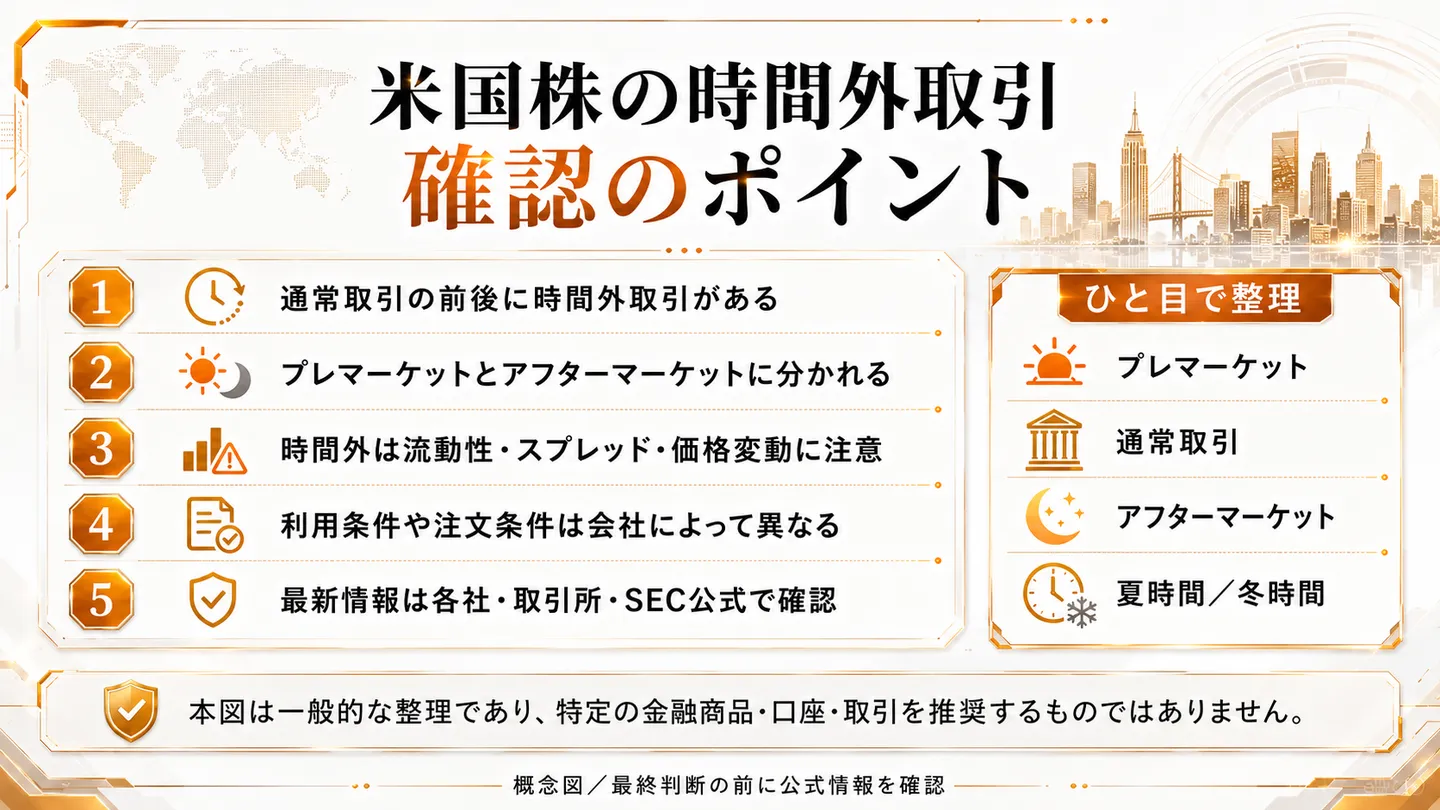
US stocks can also be traded in time bands before and after the ordinary trading hours. This is called extended-hours trading (時間外取引), and it divides into the pre-market (プレマーケット), which comes before regular trading, and the after-market (アフターマーケット, also called after-hours or the post-market), which comes after it. In this time band, however, there are several points of caution that differ from regular trading.
This article organises neutrally, on the basis of the SEC’s (the US Securities and Exchange Commission’s) official information for investors, what extended-hours trading in US stocks is, how it differs from regular trading, and what should be watched for. It does not present views such as “the extended-hours session is the place to aim at” or “extended hours let you get ahead of the market”. It is intended to be read as a map for checking and judging for yourself the mechanism of extended-hours trading and the points of caution that go with it.
Note that the basics of US stocks (foreign equities) themselves — foreign exchange, taxes, regular trading hours and so on — are organised in Basics to check before starting with US stocks (foreign equities). Building on that, this article confines its checks to the extended-hours trading that sits before and after regular trading hours.
What extended-hours trading in US stocks (the pre-market and the after-market) is
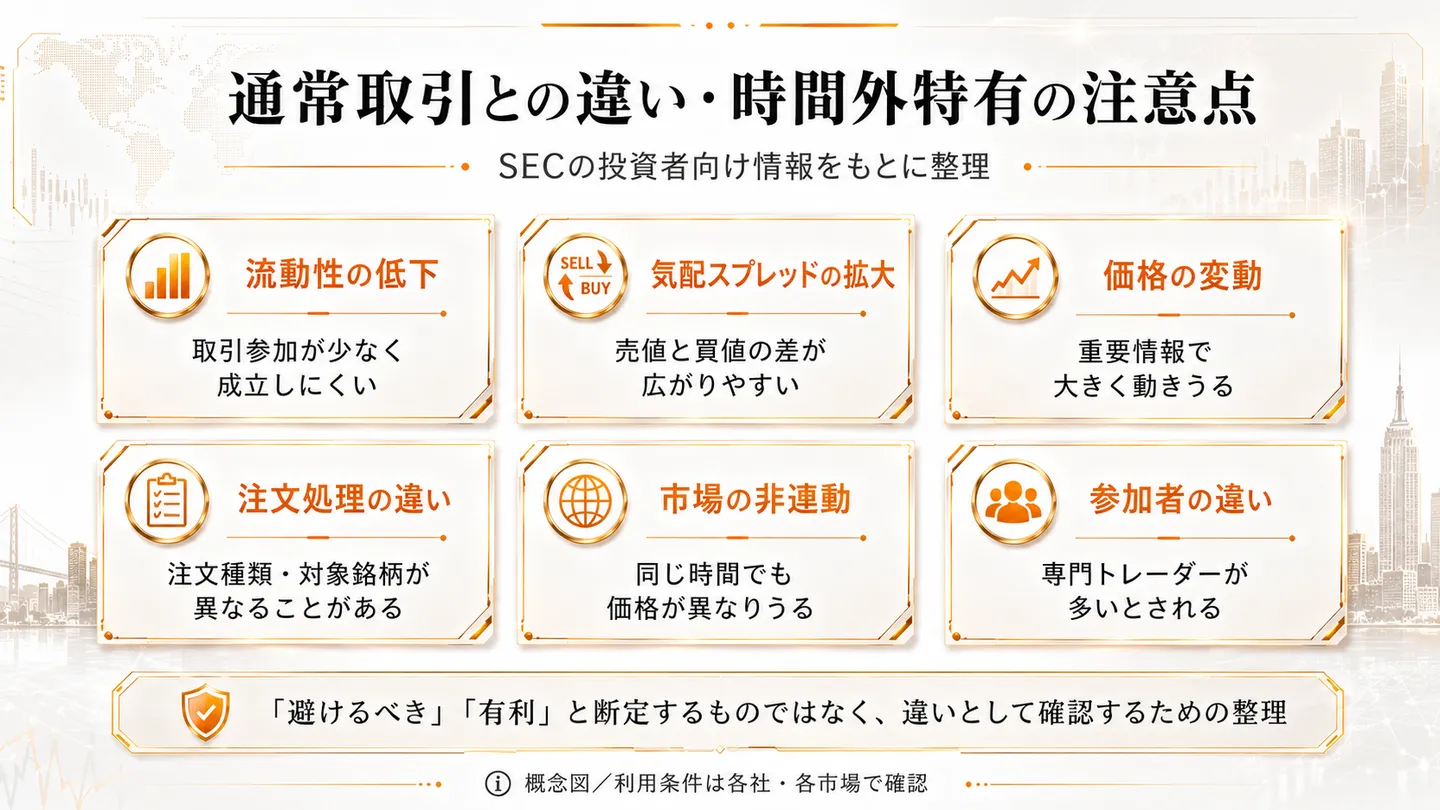
Regular trading hours for US equities are given as running roughly from 9:30 a.m. to 4:00 p.m. US Eastern Time (ET, 東部時間) (as published by the SEC). The buying and selling carried out before and after these regular trading hours is extended-hours trading.
The SEC describes extended-hours trading as trading that occurs outside of regular trading hours. Depending on the time band, it divides into the following two.
- Pre-market (プレマーケット): extended-hours trading before regular trading begins
- After-market (アフターマーケット, after-hours, also called the post-market): extended-hours trading after regular trading has ended
Extended-hours trading is not necessarily available at every securities company, or for every stock. The time bands during which orders are accepted, the types of order, and the stocks covered differ according to the securities company used.
The hours of each session (US Eastern Time, and points to note when converting into Japanese time)
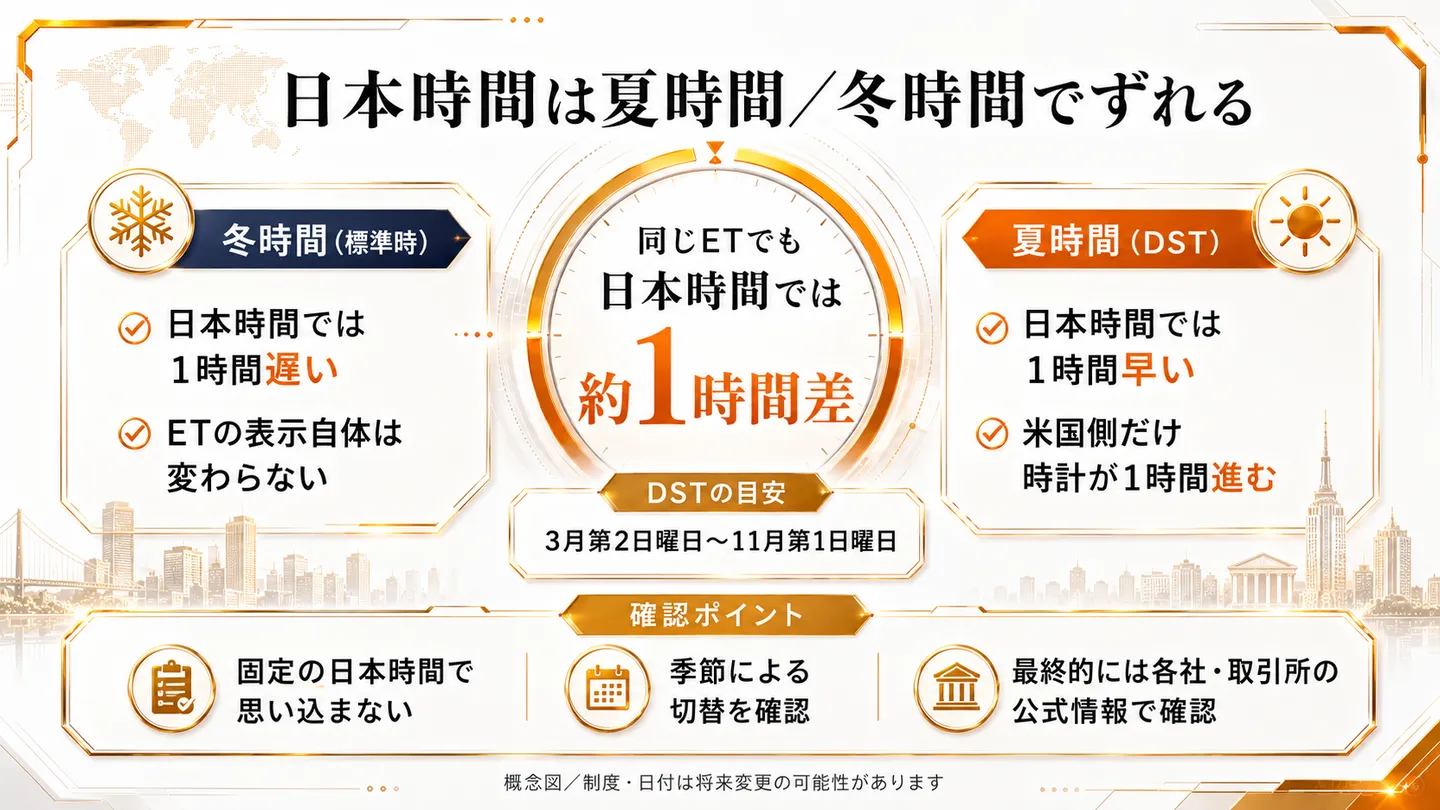
The hours of extended-hours trading are generally shown on the basis of US Eastern Time (ET). When converting them into Japanese time, attention is needed to the shift between daylight saving time (サマータイム/夏時間) and standard time, which is described below.
The hours of each session (US Eastern Time)
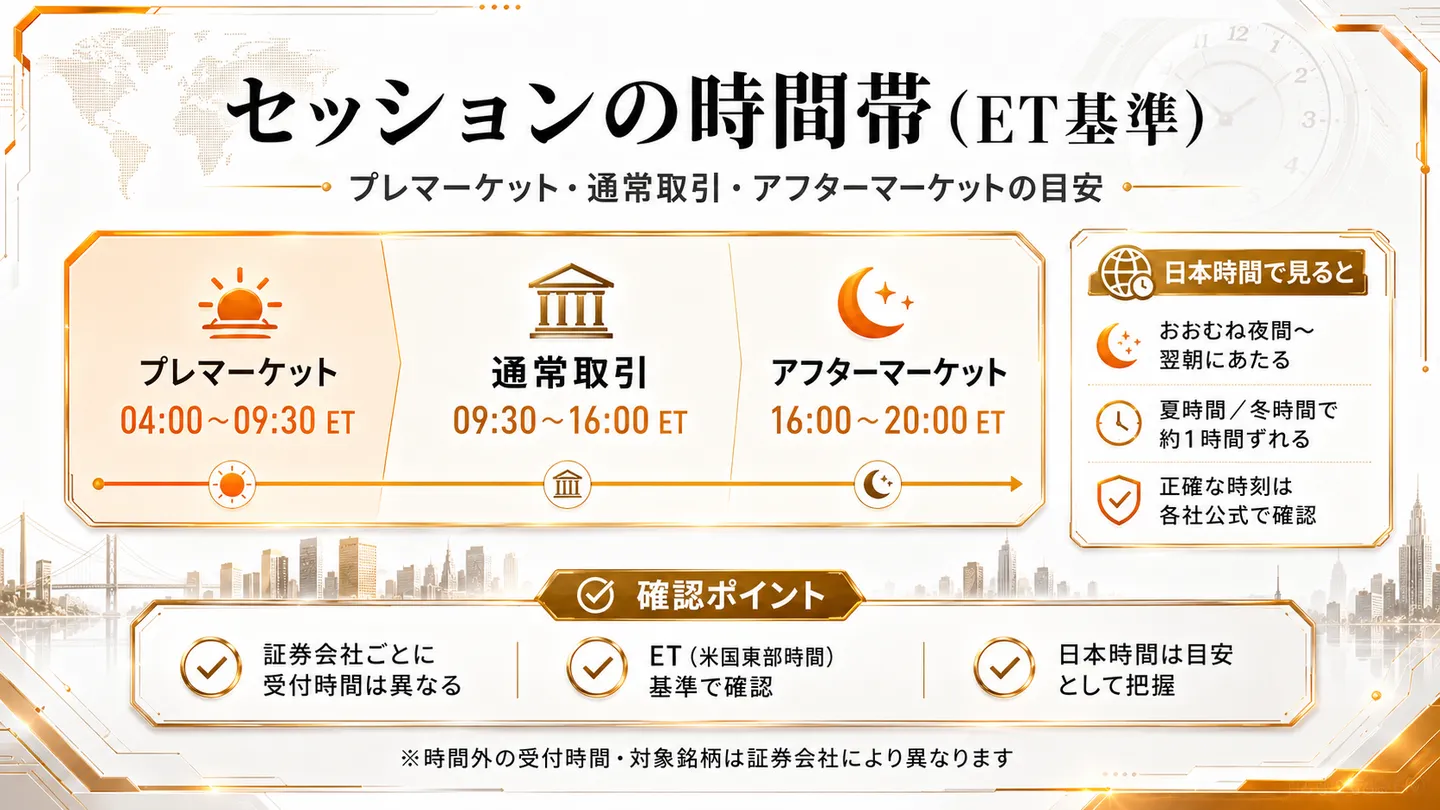
The general hours shown by the exchanges are roughly as follows. These are a guide, and the hours during which orders are accepted differ from one securities company to another.
| Session | Guide in US Eastern Time (ET) |
|---|---|
| Pre-market | Roughly 4:00 a.m. to 9:30 a.m. |
| Regular trading | Roughly 9:30 a.m. to 4:00 p.m. |
| After-market | Roughly 4:00 p.m. to 8:00 p.m. |
Of the above, regular trading (9:30 a.m. to 4:00 p.m. ET) can be confirmed in the SEC’s official information. The specific hours of the pre-market and the after-market are the general range shown by the exchanges, and the SEC itself states that the hours for pre-market and after-hours trading differ from one securities company to another. As a basic matter, the hours during which orders are actually accepted are to be confirmed in the official information of the securities company used.
Note that Japanese time shifts between daylight saving time and standard time
The United States has a system, known as daylight saving time, under which clocks are put forward by one hour for a certain period only. Because of this, even for the same band of US Eastern Time, the time when converted into Japanese time shifts by about one hour between the period during which daylight saving time is in force and the period during which it is not (standard time).
The dates of the switch change from year to year, and this article does not assert a fixed Japanese time here. If you wish to confirm, in Japanese time, “from what time to what time”, the basic approach is to confirm it — including which of daylight saving time or standard time applies — in the official information of the securities company or the exchange used.
- Whether the securities company used supports extended-hours trading (the pre-market / the after-market)
- The sessions supported, and the hours during which orders are accepted (US Eastern Time / Japanese time)
- That Japanese time shifts by one hour between daylight saving time and standard time
- The types of order accepted, and the stocks covered
Because all of these differ from company to company, the premise is that they are confirmed in each company's official information.
Differences from regular trading, and points of caution specific to extended hours
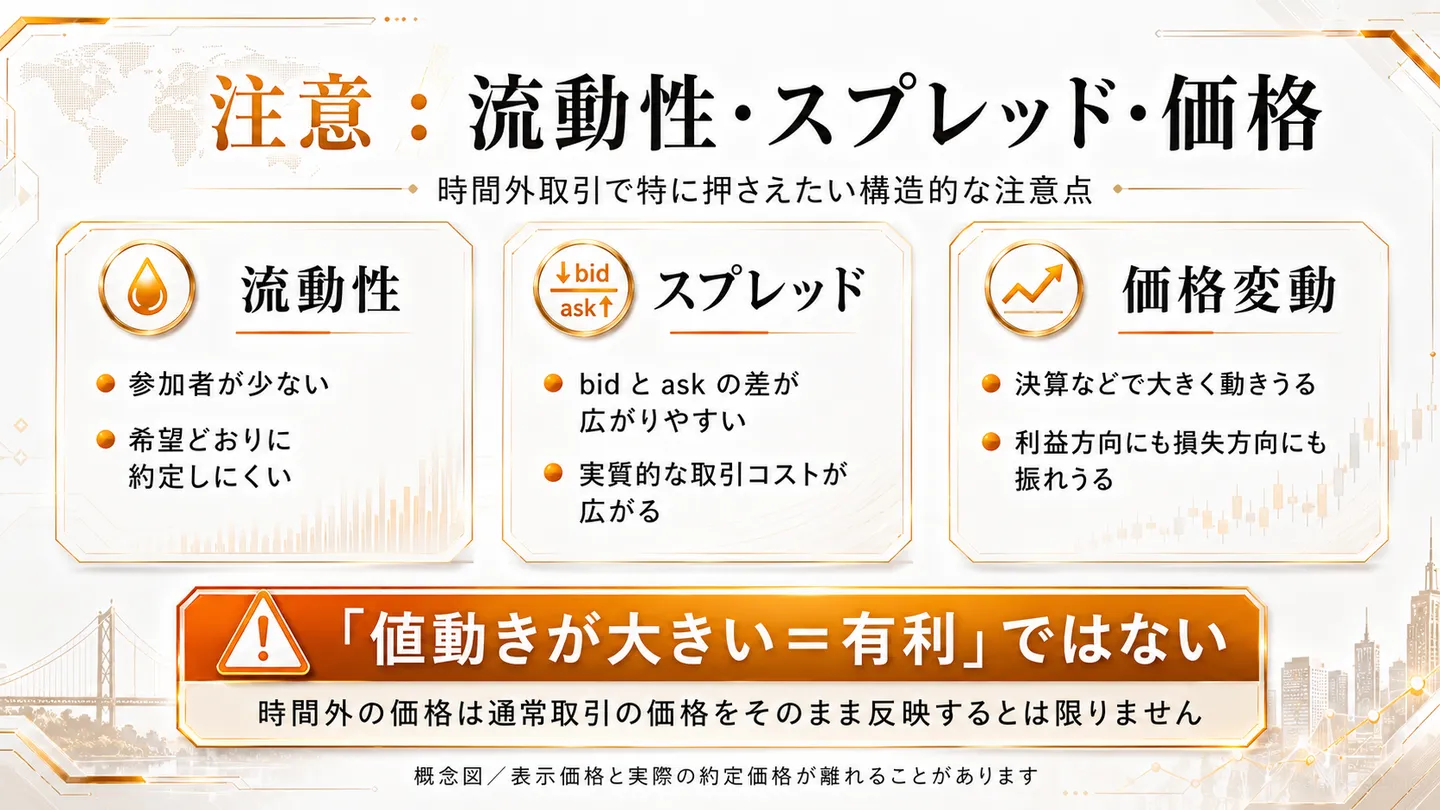
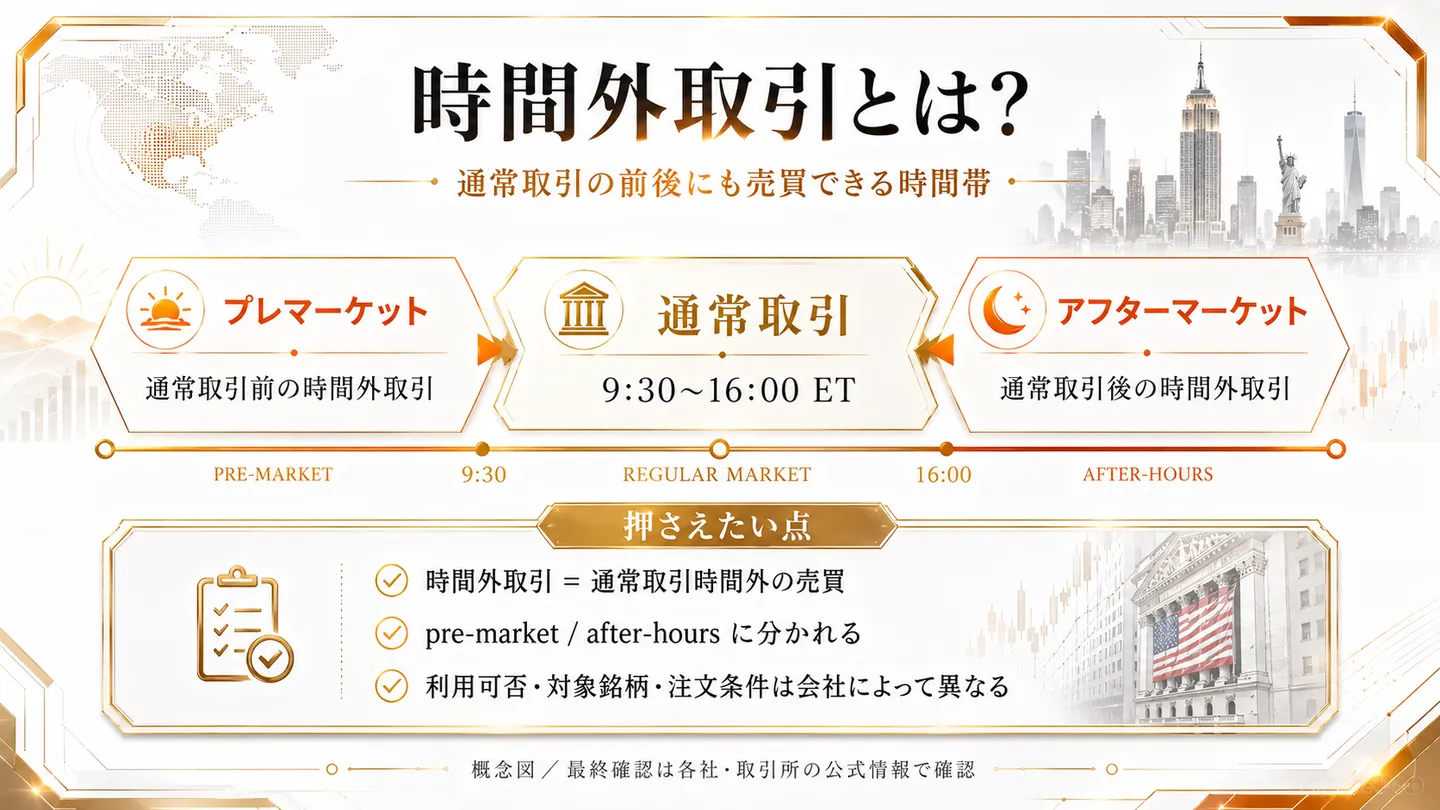
Extended-hours trading involves a number of points of caution that differ from regular trading. In its information for investors, the SEC lists points such as the following as risks of extended-hours trading. These are not asserted either as grounds for avoiding it or as grounds for treating it as an opportunity; they are facts worth confirming as differences from regular trading.
| Point of caution | The difference from regular trading | The viewpoint worth checking |
|---|---|---|
| Lower liquidity | Few people take part in trading, so buying and selling is less likely to be struck. For some stocks, trades may not be struck at all. | That an order may not be executed as hoped |
| Widening of the quote spread | The difference between the selling price (売値, bid) and the buying price (買値, ask) tends to widen, making it harder to have an order executed at the price hoped for or at a favourable price. | The effective widening of trading costs |
| Movements in price | Important information such as earnings may be released outside regular hours, and the price can move substantially. The price outside regular hours does not necessarily reflect the price in regular trading as it stands. | That the price may swing either up or down |
| Differences in the handling of orders | Some of the rules of regular trading do not apply outside regular hours. The types of order accepted, and the stocks that can be traded, may differ. | Not to think on the same premises as in regular trading |
| Markets not being linked | Prices may differ at the same moment across several trading systems. | That the price displayed is not necessarily the best price across the market as a whole |
| Differences in the participants | The SEC explains that many of the participants in extended-hours trading are professional traders. Trading may be against participants who hold more information. | That the mix of participants differs from regular trading |
What is particularly worth confirming here is movements in price. When important information such as earnings comes out outside regular hours, the price can move substantially. At such times the price may swing in a good direction or in a bad one, and it is not settled in advance that it will be one or the other. Rather than “large price movements = favourable”, it is necessary to think on the premise of both sides, including that the price may swing substantially in the direction of a loss.
Extended-hours trading is a time band in which there is less participation in trading than in regular trading, and in which the difference between the selling price and the buying price (the quote spread) tends to widen. An order may not be executed at the price hoped for, and the price displayed may diverge from the actual execution price (約定価格). The price outside regular hours also does not necessarily reflect the price in regular trading as it stands. These are structural points of caution in extended-hours trading, and they do not mean that a profit in any particular direction can be expected.
Viewpoints for checking extended-hours trading
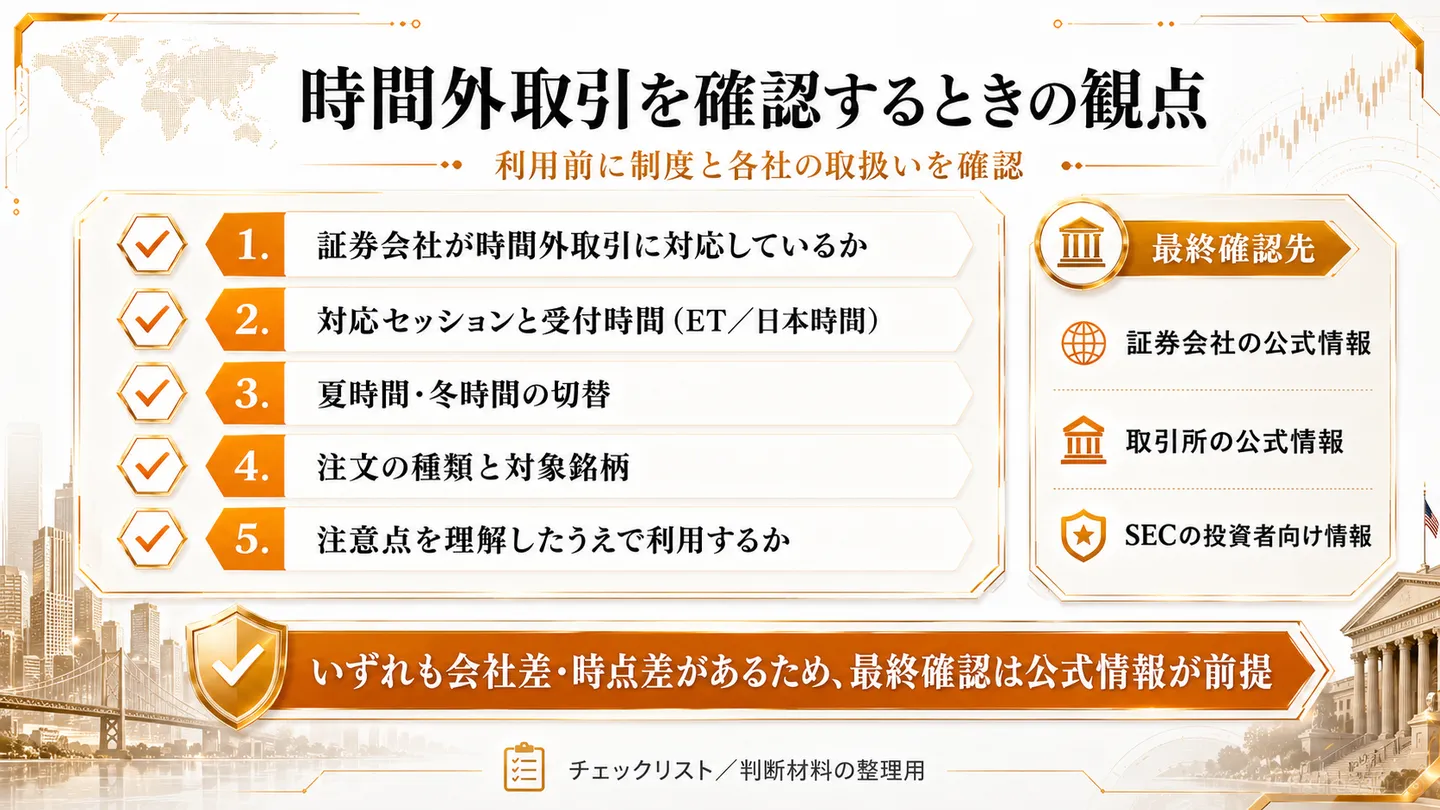
Before considering whether to use extended-hours trading, the basic approach is first to confirm the framework and the treatment adopted by each company. The viewpoints generally confirmed are as follows.
- Whether the securities company used supports extended-hours trading (the pre-market / the after-market)
- The sessions supported, and the hours during which orders are accepted (US Eastern Time / Japanese time, including the switch between daylight saving time and standard time)
- The types of order accepted (market (成行) and limit (指値) orders and so on; the types usable outside regular hours may differ from those in regular trading)
- The stocks covered by trading (there may be stocks that cannot be traded outside regular hours)
- Whether it is used with an understanding of the points of caution — lower liquidity, the widening of the quote spread and movements in price
Because these differ according to the company and the point in time, the premise is that they are ultimately confirmed in the official information of each company and each exchange.
Terms organised
Among the terms covered in this article, those that someone approaching the subject for the first time may wish to confirm are organised below.
- Extended-hours trading (時間外取引): buying and selling carried out before and after regular trading hours. It divides into the pre-market and the after-market.
- Pre-market (プレマーケット): extended-hours trading before regular trading begins.
- After-market (アフターマーケット, after-hours, also called the post-market): extended-hours trading after regular trading has ended.
- Regular trading hours: the ordinary trading hours on an exchange. For US stocks they are given as running roughly from 9:30 a.m. to 4:00 p.m. US Eastern Time (as published by the SEC).
- Quote spread: the difference between the selling price (売値, bid) and the buying price (買値, ask). It is said to widen readily outside regular hours.
- Liquidity: the ease of trading. It is said to fall readily outside regular hours.
- Daylight saving time (サマータイム, 夏時間): a system under which clocks are put forward by one hour for a certain period. It is a factor that shifts the time band by about one hour when converted into Japanese time.
Frequently checked questions
What is extended-hours trading in US stocks?
It is buying and selling carried out before and after regular trading hours. The part before regular trading is called the pre-market, and the part after regular trading the after-market (the post-market). The SEC describes it as trading that occurs outside of regular trading hours. Whether it can be used, and the hours during which orders are accepted, differ from one securities company to another.
What time are the pre-market and the after-market in Japanese time?
The general hours shown by the exchanges are, in US Eastern Time, roughly 4:00 a.m. to 9:30 a.m. for the pre-market and roughly 4:00 p.m. to 8:00 p.m. for the after-market. These are only a guide, however, and differ from company to company. Because conversion into Japanese time shifts by about one hour depending on whether US daylight saving time is in force, this article does not assert a fixed time here. If you wish to confirm the hours in Japanese time, please confirm them — including which of daylight saving time or standard time applies — in the official information of each company and each exchange.
How does extended-hours trading differ from regular trading?
The main differences include lower liquidity, under which there is little participation in trading and orders are less likely to be executed; the widening of the quote spread, being the difference between the selling price and the buying price, which tends to widen; movements in price caused by the release of important information and the like; the handling of orders being different from that in regular trading; and markets not being linked. These are points that the SEC lists as points of caution in extended-hours trading, and they are not of a nature that permits an assertion either that it should therefore be avoided or that it is therefore favourable.
Can anyone use extended-hours trading?
Whether it can be used depends on the treatment adopted by the securities company. There are companies that do not support it, and even where it is supported, the hours during which orders are accepted, the types of order and the stocks covered may be limited. The SEC explains that the participants in extended-hours trading include many professional traders. Please confirm whether it is available, and on what conditions, in each company’s official information.
Can the price outside regular hours be trusted?
The price outside regular hours does not necessarily reflect the price in regular trading as it stands. Because there is little participation in trading, and because prices may differ at the same moment across several trading systems, the price displayed may not match the best price across the market as a whole. Since the price may swing either up or down, the basic approach is not to hurry into a judgement on the basis of the price outside regular hours alone, but to check it with an understanding of the differences from regular trading.
Summary
This article has organised extended-hours trading in US stocks (the pre-market and the after-market), focusing on the differences from regular trading and the points of caution. Extended-hours trading is a time band in which buying and selling is possible before and after regular trading hours, but it carries points of caution that differ from regular trading, such as lower liquidity, the widening of the quote spread and movements in price.
The fact that price movements outside regular hours are large has two sides: they may swing in the direction of a profit or in the direction of a loss. This article does not present the view that “the extended-hours session is the place to aim at”; what has been organised here is no more than the mechanism of extended-hours trading and its points of caution. When considering using it, the premise is that you confirm whether it is supported, the hours during which orders are accepted, the types of order and the stocks covered in the official information of each company and each exchange, and that the final decision is then made by you.
Official information referred to
- SEC (the US Securities and Exchange Commission, investor.gov), “Extended-Hours Trading: Investor Bulletin” https://www.investor.gov/introduction-investing/general-resources/news-alerts/alerts-bulletins/investor-bulletins-42
- SEC (the US Securities and Exchange Commission), “After-Hours Trading: Understanding the Risks” https://www.sec.gov/about/reports-publications/investorpubsafterhourshtm
As to the specific hours of the pre-market and the after-market, and each company’s hours for accepting orders and the stocks covered, please confirm the latest content in the official information of the exchange and of the securities company used.
Articles to read next
As a reference when proceeding with checks on extended-hours trading in US stocks, the following articles may also be consulted.
- Basics to check before starting with US stocks (foreign equities) (the hours of regular trading, and points to check on US stocks generally, such as foreign exchange and taxes)
- What an FX spread is and how to view it when comparing (as a reference for the concept of a “spread”. Note that FX market hours and extended-hours trading in US stocks relate to different subjects)
Always check the latest trading conditions, fees and campaigns on each company’s official site. The information on this page is as at the time it was written.