
What a CFD (差金決済取引, contract for difference) is: how it works, the assets covered, and the basics of leverage
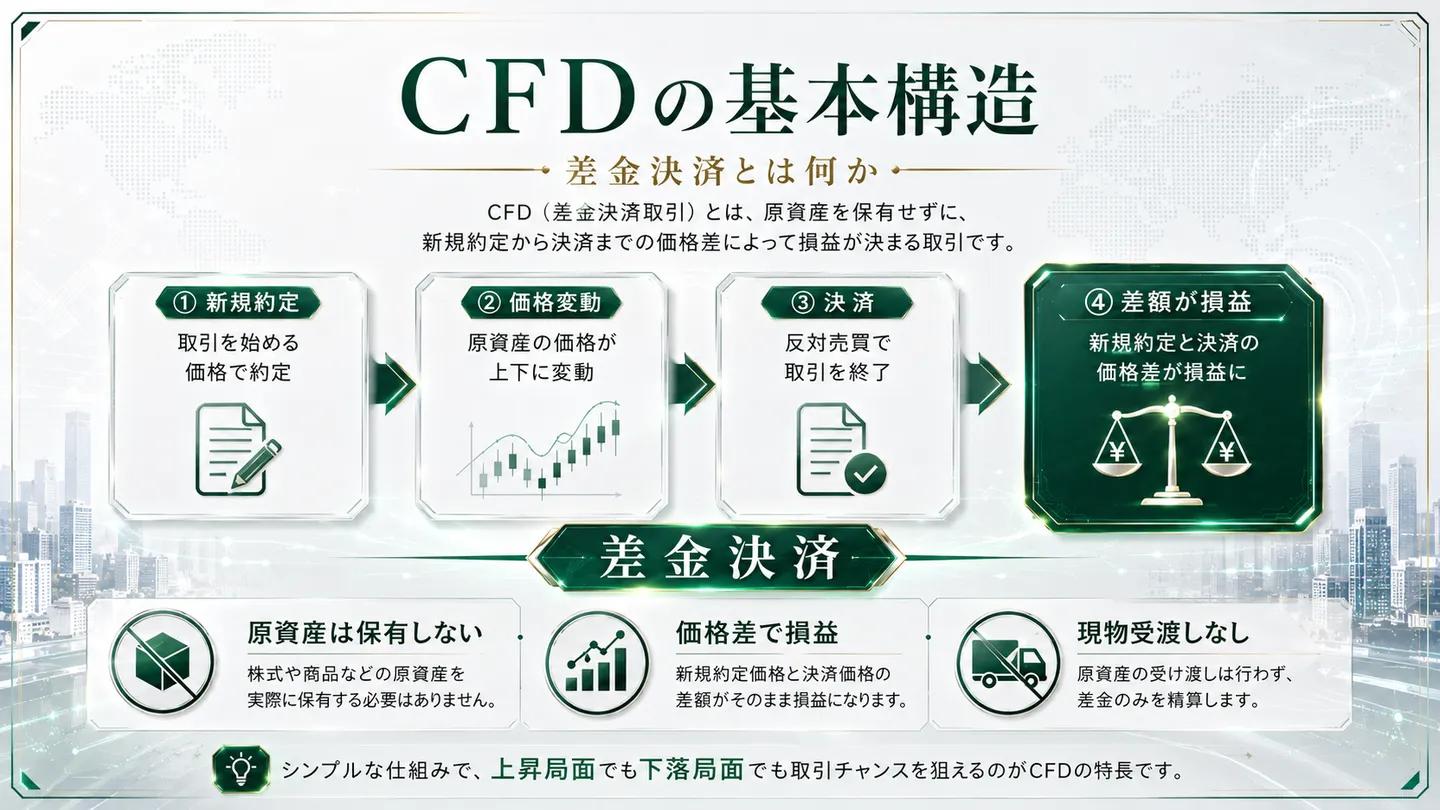
Many people may have seen or heard the term CFD (差金決済取引, contract for difference) without having organised how it differs from trading in actual shares or from FX. This article organises the basics of how CFDs work, on the basis of information published by public bodies and by self-regulatory organisations established under law. Its purpose is not to decide which company or which product is good or advantageous, but to organise what kind of transaction a CFD is, as a premise for checking matters for oneself.
One premise of CFD trading should be stated at the outset. A CFD is a leveraged derivatives transaction (a financial derivative product) in which a loss exceeding the margin deposited may arise. The Financial Services Agency has introduced margin regulation for over-the-counter derivatives transactions in securities (有価証券店頭デリバティブ取引) with individuals as counterparty, CFDs included, treating them as transactions that carry high risk, and has set out the approach that the level of that margin is based in principle on a level able to cover one day’s movement in the price of the asset covered. This article organises the basics of the mechanism on that premise; it does not recommend CFD trading, nor does it compare or evaluate particular companies or products. Details on the risk side, such as loss cuts (ロスカット), additional margin calls (追証) and the risk of the operator, are organised separately in The basics of the risks of CFD trading and of margin, loss cuts and additional margin calls.
What a CFD (差金決済取引) is
A CFD (Contract For Difference) is a transaction in which the underlying asset itself — the original asset on which the transaction is based, such as a stock index or a commodity — is not delivered, and only the difference between the execution price at which the position is opened and the settlement price is exchanged. In Japanese it is called 差金決済取引. In the case, for example, of a CFD covering a stock index, the mechanism is that one does not hold the index itself, and the profit or loss is the difference corresponding to the movement in the price.
Settlement by payment of differences is the major difference from trading in the actual asset (現物取引). With actual shares, one holds the shares themselves that were bought, and delivery takes place when they are sold. In the case of a CFD, the asset covered is not held, and the profit or loss is determined by the difference arising from the movement in price. The Japan Securities Dealers Association’s 「CFD取引に関する規則」 (its rules concerning CFD transactions) states its purpose as being to lay down the matters that association members must comply with in respect of the CFD transactions they conduct with customers, and thereby to contribute to the protection of investors; from this it can be seen that CFDs are transactions made subject to self-regulation from the standpoint of investor protection.
What can be traded (the assets covered)
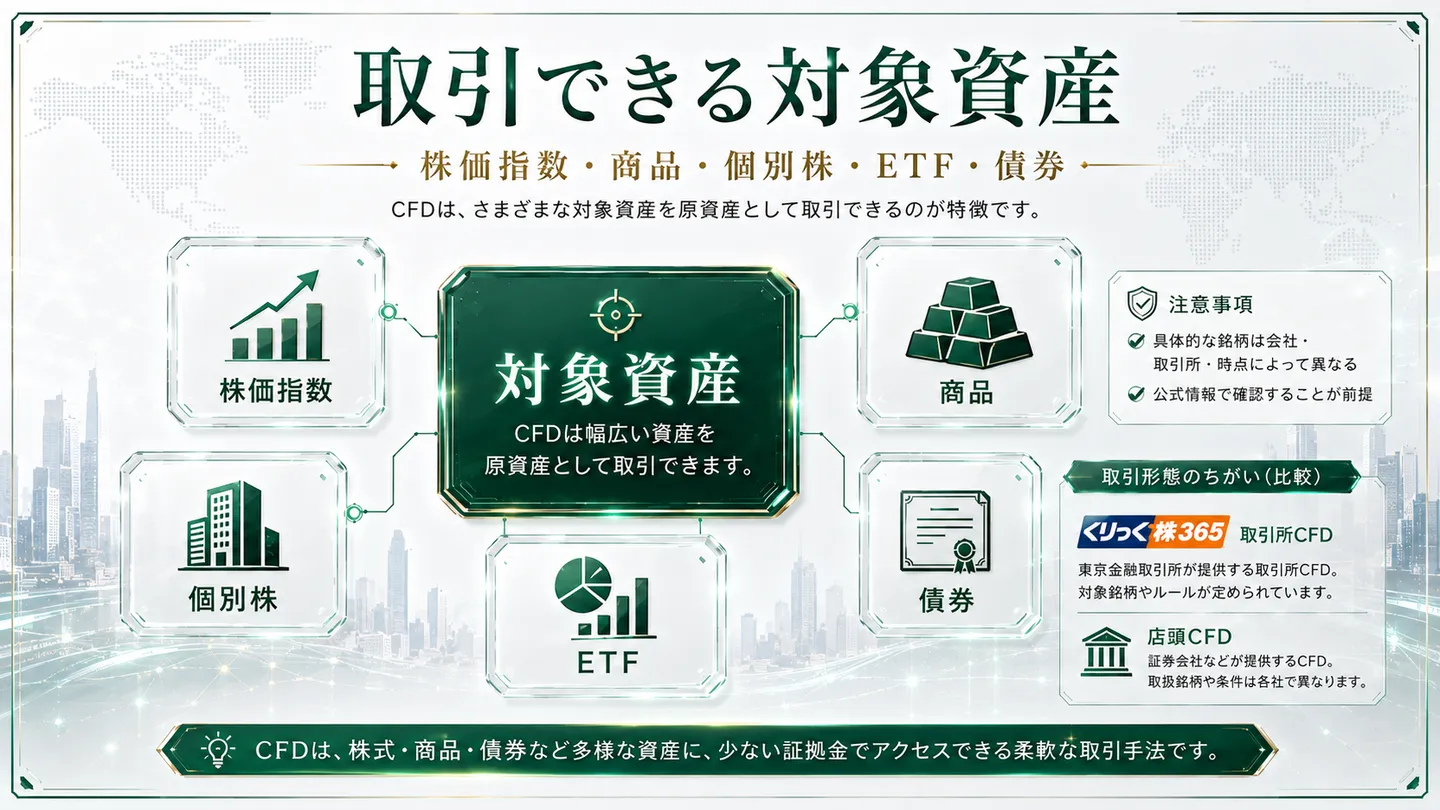
CFDs are said to be characterised by the breadth of the assets they can cover. A wide variety of assets can be covered: stock indices, commodities (gold, silver, crude oil and the like), individual shares, ETFs (exchange traded funds, 上場投資信託), bonds and so on.
Of these, Click Kabu 365 (くりっく株365) — the product referred to in Japanese as an exchange-traded CFD (取引所CFD), listed on the Tokyo Financial Exchange under the product name 取引所株価指数証拠金取引 (Equity Index Daily Futures) — covers, according to the Tokyo Financial Exchange’s explanation, domestic and overseas stock indices and ETFs (exchange traded funds). Over-the-counter CFDs (店頭CFD), on the other hand, differ from one company handling them to another in what they offer, such as stock indices, commodities and individual shares.
What is worth grasping here is that exactly which instruments can be traded differs by company, by exchange and by point in time. This article does not fix any list of particular instruments. The premise is that the instruments handled are confirmed in the official information of the company or exchange one uses (or is considering).
It should be added that くりっく365 (Click 365), the FX product covering foreign exchange, and くりっく株365, the CFD product covering stock indices and ETFs, are similar in name but are different products. Care should be taken not to confuse them. The framework for organising over-the-counter trading and exchange trading is also dealt with in The differences between over-the-counter FX and exchange-traded FX (くりっく365), but please note that these are different products covering different assets.
Buying (long) and selling (short)
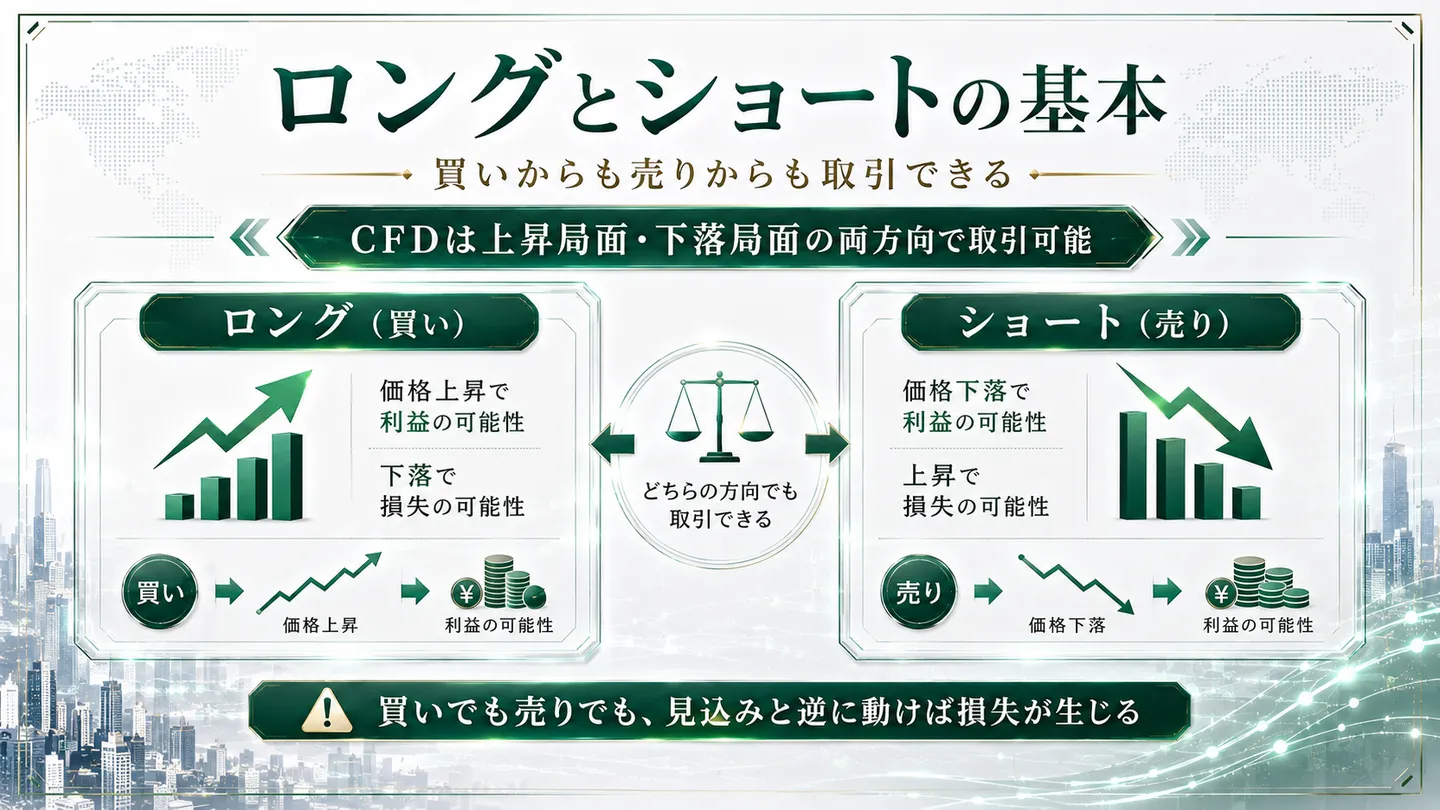
CFDs are described as a mechanism in which a transaction can be started not only from the buy side (long) but also from the sell side (short). The official explanation of Click Kabu 365 likewise states that trading can be started from the sell side as well.
This is an explanation of the mechanism, namely that a phase in which prices are expected to fall can also be a subject of trading. It is, however, an explanation of how the mechanism works, and does not indicate that a profit will be obtained in any particular market phase. Whether one buys or sells, a loss arises if the market moves contrary to expectations. Rather than an understanding that calls to mind an outcome such as being able to earn even in a falling market, it is desirable to grasp this as the fact that there is a mechanism allowing trading to begin from either the buy side or the sell side.
The basic way of thinking about leverage and margin
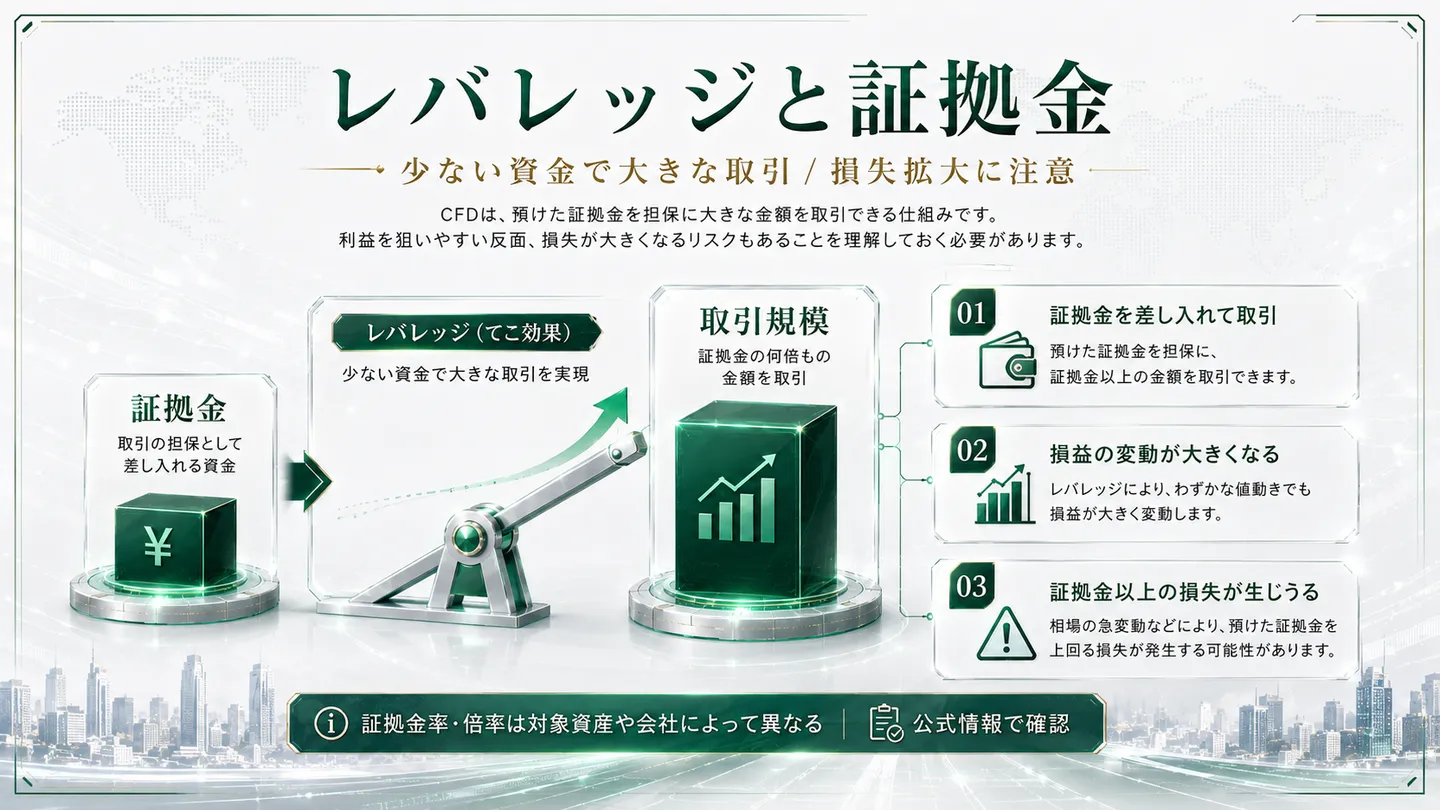
A CFD is a mechanism under which trading is possible by depositing as margin not the full amount one wishes to trade, but a part of it. This makes possible transactions on a scale exceeding the margin deposited. This is what is called leverage (レバレッジ, the principle of the lever). The official explanation of Click Kabu 365 states that, on the basis of the margin deposited, transactions amounting to several times to several tens of times that amount can be carried out.
The point to note here is that leverage magnifies movements in either direction, in profit as in loss. While a large amount can be traded with a small amount of margin, if the market moves unfavourably the loss likewise becomes larger, and a loss exceeding the margin deposited may arise. It is considered necessary to understand this on both sides: not only the aspect of being able to trade a large amount with a small amount of funds, but also the fact that losses too may be magnified.
The proportion of margin (the margin ratio, 証拠金率) has a lower limit laid down by regulation according to the kind of asset covered, and it differs for each kind of asset covered, such as individual shares, stock indices and bonds. Because specific margin ratios and leverage multiples differ by company, by product and by point in time, this article does not present any fixed figures. The framework of margin regulation, and the point that a loss exceeding the margin may arise when the market moves suddenly, are organised in The basics of the risks of CFD trading and of margin, loss cuts and additional margin calls. The premise is that the margin ratio and leverage actually applied are confirmed in the official information of each company and of the exchange.
The differences between exchange-traded CFDs and over-the-counter CFDs (an overview)
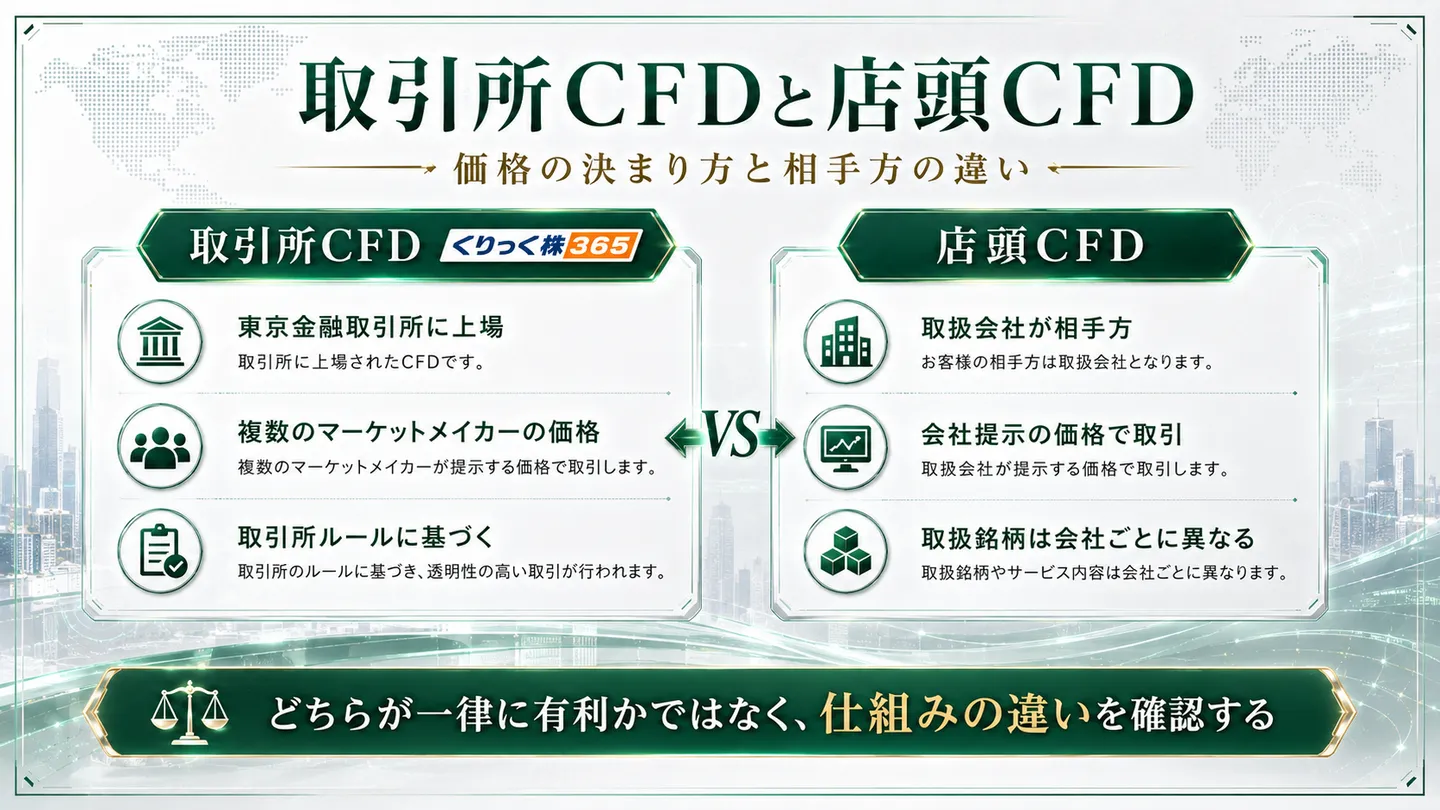
CFDs come in two forms: the exchange-traded CFD (取引所CFD), which is listed on an exchange, and the over-the-counter CFD (店頭CFD), in which the company handling the transaction is the counterparty.
The representative exchange-traded CFD is Click Kabu 365 (くりっく株365), which is listed on the Tokyo Financial Exchange. According to the official explanation of Click Kabu 365, it is a mechanism that provides, from among the prices quoted by a number of market makers, the most favourable price at that point in time. An over-the-counter CFD, on the other hand, is a bilateral transaction (相対取引, aitai torihiki) carried out at the price quoted by the company handling it.
What matters here is that this is not a distinction for deciding across the board which of the two is advantageous, but a difference in how the mechanisms work: in how the price is determined and in who the counterparty to the transaction is. Differences bearing on risk, such as the treatment where an operator fails and the protection of customer assets, are organised in The basics of the risks of CFD trading and of margin, loss cuts and additional margin calls.
How the price is determined and the elements of cost (an overview)
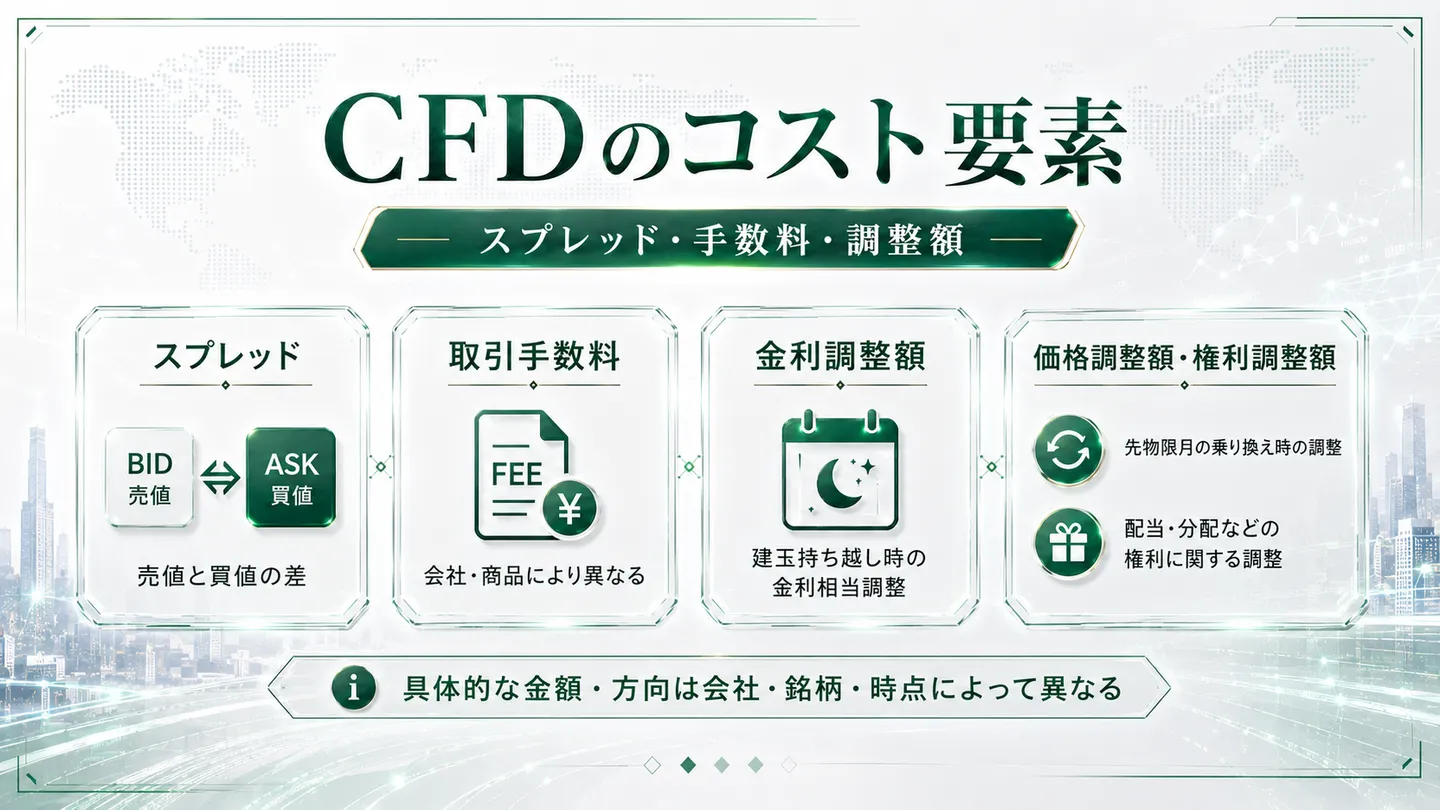
How the price of a CFD is determined differs between exchange-traded CFDs and over-the-counter CFDs. The exchange-traded CFD (Click Kabu 365) is, as stated above, described as a mechanism in which a favourable price is provided from among the prices quoted by a number of market makers, while in over-the-counter CFDs the company handling the transaction quotes the price.
The elements of cost are mainly the following.
- The spread (スプレッド): the difference between the selling price (売値, the price at which one sells) and the buying price (買値, the price at which one buys). It differs according to the instrument, the company and the state of the market at the time. On how to think about the spread, What an FX spread is and how to view it when comparing may also be consulted (FX and CFDs are different products, but the framework of the idea of a spread is common to both).
- Trading fees: fees arising on each transaction, or under certain conditions. Whether they are charged at all, and at what level, differs by company and by product.
- The adjustment amounts arising when an open position is carried over: when an open position (建玉, the position held) is carried over to the next business day or beyond, three kinds of adjustment amount may arise — the interest adjustment amount, the price adjustment amount and the entitlement adjustment amount.
These three kinds of adjustment amount are generally explained as follows. The interest adjustment amount is an adjustment corresponding to interest, arising when an open position is carried over to the next business day. The price adjustment amount adjusts the unrealised profit or loss arising on an open position when the contract month (限月, the settlement deadline) of the futures on the underlying asset that is referenced rolls over. The entitlement adjustment amount adjusts the portion corresponding to an entitlement when a dividend, a distribution or the like arises on the underlying asset that is referenced. Because the specific amounts and their direction (whether they are received or paid) differ by company, by instrument and by point in time, this article does not indicate any specific levels. The premise is that the actual content of the costs is confirmed in the official information of each company and of the exchange.
The tax treatment (an overview)
Tax is payable on profits from CFDs. Profits arising from 差金等決済 (settlement by payment of differences) in certain CFD transactions with a domestic financial instruments business operator (金融商品取引業者) or the like as counterparty are subject to separate self-assessment taxation (申告分離課税) as 「先物取引に係る雑所得等」 (miscellaneous income and the like relating to futures transactions). This differs from the treatment of income from crypto-asset transactions, which is in principle subject to aggregate taxation (総合課税). Where a loss arises, certain requirements apply to the extent to which it may be set against other 「先物取引に係る雑所得等」 by way of offsetting of gains and losses (損益通算), and to the loss carry-forward (繰越控除) over three years.
Care is needed on the point that what is covered here is not every CFD, but certain CFD transactions with a domestic financial instruments business operator or the like as counterparty. The premise is that the specific tax position and requirements, and whether one’s own transactions fall within the scope, are confirmed in the latest information from the National Tax Agency and with the tax office (税務署) or a tax accountant (税理士). This article sets out an overview of the general framework, and is not tax advice.
Terms organised
The main terms covered in this article are organised below.
- CFD (差金決済取引, Contract For Difference): a transaction in which the underlying asset is not delivered and only the difference between the execution price and the settlement price is settled. The asset covered is not held, and the profit or loss is determined by the difference arising from the movement in price.
- The underlying asset: the original asset covered by a CFD (a stock index, a commodity, individual shares, an ETF, a bond and so on).
- Leverage (レバレッジ, the principle of the lever): being able to carry out transactions on a scale exceeding the margin, by depositing a part of the transaction amount as margin. It magnifies movements in either direction, in profit as in loss.
- Margin (証拠金): funds, in the nature of collateral, deposited in order to trade. The lower limit of the margin ratio is laid down by regulation for each kind of asset covered.
- Long (buying) / short (selling): a transaction begun from the buy side is long, and one begun from the sell side is short. CFDs are described as a mechanism in which trading is possible from both directions.
- The spread (スプレッド): the difference between the selling price (売値) and the buying price (買値). It differs according to the instrument, the company and the state of the market.
- The interest adjustment amount, the price adjustment amount and the entitlement adjustment amount: the three kinds of adjustment amount that may arise when an open position is carried over. The amounts and their direction differ by company, by instrument and by point in time.
- Exchange-traded CFD (取引所CFD) / over-the-counter CFD (店頭CFD): what is listed on an exchange is the exchange-traded CFD (Click Kabu 365 and the like); the bilateral transaction in which the company handling it is the counterparty to the transaction is the over-the-counter CFD.
Frequently checked questions
What is a CFD?
It is a transaction in which the underlying asset is not delivered and only the difference between the execution price and the settlement price is settled (差金決済取引, Contract For Difference). The asset covered is not itself held, and the profit or loss is determined by the difference arising from the movement in price. The premise is that it is a leveraged derivatives transaction in which a loss exceeding the margin deposited may arise.
What can be traded with CFDs?
The range covered is wide — stock indices, commodities, individual shares, ETFs, bonds and so on — and for Click Kabu 365 (くりっく株365), the exchange-traded CFD, the assets covered are, according to the Tokyo Financial Exchange’s explanation, domestic and overseas stock indices and ETFs. Because the specific instruments handled differ by company, by exchange and by point in time, the premise is that they are confirmed in the official information of each company and of the exchange.
Can trading also be started from the sell side?
Click Kabu 365 is described as allowing trading to be started from the sell side as well, and it is a mechanism in which trading can begin from either the buy side or the sell side. This is, however, an explanation of how the mechanism works, and does not indicate that a profit will be obtained in any particular market phase. Whether one buys or sells, a loss arises if the market moves contrary to expectations.
How many times is the leverage?
It differs by company and by product. Click Kabu 365 is described as allowing transactions of several times to several tens of times the margin deposited. For over-the-counter CFDs, the margin ratio has a lower limit laid down by regulation for each kind of asset covered, and to that extent the upper limit of leverage also differs with the asset covered. This article does not fix any specific multiple; the premise is that it is confirmed in the official information of each company and of the exchange. Because leverage magnifies movements in either direction, in profit as in loss, it is necessary to understand at the same time that losses too may be magnified.
Are くりっく365 for FX and くりっく株365 for CFDs the same thing?
They are different products. くりっく365 is exchange-traded FX (取引所FX) covering foreign exchange, while くりっく株365 is the exchange-traded CFD (取引所CFD) covering domestic and overseas stock indices and ETFs. Because the names are similar they are readily confused, but the assets they cover differ.
Does this article recommend CFDs?
No. This article organises how CFDs work on the basis of official information; it does not recommend CFD trading, nor does it compare or evaluate particular companies or products. Please make the final judgment yourself, having understood the mechanism and the risks and having confirmed the official information of each company and of the exchange.
Summary
A CFD (差金決済取引) is a transaction in which the underlying asset is not delivered and only the difference between the execution price and the settlement price is settled. The range of assets covered is wide — stock indices, commodities, individual shares, ETFs, bonds and so on — and the exchange-traded CFD (取引所CFD, Click Kabu 365) is described as covering domestic and overseas stock indices and ETFs. There is a mechanism allowing trading to begin from either the buy side or the sell side, and by depositing a part of the transaction amount as margin one can carry out transactions on a scale exceeding that margin (leverage). The premise, however, is that leverage magnifies movements in either direction, in profit as in loss, and that a loss exceeding the margin deposited may arise. Exchange-traded CFDs and over-the-counter CFDs differ in how the price is determined and in who the counterparty to the transaction is, and there are elements of cost such as the spread, trading fees and the three kinds of adjustment amount (interest, price and entitlement). Because the specific instruments, margin ratios, leverage, spreads and levels of adjustment amount differ by company, by exchange and by point in time, the premise is that the overall picture of the mechanism is confirmed in this article and in public information, and that specific terms are confirmed in the official information of each company and of the exchange. Details of the risks and of matters surrounding margin are organised in The basics of the risks of CFD trading and of margin, loss cuts and additional margin calls.
Official information referred to
- Tokyo Financial Exchange, 「取引所株価指数証拠金取引 くりっく株365」 (https://www.tfx.co.jp/retail/cfd.html)
- Click Kabu 365 (くりっく株365), 「くりっく株365とは?」 (https://www.clickkabu365.jp/about_cfd/)
- Click Kabu 365 (くりっく株365), 「『くりっく株365』と『店頭CFD』の違い」 (https://www.clickkabu365.jp/about_cfd/about_cfd22.html)
- Japan Securities Dealers Association, 「CFD取引に関する規則」 (https://www.jsda.or.jp/about/kisoku/files/100316_cfdkisoku.pdf)
- Financial Services Agency, 「平成21年金融商品取引法等の一部改正に係る政令案・内閣府令案等の公表について」 (https://www.fsa.go.jp/news/21/20091016-1.html)
- National Tax Agency, タックスアンサー No.1522 「先物取引に係る雑所得等の課税の特例」 (https://www.nta.go.jp/taxes/shiraberu/taxanswer/shotoku/1522.htm)
This article has been prepared on the basis of official information confirmed as at 12 June 2026. Because the specific levels of the instruments handled, the margin ratio, leverage, the spread and the adjustment amounts for CFDs differ by company, by exchange and by point in time, please confirm the actual terms in the official information of each company and of the exchange, and in the official information listed above.
Always check the latest trading conditions, fees and campaigns on each company’s official site. The information on this page is as at the time it was written.