
The differences between over-the-counter FX and exchange-traded FX (くりっく365)
FX (foreign exchange margin trading, 外国為替証拠金取引) is broadly divided into two kinds: over-the-counter FX (店頭FX) and exchange-traded FX (取引所FX, くりっく365 / Click 365). Although both are FX, there are institutional differences in the counterparty to the transaction, the mechanism by which prices are quoted, where the margin is deposited and so on, so many people may not have fully organised what differs and how. This article organises the differences between over-the-counter FX and exchange-traded FX on the basis of information published by public bodies and by the exchange. Its purpose is to organise these differences in how each works, as a premise for understanding them and for checking the actual terms on offer for oneself in the official information of each company and of the exchange.
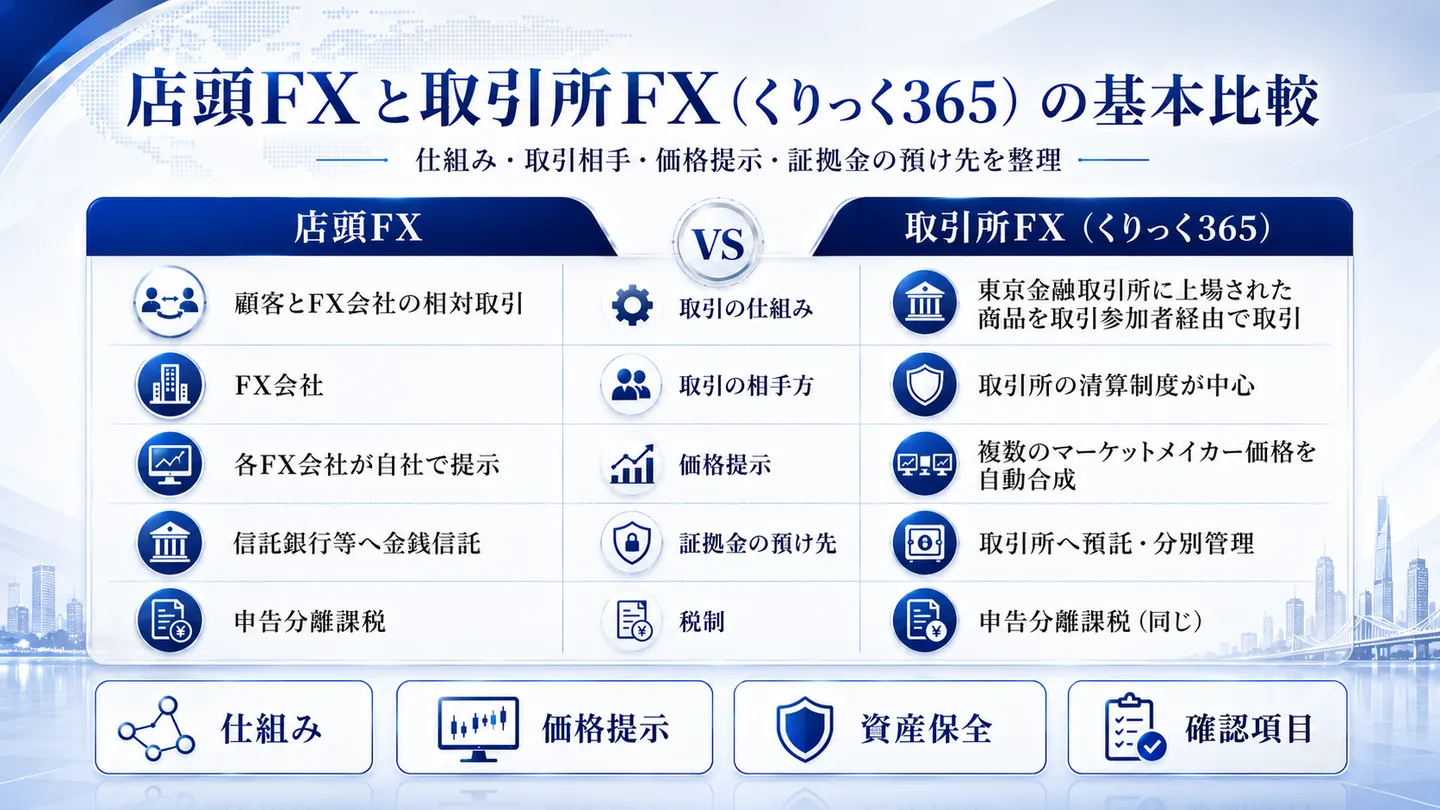
A short answer to the question comes first. Over-the-counter FX is a bilateral transaction (相対取引, aitai torihiki) in which the customer and the FX company are directly each other’s counterparty, while exchange-traded FX (くりっく365) is trading in a product listed on the Tokyo Financial Exchange, conducted through an FX company that is a trading participant (取引参加者). There are institutional differences in the counterparty to the transaction, the mechanism by which prices are quoted, where the margin is deposited and so on, but the tax treatment — separate self-assessment taxation (申告分離課税) as 「先物取引に係る雑所得等」 (miscellaneous income and the like relating to futures transactions) — is the same for both. Having understood the differences in how each works, the premise is that the terms on offer are confirmed in the official information of each company and of the exchange. The following organises matters one by one on this premise.
| Point of comparison | Over-the-counter FX (店頭FX) | Exchange-traded FX (取引所FX, くりっく365) |
|---|---|---|
| How the trading works | A bilateral transaction (相対取引) between the customer and the FX company | Trading in a product listed on the Tokyo Financial Exchange, conducted through an FX company that is a trading participant |
| The counterparty to the transaction | The FX company (each company becomes the customer's counterparty) | The exchange (the clearing organisation) stands at the centre of the clearing framework; orders are routed through an FX company |
| The quoting of prices | Each FX company quotes prices itself (the terms of trading are determined by each company at its own discretion) | The exchange explains that it is a mechanism in which a price is automatically composed from the prices quoted by a number of market makers |
| Where the margin is deposited | A money trust with a trust bank or similar institution (a trust for separate customer money control, 区分管理信託) | Deposited directly with the exchange (the Tokyo Financial Exchange) and under segregated management |
| The tax treatment | Separate self-assessment taxation as 「先物取引に係る雑所得等」 | The same as on the left (identical over the counter and on the exchange) |
Note: this table sets out side by side the differences in how over-the-counter FX and exchange-traded FX work. Because terms such as the currency pairs handled, the spread and the fees differ by company, by exchange and by point in time, the premise is that actual terms are confirmed in the official information of each company and of the exchange.
What over-the-counter FX is — a bilateral transaction between the customer and the FX company
Over-the-counter FX (店頭FX, tento FX) is a transaction concluded by agreement between the customer and the FX company, without going through an exchange. The Financial Futures Association of Japan (一般社団法人 金融先物取引業協会, FFAJ) explains that a transaction concluded by agreement between the parties without going through an exchange is called a bilateral transaction, and that over-the-counter FX too is a bilateral transaction between the customer and the FX operator. A bilateral transaction (相対取引, aitai torihiki) here means a transaction concluded by agreement between the parties themselves, without going through an exchange. In other words, in over-the-counter FX the counterparty to the customer’s transaction is the FX company itself.
A characteristic feature is that the terms of trading differ from one FX company to another. The FFAJ explains that, in over-the-counter FX, the terms of trading, such as the currency pairs available for trading and the spread, differ depending on the FX operator that acts as the counterparty, and that these terms of trading are determined by the FX operator at its own discretion. Because terms such as the currency pairs handled and the spread may differ from company to company, this article does not give specific figures. The premise is that the actual terms of trading are confirmed in each company’s official explanations.
As to where the margin is deposited, the FFAJ explains that, in the case of over-the-counter FX, margin deposited by a customer with an FX operator is required by law to be placed in a money trust with a trust company or a trust bank. This is a mechanism under which the margin an operator has received from customers is kept separate from the operator’s own assets and deposited with a trust bank or similar institution (区分管理信託, a trust for separate customer money control). The framework for protecting margin is organised side by side with exchange-traded FX below, under “The framework for protecting customer assets”.
What exchange-traded FX (くりっく365) is — a product listed on an exchange
Exchange-traded FX (取引所FX, torihikijo FX) is FX listed on a financial instruments exchange (金融商品取引所), traded through an FX company that is a trading participant. The FFAJ explains that the only exchange-traded FX currently conducted in Japan is くりっく365, the product listed on the Tokyo Financial Exchange. くりっく365 is the popular name for the exchange-traded foreign exchange margin trading (取引所為替証拠金取引) operated by Tokyo Financial Exchange Inc. (株式会社東京金融取引所, TFX), and is a product listed on that exchange.
The framework of the trading takes a form similar to transactions in securities such as listed shares. The FFAJ explains that, in exchange-traded FX, customers trade くりっく365, a listed product, through an FX operator that is a trading participant, and that this may be regarded as similar to the way in which transactions in securities such as listed shares are conducted through a securities company that is a trading participant. A trading participant here means an FX company that stands between the customer and the exchange and routes orders.
The structure of the counterparty also differs from over-the-counter FX. The Tokyo Financial Exchange explains that it is a clearing organisation for financial instruments transactions (金融商品取引清算機関) that has received approval under the Financial Instruments and Exchange Act, and that it carries out clearing operations in respect of the products it lists. It is explained that exchange-traded FX uses a clearing system (清算制度) in which the exchange (the clearing organisation) stands at the centre of the clearing framework. As to where the margin is deposited, the Tokyo Financial Exchange also explains that trading participants deposit with the exchange the margin they have received from investors, and that the exchange manages it separately for each investor. This is organised in detail below, side by side with over-the-counter FX, under “The framework for protecting customer assets”.
Differences in the mechanism by which prices are quoted
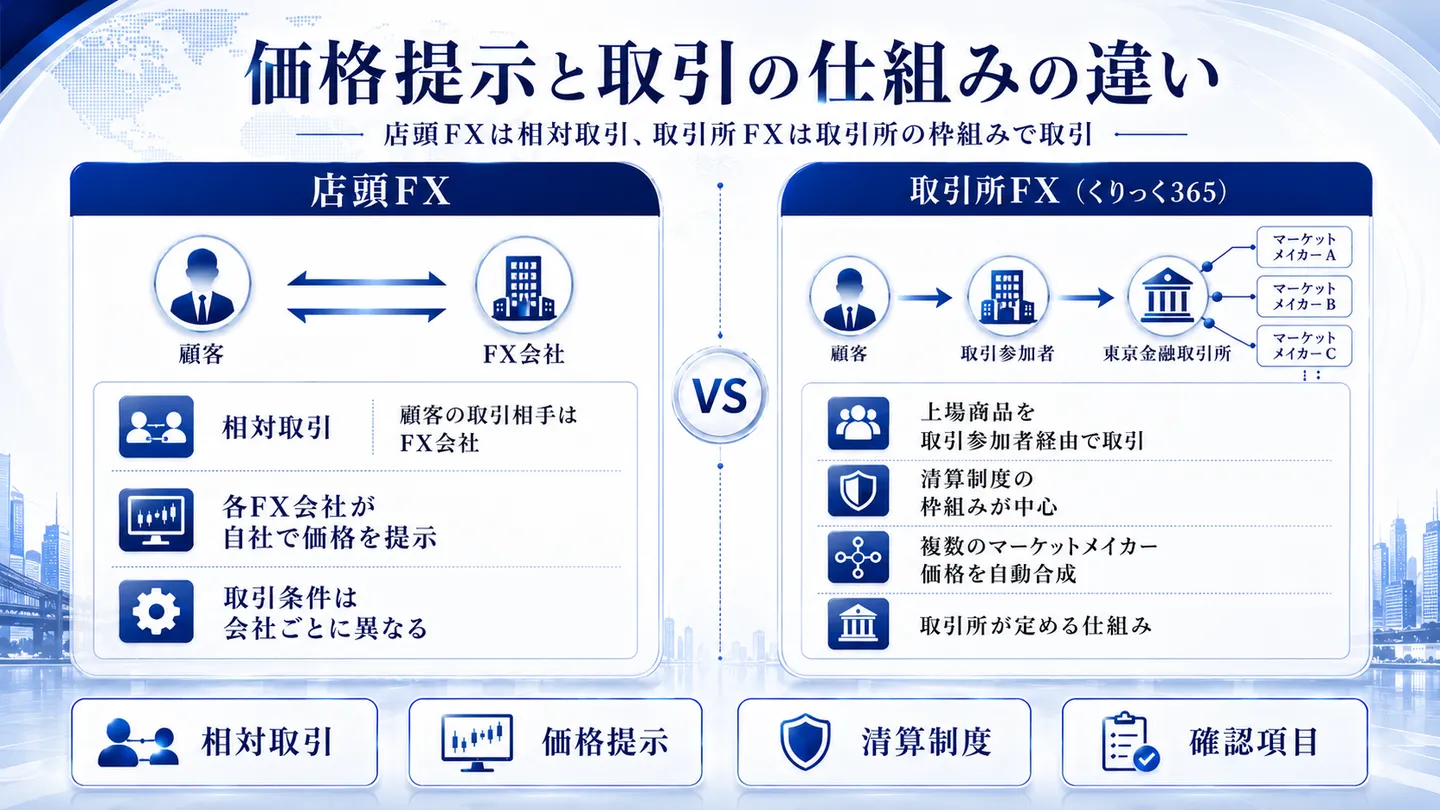
The mechanism by which prices are quoted rests on a different idea in over-the-counter FX and in exchange-traded FX.
In over-the-counter FX, each FX company quotes prices itself, and that company is itself the customer’s counterparty. As stated above, the FFAJ explains that the terms of trading are determined by the FX company at its own discretion, so the prices and spreads quoted can be organised as matters that may differ from company to company.
For exchange-traded FX (くりっく365), on the other hand, the Tokyo Financial Exchange explains that a number of financial institutions (market makers) quote prices, and that from among them a price favourable to the customer is automatically composed. The point that there are several parties quoting prices may be cited as a structural difference from over-the-counter FX, in which each FX company quotes prices on its own.
This is not, however, a question of which way of quoting prices is superior. Total cost, including the spread, is a variable condition that differs by company, by exchange and by point in time. The premise is that actual spreads and costs are confirmed in the official information of each company and of the exchange. As for the spread itself, which is the difference between the selling price and the buying price, it is organised separately in What an FX spread is and how to view it when comparing.
Differences in the currency pairs handled and the trading hours
The currency pairs handled and the trading hours are also determined in different ways in over-the-counter FX and in exchange-traded FX.
In over-the-counter FX, as stated above, the currency pairs handled differ from one FX company to another, and each company determines them at its own discretion. Because which currency pairs are handled and how trading hours are set may differ from company to company, this article does not give specific numbers of instruments or specific hours.
In exchange-traded FX (くりっく365), one follows the instruments and the trading hours laid down by the exchange. Exactly which currency pairs are listed, and when the trading hours are, are matters laid down by the exchange, and this too is variable information that may change according to the point in time.
The number of currency pairs handled and the trading hours are variable conditions that change according to the point in time, both over the counter and on the exchange. The premise is that the instruments actually handled and the trading hours are confirmed in the official information of each company and of the exchange. As for how trading hours are thought about in FX generally, FX trading hours and the time zones of the main markets may also be consulted.
In addition, as regards the amount equivalent to interest (the swap) that arises when an open position (建玉) is carried over to the following day, the point that an amount equivalent to interest arises when a position is carried over is common to both over-the-counter and exchange trading, but the mechanism by which it is credited and how it is handled differ by company and by exchange. How the swap itself works is organised separately in How FX swap points work and how to check them.
The tax treatment is the same — a point readily misunderstood
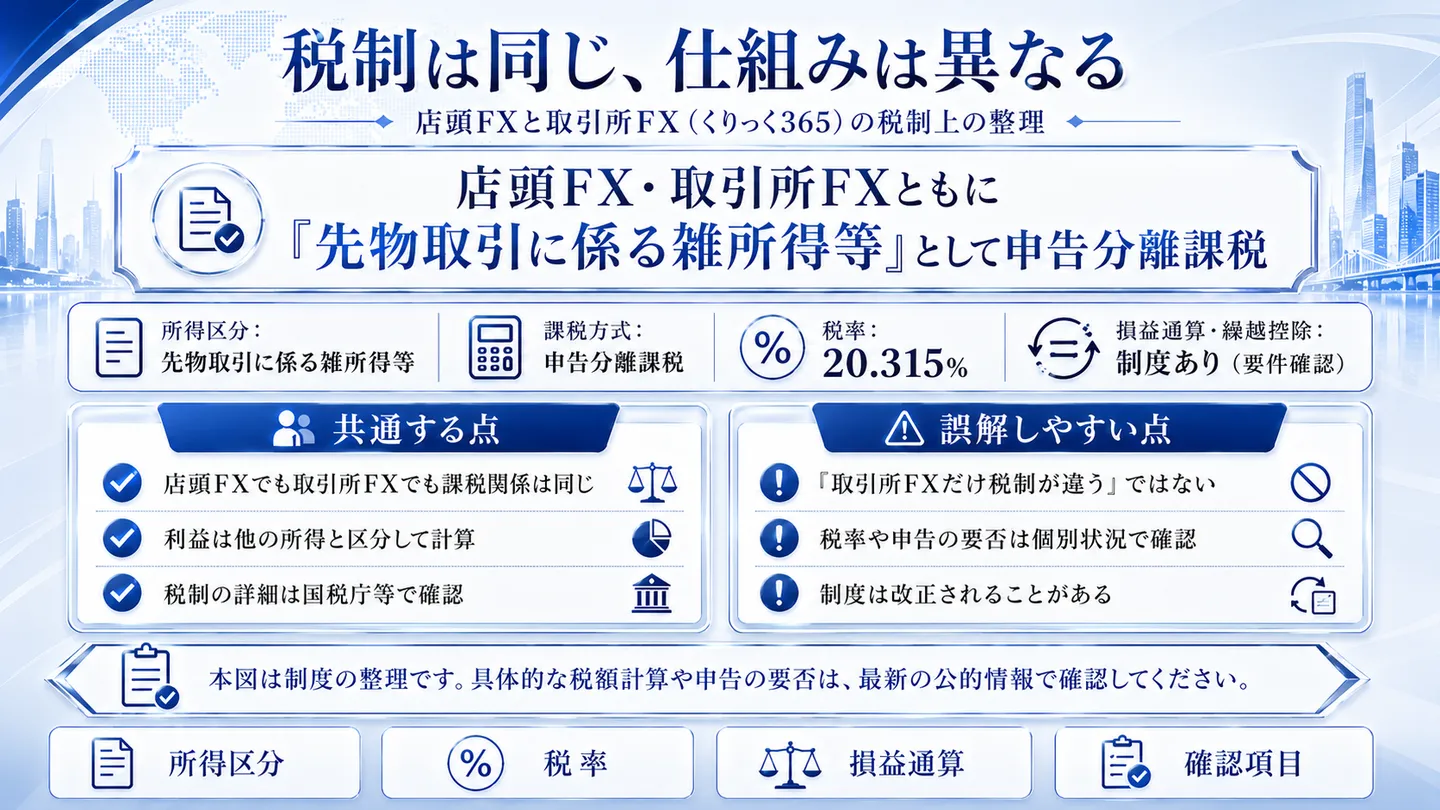
Among the differences between over-the-counter FX and exchange-traded FX, the one most readily misunderstood is the treatment of tax. It is sometimes taken that exchange-traded FX has a different tax treatment, or that the tax changes compared with over-the-counter trading, but the tax treatment is the same for both.
The National Tax Agency explains, in its タックスアンサー No.1521 「外国為替証拠金取引(FX)の課税関係」, that foreign exchange margin trading (FX) comprises over-the-counter derivatives transactions and market derivatives transactions (transactions conducted on a financial instruments market established by a financial instruments exchange), but that the tax treatment is the same in either case. In other words, the position is that, whether the trading is over-the-counter FX or exchange-traded FX (くりっく365), the gain is subject to separate self-assessment taxation as 「先物取引に係る雑所得等」.
What this article covers here goes as far as confirming the framework that the tax treatment is the same over the counter and on the exchange. Details such as the specific tax rate and the calculation of the tax amount, whether offsetting of gains and losses (損益通算) and loss carry-forward (繰越控除) are required, and the procedure for a Japanese tax return (確定申告) are matters whose treatment may vary from person to person and from situation to situation, and this article does not go into them. Details of the tax treatment are organised separately in The basics of FX taxation (how taxation works and the flow of checks), and the premise is also that they are confirmed in the National Tax Agency’s information and in each company’s official explanations.
The framework for protecting customer assets
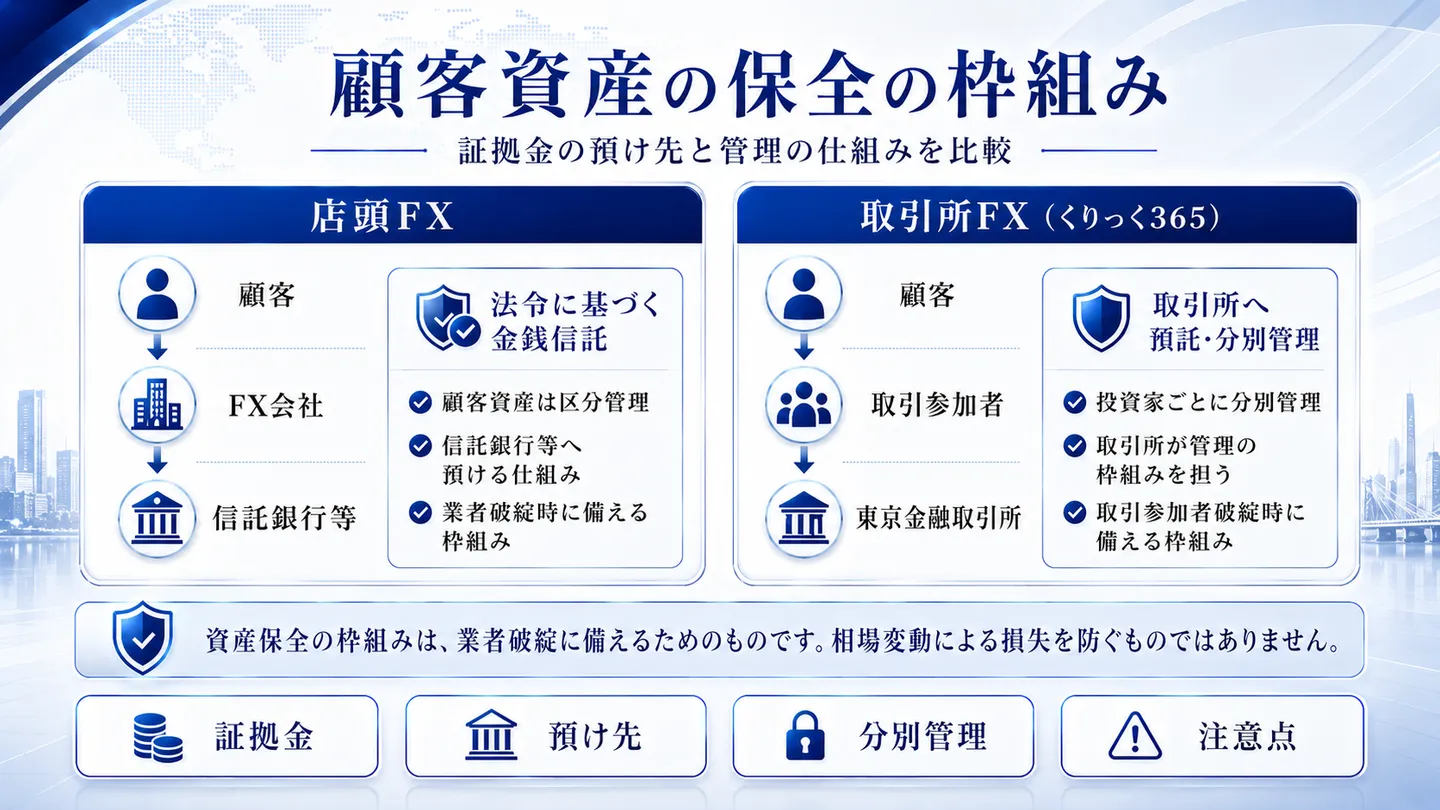
The protection of margin (the assets a customer deposits) also works differently in over-the-counter FX and in exchange-traded FX.
In over-the-counter FX, as the FFAJ explains, operators are obliged to place the margin received from customers in a money trust with a trust bank or similar institution. With respect to margin for currency-related derivatives, the FFAJ explains a mechanism of separate customer money control (区分管理) consolidated into a trust (信託一本化), under which an operator places the margin received from customers in a money trust with a trust bank or similar institution; it explains that the requirements include the appointment of a beneficiary’s agent (受益者代理人), and that where the operator fails it is this beneficiary’s agent who is involved in the return of customer assets.
In exchange-traded FX (くりっく365), the Tokyo Financial Exchange explains that trading participants deposit with the exchange the margin they have received from investors, and that the exchange manages it separately for each investor. It is explained that, even where a trading participant (an FX company) fails, the margin is under segregated management (分別管理) at the exchange.
Thus both over-the-counter FX and exchange-traded FX have a framework for protecting customer assets, but where the assets are deposited (with a trust bank or similar institution, or with the exchange) and the mechanism differ. What is worth noting here, however, is that these protective frameworks exist in preparation for the failure of an operator or of a trading participant, and are not something that prevents losses arising from market movements themselves. It does not mean that assets are safe because they are protected, or that the principal is guaranteed. This point is organised again in the caution box that follows.
This article organises the differences in how over-the-counter FX and exchange-traded FX work. There are institutional differences in the counterparty to the transaction, the quoting of prices, where the margin is deposited and so on, but each has its own characteristics, and it is not possible to judge across the board that one is superior — that exchange-traded FX is safer, or that over-the-counter FX is lower in cost and more advantageous. Because terms such as the currency pairs handled, the spread and the fees differ by company, by exchange and by point in time, the premise is that you confirm the actual terms for yourself in the official information of each company and of the exchange.
The Financial Services Agency explains that FX is trading in which losses exceeding the margin may arise and in which neither the principal nor any profit is guaranteed, and that when the market moves sharply a loss exceeding the amount of the margin may arise. This is a premise common to both over-the-counter FX and exchange-traded FX. Care is also needed on the point that the framework for protecting margin exists in preparation for the failure of an operator, and is not something that prevents losses arising from market movements themselves.
Key terms
The main terms covered in this article are organised below.
- Over-the-counter FX (店頭FX, tento FX): a transaction concluded by agreement between the customer and the FX company, without going through an exchange. The counterparty to the customer’s transaction is the FX company itself.
- Bilateral transaction (相対取引, aitai torihiki): a transaction concluded by agreement between the parties themselves, without going through an exchange. The FFAJ explains that over-the-counter FX too is a bilateral transaction between the customer and the FX operator.
- Exchange-traded FX (取引所FX, torihikijo FX): FX listed on a financial instruments exchange, traded through an FX company that is a trading participant. The FFAJ explains that the only exchange-traded FX conducted in Japan at present is くりっく365, the product listed on the Tokyo Financial Exchange.
- くりっく365: the popular name for the exchange-traded foreign exchange margin trading (取引所為替証拠金取引) operated by Tokyo Financial Exchange Inc. (TFX); a product listed on that exchange.
- Trading participant (取引参加者): in exchange-traded FX, an FX company that stands between the customer and the exchange and routes orders.
- Separate self-assessment taxation (申告分離課税, as 「先物取引に係る雑所得等」): the method of taxation applying to gains on FX. The National Tax Agency explains that the tax treatment is the same for both over-the-counter FX and exchange-traded FX.
Common questions
Is the treatment of tax different between over-the-counter FX and exchange-traded FX?
It is the same. The National Tax Agency explains that FX comprises over-the-counter derivatives transactions and market (exchange) derivatives transactions, but that the tax treatment is the same in either case; both are subject to separate self-assessment taxation as 「先物取引に係る雑所得等」. For details such as the specific calculation and whether a Japanese tax return is required, the premise is that they are confirmed in The basics of FX taxation (how taxation works and the flow of checks), in the National Tax Agency’s information and in each company’s official explanations.
Is くりっく365 the only exchange-traded FX?
The FFAJ explains that the only exchange-traded FX currently conducted in Japan is くりっく365, the product listed on the Tokyo Financial Exchange. Over-the-counter FX is offered by many FX companies, and the terms of trading differ from company to company.
In over-the-counter FX, is the margin deposited not protected?
In over-the-counter FX too, operators are obliged by law to place the margin received from customers in a money trust with a trust bank or similar institution (as the FFAJ explains). In the case of exchange-traded FX, it is explained that the margin is deposited with the exchange (the Tokyo Financial Exchange) and managed separately for each investor. Both have a framework for protecting customer assets, but where the assets are deposited and the mechanism differ. These protective frameworks exist in preparation for the failure of an operator, and are not something that prevents losses arising from market movements themselves.
Which has lower fees and costs?
This is not something determined across the board. The FFAJ explains that, in the case of over-the-counter FX, trading fees are in general often lower or free compared with exchange-traded FX, which is conducted through an exchange; but this is an explanation about a general tendency only. Because total cost including the spread, and fees, differ by company, by exchange and by point in time, the premise is that actual terms are confirmed in the official information of each company and of the exchange.
Which should I choose?
This article organises the differences in how each works. The premise is that, having understood the differences in the counterparty to the transaction, the quoting of prices, where the margin is deposited, the currency pairs handled and so on, you confirm the conditions you yourself wish to check (the instruments handled, costs, trading hours and so on) in the official information of each company and of the exchange, and judge for yourself.
Summary
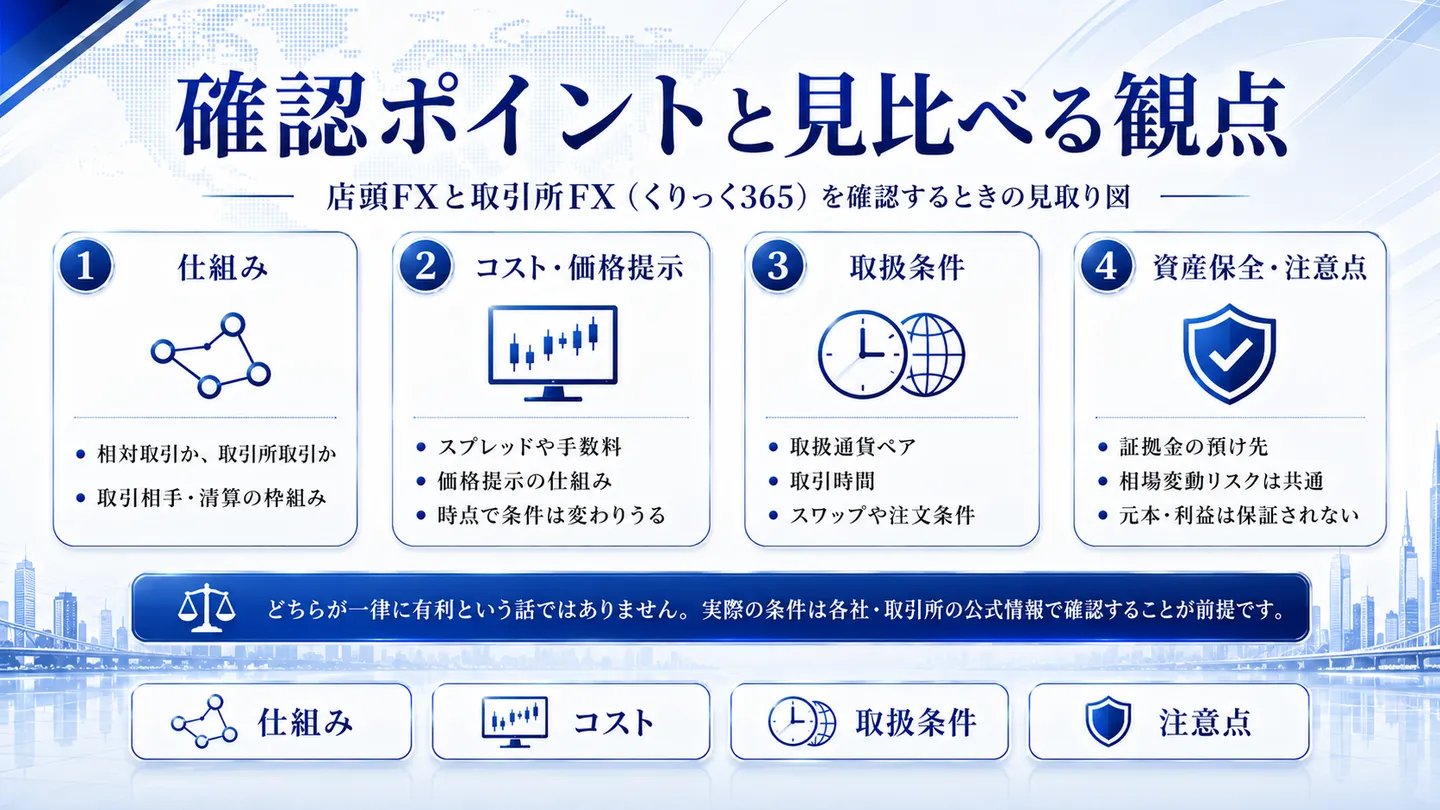
Over-the-counter FX and exchange-traded FX (くりっく365) are both FX (foreign exchange margin trading), yet there are institutional differences in how they work. Over-the-counter FX is a bilateral transaction (相対取引, aitai torihiki) between the customer and the FX company: the counterparty to the transaction is the FX company itself, and the terms of trading are determined by each company at its own discretion. Exchange-traded FX (くりっく365) is trading in a product listed on the Tokyo Financial Exchange, conducted through an FX company that is a trading participant, and the mechanisms for quoting prices and for where the margin is deposited differ from over-the-counter FX. On the other hand, the tax treatment is the same for both, and the National Tax Agency explains that the tax treatment is the same in either case, over the counter or on the exchange.
As for the protection of customer assets, there is a framework in both — a money trust with a trust bank or similar institution in over-the-counter FX, and deposit with the exchange and segregated management in exchange-traded FX — but where the assets are deposited and the mechanism differ. These protective frameworks exist, however, in preparation for the failure of an operator, and are not something that prevents losses arising from market movements themselves. As the Financial Services Agency explains, the point that FX, both over the counter and on the exchange, is trading in which losses exceeding the margin may arise is a premise common to both. Because terms such as the currency pairs handled, the fees and the spread differ by company, by exchange and by point in time, the premise when checking actual terms is that they are confirmed in the official information of each company and of the exchange, and in official information from bodies such as the National Tax Agency and the FFAJ.
Official information referred to
- National Tax Agency, 「No.1521 外国為替証拠金取引(FX)の課税関係」 (https://www.nta.go.jp/taxes/shiraberu/taxanswer/shotoku/1521.htm)
- The Financial Futures Association of Japan (一般社団法人 金融先物取引業協会), 「取引所取引と店頭取引について(学ぼう!FX)」 (https://www.ffaj.or.jp/learning/?p=29)
- The Financial Futures Association of Japan (一般社団法人 金融先物取引業協会), 「区分管理方法の信託一本化」 (https://www.ffaj.or.jp/regulation/trust/)
- Tokyo Financial Exchange Inc. (TFX), 「取引所為替証拠金取引 くりっく365(個人のお客様へのご案内)」 (https://www.tfx.co.jp/retail/click365.html)
- Tokyo Financial Exchange Inc. (TFX), 「個人のお客様向け清算決済業務詳細」 (https://www.tfx.co.jp/retail/clearing.html)
- くりっく365 (Tokyo Financial Exchange Inc.) official website (https://www.click365.jp/about_fx/about_fx04.html)
- Financial Services Agency, 「いわゆる外国為替証拠金取引について」 (https://www.fsa.go.jp/ordinary/iwagai/)
This article has been prepared on the basis of official information confirmed as at 8 June 2026. Because terms such as the currency pairs handled, the fees and the spread differ by company, by exchange and by point in time, please confirm the actual terms in the official information of each company and of the exchange, and in the official information listed above.
Always check the latest trading conditions, fees and campaigns on each company’s official site. The information on this page is as at the time it was written.