
How FX swap points work and how to check them
FX (foreign exchange margin trading, 外国為替証拠金取引) brings up the term “swap point”, but what sort of mechanism is it? It is a term for which the image of “something received for holding a position” tends to come first, but in reality it can be a receipt in some cases and a payment in others. This article organises how swap points work and how to view them when checking by company and by currency pair, with the aim of handing the reader a way of checking matters for themselves.
One premise comes first. This article does not deal with specific figures for swap points. Swap points differ by company, by currency pair and by point in time, and they fluctuate from day to day, so the most accurate and current information needs to be confirmed in each company’s official information. What this article presents is a framework: what a swap point is, and from which viewpoints it can be checked.
What a swap point is
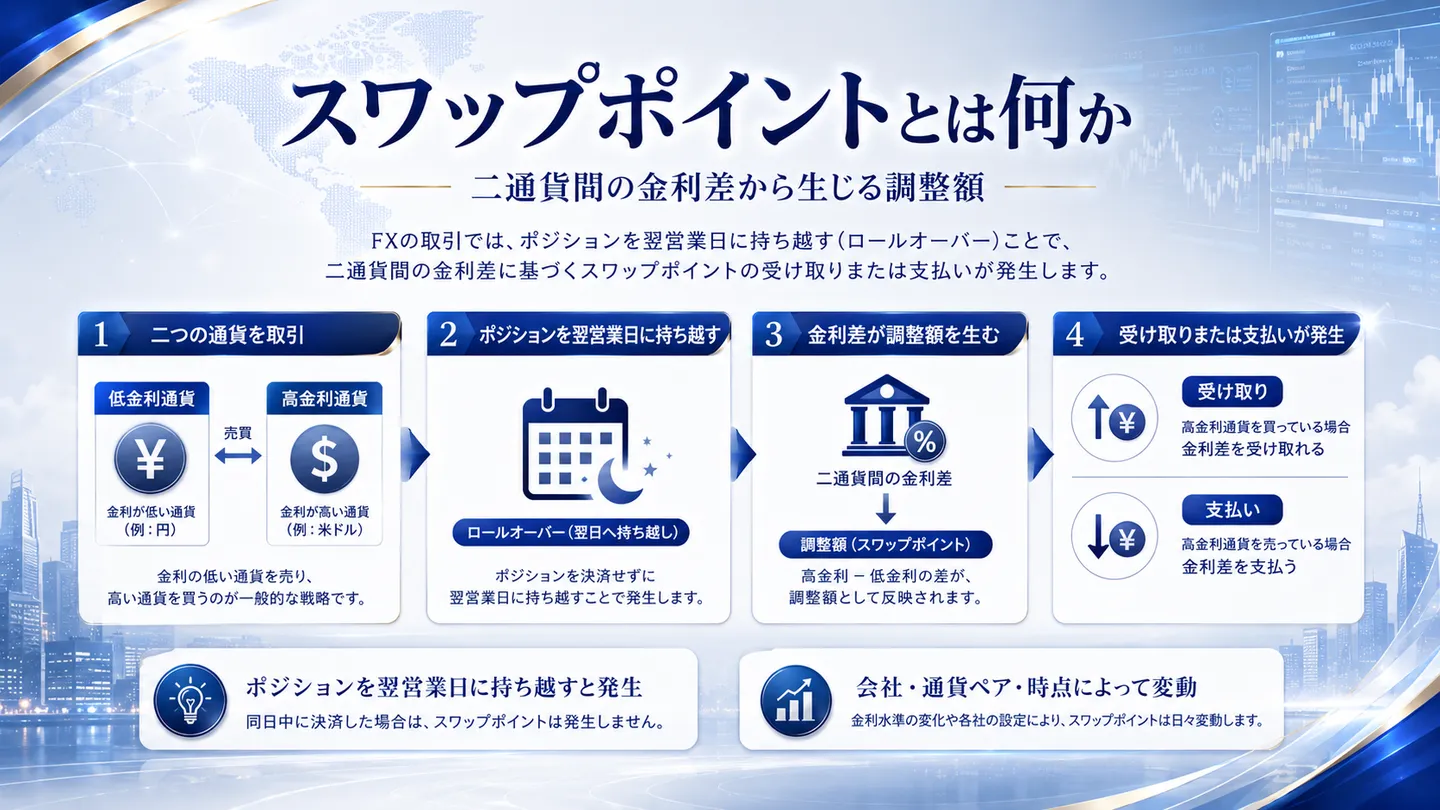
A swap point is an adjustment amount arising from the interest rate differential between the two currencies being traded. It arises when a position is carried over to the next business day (when it is rolled over).
The core point here is that swap points run in both directions: receipt and payment. In the direction of buying a high interest rate currency and selling a low interest rate currency, a swap point may be received, while in the opposite direction (buying a low interest rate currency and selling a high interest rate currency), a swap point may be paid. In other words, it is not something that is “always received”; receipt and payment are reversed according to the direction of the position one holds.
Also, a swap point does not necessarily reflect the difference in the two countries’ policy interest rates uniformly and as it stands. It differs according to conditions in the short-term interest rate market and the settings of each company, among other factors. It needs to be understood as something that differs by company, by currency pair and by point in time, and that fluctuates from day to day.
Organising how to view when checking
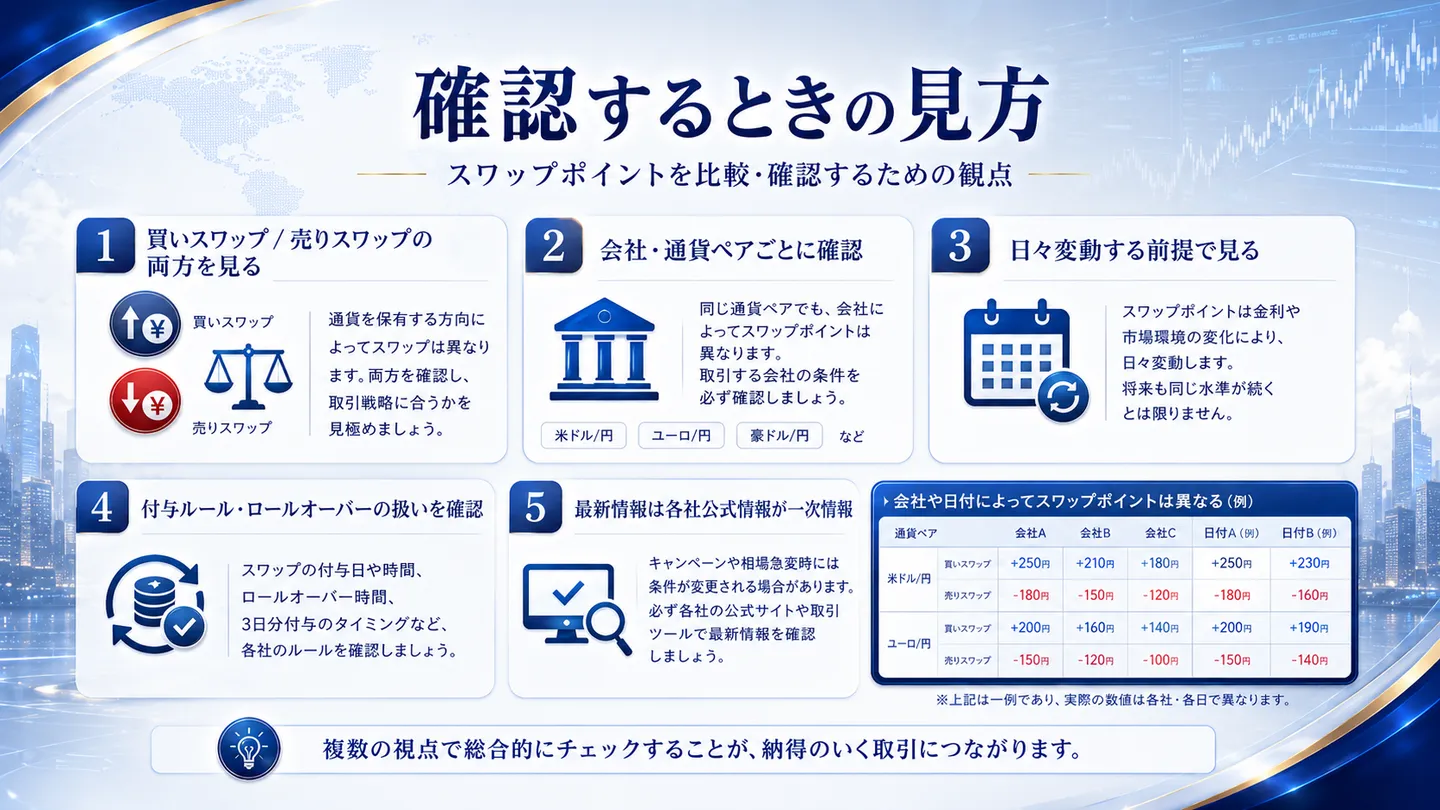
The following sets out, in order, the viewpoints that are often looked at when checking swap points.
Checking both the receiving side and the paying side
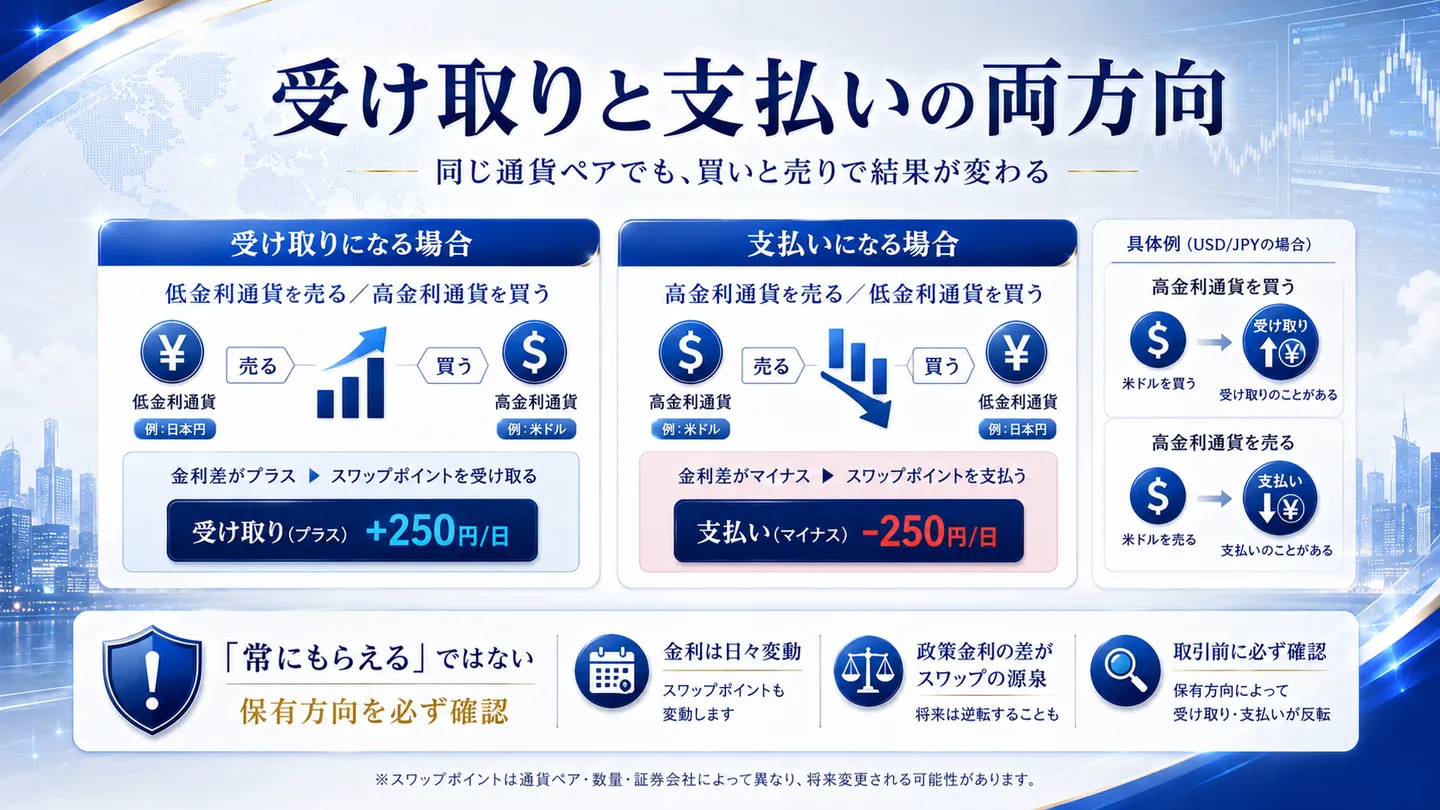
Even for the same currency pair, the “swap on a buy” and the “swap on a sell” are separate figures. Because whether it becomes a receipt or a payment changes according to the direction of the position one intends to hold, there is a viewpoint that checks the swap corresponding to one’s own direction.
Rather than viewing matters one-sidedly as “the swap on this currency pair is high”, it may be desirable to check at the same time which direction is being spoken of.
Viewing them on the premise that they fluctuate
Swap points increase and decrease according to interest rate conditions in each country (movements in monetary policy). Something that has been received up to now may turn into a payment as a result of a change in interest rate conditions.
For that reason, they need to be viewed on the premise that past figures will not necessarily continue into the future. Looking only at the swap point at one point in time and thinking that the same level will continue in the future may not be appropriate.
Each company’s official information is the primary source
The specific figures for swap points, and the rules for crediting them (such as the treatment of the Saturday and Sunday portions, or the treatment whereby they are credited together on a particular day of the week), differ by company. Because the information each company officially discloses is the primary source for these, confirming them in the official information of the company one is considering using is a premise.
Viewing the long-term holding context with care
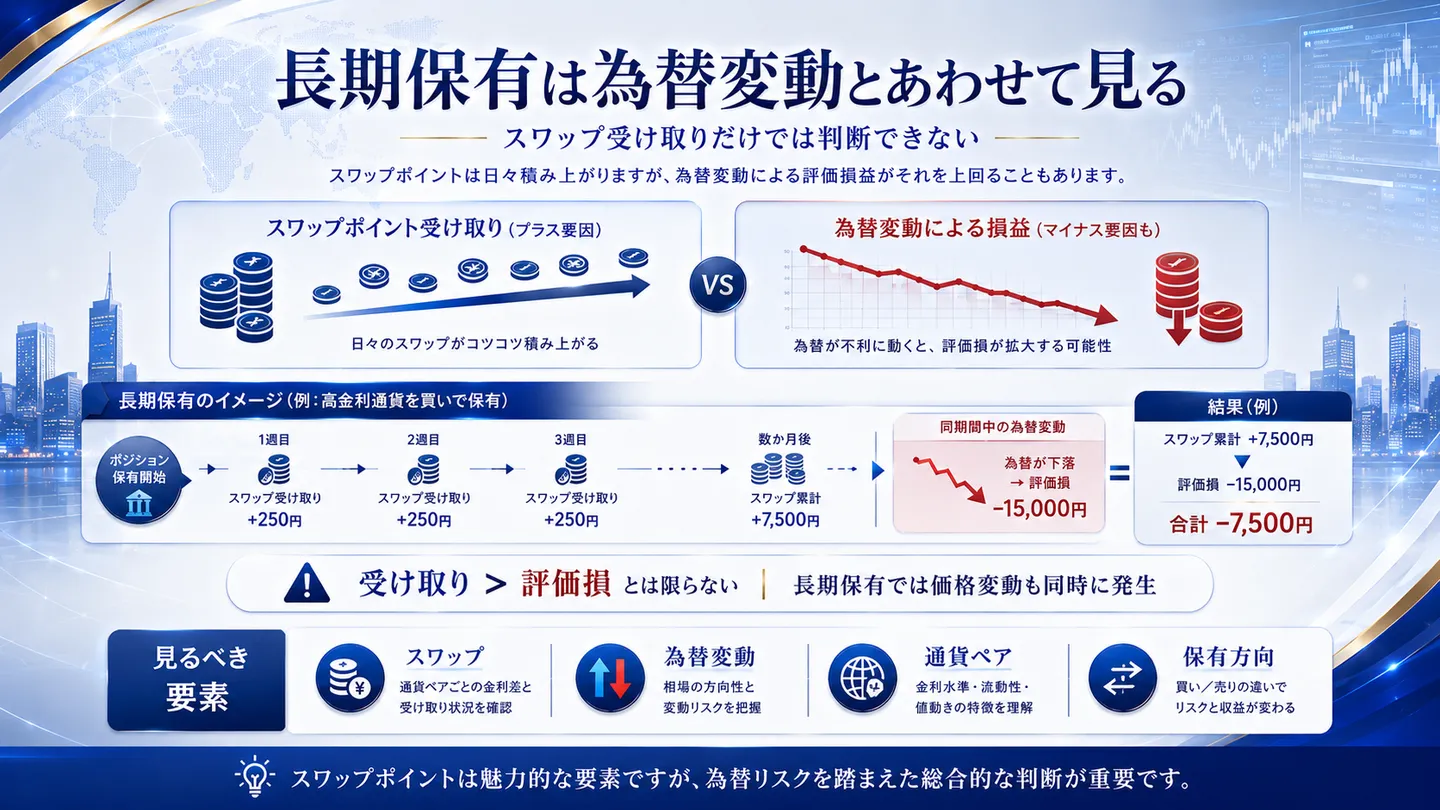
The idea of holding a particular currency for a long period with swap points as the aim is sometimes presented. This point, however, needs to be viewed with care.
While a position is held, profit and loss arising from exchange rate movement also arises at the same time. Where the exchange rate moves in an unfavourable direction, that loss may exceed the swap points received. Rather than focusing only on the receipt of swap points and thinking that “holding it will make it grow”, a viewpoint that views it together with the profit and loss arising from exchange rate movement may be regarded as indispensable.
Organising the terms and the risks
The main terms that have appeared so far are organised below.
- Interest rate differential: the difference between the interest rates on each of the two currencies being traded. A swap point is positioned as an adjustment amount arising from this difference.
- Rollover: carrying a position over to the next business day. A swap point arises at this time.
Also, not only do swap points run in both directions of receipt and payment, but it needs to be kept in mind as a premise that FX itself carries risk accompanying market fluctuation. FX is a form of trading in which losses exceeding the margin deposited may arise, and profit and loss change according to the movement of the market and the direction of the position one holds (buy or sell). Even in a direction in which swap points can be received, the possibility of a loss arising from exchange rate movement remains.
Points to check

Finally, the points worth bearing in mind when checking swap points are summarised below.
- A swap point is an adjustment amount arising from the interest rate differential between two currencies, and it runs in both directions of receipt and payment.
- Even for the same currency pair, the swap figures are separate for the buy direction and the sell direction.
- They fluctuate according to interest rate conditions, and something that has been received may turn into a payment.
- Because specific figures and the rules for crediting them differ by company, they are confirmed in each company’s official information.
- Even where long-term holding is being considered, it is viewed together with the profit and loss arising from exchange rate movement.
Common questions to check
Are swap points always received?
No. A swap point is an adjustment amount arising from the interest rate differential between two currencies, and depending on the direction of the position one holds, there are cases in which it becomes a receipt and cases in which it becomes a payment. In the direction of buying a high interest rate currency it may be received, while in the opposite direction it may be paid. Viewing it as something that is “always received” may not be appropriate.
If I buy a high interest rate currency, will swap points make my funds grow?
In the direction of buying a high interest rate currency, swap points may be received. While a position is held, however, profit and loss arising from exchange rate movement also arises at the same time, and where the exchange rate moves unfavourably, that loss may exceed the swap points received. Rather than looking only at the receipt of swap points and thinking that funds will “grow”, they may need to be viewed together with the profit and loss arising from exchange rate movement.
Can swap points become negative?
Yes. Swap points fluctuate according to interest rate conditions in each country, and something that has been received up to now may turn into a payment. It may be desirable to view them on the premise that past figures will not necessarily continue into the future.
Where can the figures for swap points be confirmed?
For the specific figures for swap points and the rules for crediting them, the information each company officially discloses is the primary source. Because they differ by company, by currency pair and by point in time, this article does not deal with specific figures. Please confirm them in the official information of the company you are considering using.
In closing
A swap point is a term for which the image of “something received” tends to come first, but in reality it runs in both directions of receipt and payment, and it fluctuates according to interest rate conditions. The way of viewing set out in this article is a clue for checking swap points oneself.
Specific figures, the latest conditions, and the details of the risks accompanying trading are premised on being confirmed in each company’s official information, or in information published by public bodies such as the Financial Services Agency and The Financial Futures Association of Japan. Any final decision on opening an account or on trading should be made by the reader after confirming official information for themselves.
For costs and risks other than swap points, and for the overall picture when comparing companies, the following articles may also be of use.
- What an FX spread is and how to view it when comparing
- Risks of FX trading and points worth checking
- Points to look at when comparing FX companies
Always check the latest trading conditions, fees and campaigns on each company’s official site. The information on this page is as at the time it was written.