
The basics of FX taxation and the Japanese tax return (separate self-assessment taxation, offsetting of gains and losses, and loss carry-forward)
When a profit or a loss arises in FX (foreign exchange margin trading, 外国為替証拠金取引), how tax applies and whether a Japanese tax return (確定申告) is needed are points that most people wonder about at some stage. This article organises the tax treatment and the tax return procedures that apply to FX trading in Japan, on the basis of information published by the National Tax Agency. Note that this article is a general explanation of the tax rules; it is neither tax advice nor investment advice. It does not indicate that anything saves tax or is advantageous, and rules such as tax rates, the requirements for deductions and whether a return is required may change through amendments to the law. The premise is that the calculation of a specific amount of tax, and the treatment of an individual case, must always be confirmed with the tax office (税務署), a tax accountant (税理士), or the latest information from the National Tax Agency.
A short answer to the question comes first. Profit or loss arising from 差金等決済 (settlement by payment of differences) in FX conducted in Japan — both over-the-counter FX (店頭FX) and exchange-traded FX (取引所FX) — is treated separately from other income such as salary, as 先物取引に係る雑所得等 (miscellaneous income and the like arising from futures transactions), and is subject to separate self-assessment taxation (申告分離課税). The tax rate is flat regardless of the size of the profit: 20.315% in total, being 15% income tax (所得税), 0.315% 復興特別所得税 (the special income tax for reconstruction) and 5% 住民税 (the local inhabitant tax) combined. Offsetting of gains and losses (損益通算) is possible within the same category of 先物取引に係る雑所得等, and a loss that cannot be fully absorbed may, where certain requirements are met, in some cases be carried forward and deducted within the three years from the following year onwards. The sections below organise this framework one step at a time, covering both the case where a profit arises and the case where a loss arises.
| Item | Details |
|---|---|
| Income category | 先物取引に係る雑所得等 (classified separately from other income) |
| Method of taxation | Separate self-assessment taxation (申告分離課税) |
| Tax rate (total) | A flat 20.315% |
| Offsetting of gains and losses | Can be offset against other 先物取引に係る雑所得等 / cannot be offset against other income such as salary |
| Loss carry-forward | Where certain requirements are met, a loss may in some cases be carried forward and deducted within the three years from the following year onwards |
Note: the table above organises the rules as confirmed at the present time, and the rules may change through amendments to the law. In addition, because the calculation of a specific amount of tax and whether a return is required differ according to each person’s circumstances, the premise is that the actual treatment is confirmed with the tax office, a tax accountant, or the latest information from the National Tax Agency.
Which income category FX profits fall into — 先物取引に係る雑所得等
The National Tax Agency explains that a gain arising from 差金等決済 in FX conducted in Japan is treated separately from other income, such as 給与所得 (employment income), as 先物取引に係る雑所得等. This income category is stated to include, besides FX, 差金等決済 in 商品先物取引 (commodity futures transactions), the settlement of 金融商品先物取引等 (futures transactions in financial instruments and the like) such as 有価証券先物取引 (securities futures transactions) and 通貨等先物取引 (futures transactions in currencies and the like), and 差金等決済 of covered warrants (National Tax Agency No.1521 / No.1522).
This 先物取引に係る雑所得等 is subject to separate self-assessment taxation. Separate self-assessment taxation is a method of taxation under which the income concerned is not aggregated with other income such as employment income, but is separated out so that the tax amount is calculated on it alone and declared in a tax return. Unlike aggregate taxation (総合課税), where progressive rates mean that the rate rises as income grows larger, separate self-assessment taxation can be organised as a method in which the rate is constant regardless of the size of the profit.
Note that it is said that, even within FX, the tax treatment may differ depending on the operator used and on the classification of the transaction. This article organises information published by the National Tax Agency on the premise of domestic FX conducted through a financial instruments business operator (金融商品取引業者) in Japan. Because which classification one’s own trading falls into, and which method of taxation applies, differ according to each person’s circumstances, the premise is that the specific treatment is confirmed with the tax office, a tax accountant, or the National Tax Agency.
How the tax rate works — a flat 20.315% and its components
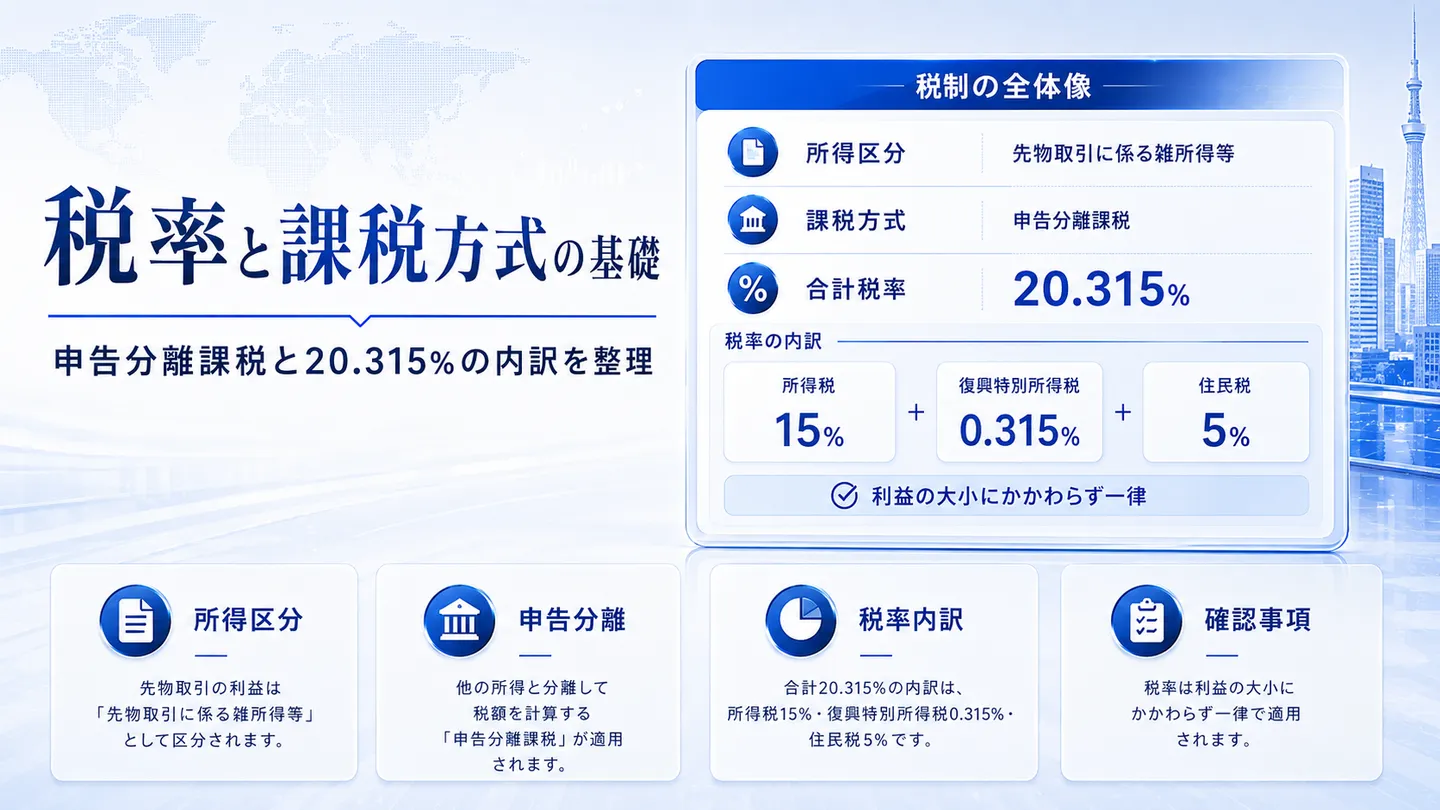
The tax rate on 先物取引に係る雑所得等 from domestic FX is stated to be separate self-assessment taxation at 15% income tax (with, in addition, 5% 地方税, local tax) (National Tax Agency No.1521 / No.1522). Adding 復興特別所得税 to this gives a flat total of 20.315% (for 復興特別所得税, see National Tax Agency No.2260). The components are organised as follows.
| Component | Tax rate | Notes |
|---|---|---|
| Income tax | 15% | Separate self-assessment taxation |
| 復興特別所得税 | 0.315% | 15% income tax × 2.1%. A time-limited measure running until 令和19年 (2037) |
| 住民税 (local inhabitant tax, 地方税) | 5% | ― |
| Total | 20.315% | Flat, regardless of the size of the profit (in the case of domestic FX) |
復興特別所得税 is stated to be declared and paid together with income tax for each year from 平成25年 (2013) through to 令和19年 (2037), and to be, as a general rule, 2.1% of the 基準所得税額 (the base income tax amount) for the year concerned (National Tax Agency No.2260). In the FX tax rate, 2.1% is added on top of the 15% income tax, and the figure of 15% × 2.1% = 0.315% is what is derived by that calculation.
What is worth grasping here is, first, that this 20.315% is flat regardless of the size of the profit, and second, that 復興特別所得税 is a time-limited measure. The ratio of 0.315% is not something that remains unchanged indefinitely: 復興特別所得税 is a measure for which a period has been fixed, and the tax rates and the rules themselves may change through amendments to the law. The premise is that specific rates and amounts are confirmed, for the year in question, with the National Tax Agency or the tax office. Note that this article does not give a worked example of a specific tax calculation (how much tax arises on a given amount of profit), because the premises differ according to each person’s circumstances.
When a loss arises — offsetting of gains and losses, and loss carry-forward
FX taxation involves not only the taxation of profits, but also mechanisms for the case where a loss arises. The National Tax Agency explains that a loss on FX can be offset against amounts of other 先物取引に係る雑所得等, while on the other hand it cannot be offset against income outside that category, such as employment income (National Tax Agency No.1521 / No.1522). In other words, the organising point is that the scope within which gains and losses can be offset is limited to the same category of 先物取引に係る雑所得等.
As for the amount of a loss that still cannot be fully absorbed after offsetting within the year, it is stated that it may in some cases be deducted from the amount of 先物取引に係る雑所得等 for each of the three years from the following year onwards, where certain requirements are met. This is the system known as loss carry-forward (繰越控除), in full 先物取引の差金等決済に係る損失の繰越控除 (the carry-forward of losses on 差金等決済 in futures transactions) (National Tax Agency No.1521 / No.1522 / No.1523). Where (viewed from the year in which the deduction is taken) there are losses from more than one year within the three preceding years, the deduction is stated to be taken in order, starting from the oldest year.
There are requirements for receiving this loss carry-forward. The National Tax Agency explains that, for the year in which the loss arose, the tax return form (確定申告書) must be filed together with the prescribed appended table and statement of calculation (「申告書付表(先物取引に係る繰越損失用)」 and 「先物取引に係る雑所得等の金額の計算明細書」), and that tax return forms must thereafter continue to be filed without a break (National Tax Agency No.1523).
What calls for care here is that loss carry-forward and the offsetting of gains and losses are not mechanisms that can always be used; they are systems that apply where certain requirements are met. This article does not recommend them as a means of reducing tax, nor does it encourage any particular transaction. Where a profit arises there is taxation, and where a loss arises these mechanisms exist — both sides are organised here as a matter of the rules. Because whether the requirements are met, and how they apply in a specific case, differ according to each person’s circumstances, the premise is that this is confirmed with the tax office or a tax accountant.
This article organises the general rules on FX taxation on the basis of information published by the National Tax Agency. It is not tax advice or investment advice. Rules such as tax rates, the requirements for deductions and whether a return is required may change through amendments to the law, and the relationship with 扶養 (dependant status) and with other income, whether a return is required, and the calculation of a specific amount of tax all differ according to each person's circumstances. The premise is that the actual treatment must always be confirmed with the tax office, a tax accountant, or the latest information from the National Tax Agency.
The basics of the Japanese tax return — the documents needed and whether a return is required
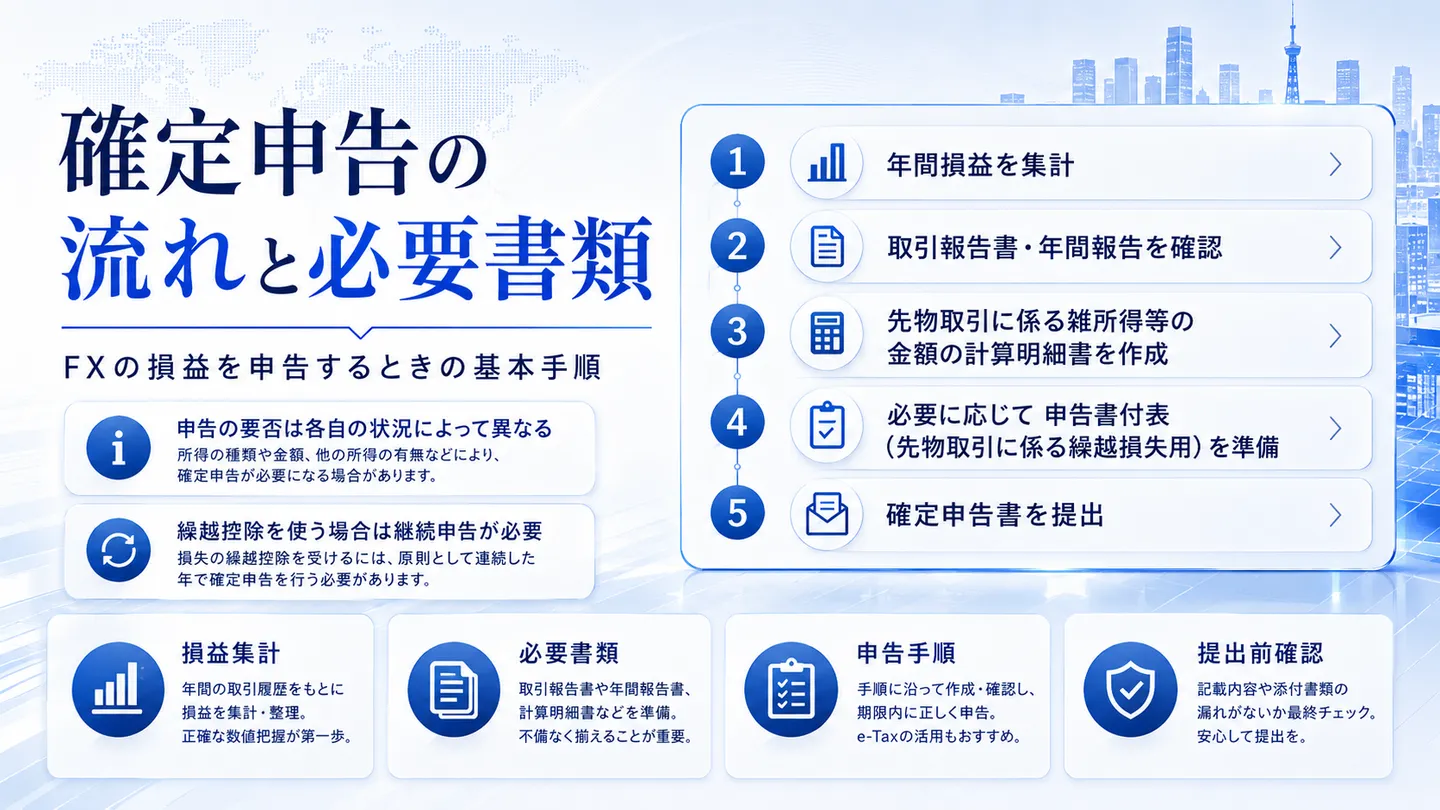
Where separate self-assessment taxation is applied to FX as 先物取引に係る雑所得等, or where the carry-forward of losses is claimed, it is stated that prescribed documents must be attached to the tax return. The National Tax Agency’s explanation lists, as requirements, attaching 「先物取引に係る雑所得等の金額の計算明細書」 when filing the return, and, where loss carry-forward is claimed, additionally submitting 「申告書付表(先物取引に係る繰越損失用)」 (National Tax Agency No.1522 / No.1523).
Whether a return is required differs according to each person’s circumstances. In general, a Japanese tax return is stated to be required where, for example, a person receives salary from one place, the whole of that salary is subject to withholding at source (源泉徴収), and the total amount of income other than 給与所得 (employment income) and 退職所得 (retirement income) exceeds 200,000 yen (20万円) (National Tax Agency No.1900). However, this treatment carries many premises and exceptions: whether one is an earner of employment income, whether the 年末調整 (year-end adjustment) has been completed, the fact that 住民税 may in some cases require a separate return, and so on. For that reason, the premise is that whether one needs to file is confirmed with the National Tax Agency or the tax office, rather than being concluded for oneself.
Where a system spanning several years, such as loss carry-forward, is used, care is also needed on the point that filing tax return forms without a break is stated to be a requirement (National Tax Agency No.1523). Because whether a return is required, the documents needed and the details of the procedures change with the rules for the year concerned and with each person’s circumstances, the premise is that the latest forms and requirements are confirmed with the National Tax Agency or the tax office.
FX gains and losses involve mechanisms on both sides: taxation where a profit arises, and the offsetting of gains and losses and loss carry-forward where a loss arises. This article does not recommend either one of them, nor does it indicate that tax can be saved or that anything is advantageous. Using systems such as loss carry-forward involves requirements such as filing a tax return, and whether they apply depends on each person's circumstances. In the case of both profits and losses, the premise is that the treatment is confirmed in official information and with a professional.
Terms organised
The main terms covered in this article are organised below.
- 先物取引に係る雑所得等 (miscellaneous income and the like arising from futures transactions): the income category into which gains and losses from 差金等決済 in FX are classified. It is separated from other income and is subject to separate self-assessment taxation. Besides FX, the settlement of 商品先物取引, 有価証券先物取引, 通貨等先物取引 and the like is stated to be included.
- Separate self-assessment taxation (申告分離課税): a method of taxation in which the income concerned is not aggregated with other income such as employment income, but is separated out so that the tax amount is calculated on it alone and declared in a tax return. The point that the rate is constant regardless of the size of the profit is what differs from aggregate taxation with its progressive rates.
- Offsetting of gains and losses (損益通算): setting profits and losses against each other within a certain scope. A loss on FX can be offset against other 先物取引に係る雑所得等, but is stated not to be offsettable against income outside that category, such as salary.
- Loss carry-forward (繰越控除, 先物取引の差金等決済に係る損失の繰越控除): a system under which a loss that still cannot be fully absorbed after offsetting within the year may, where certain requirements are met, be deducted from the amount of 先物取引に係る雑所得等 for the three years from the following year onwards.
- 復興特別所得税 (the special income tax for reconstruction): a tax declared and paid together with income tax for each year from 平成25年 (2013) through to 令和19年 (2037). As a general rule it is 2.1% of the 基準所得税額, and in the FX tax rate it corresponds to 0.315% against the 15% income tax.
Frequently checked questions
What tax applies to FX profits?
A gain arising from 差金等決済 in FX conducted in Japan is stated to be subject to separate self-assessment taxation as 先物取引に係る雑所得等. The tax rate is a flat 20.315%, being 15% income tax, 0.315% 復興特別所得税 and 5% 住民税 combined (National Tax Agency No.1521 / No.1522). The rate does not change with the size of the profit, but because whether a return is required and the specific treatment differ according to each person’s circumstances, the premise is that this is confirmed with the tax office, a tax accountant, or the latest information from the National Tax Agency.
Are FX profits aggregated with other income such as salary?
Because they are stated to be subject to separate self-assessment taxation, the tax amount is calculated separately from other income such as salary. It can be organised as meaning that, unlike aggregate taxation, progressive rates are not applied after aggregation with other income (National Tax Agency No.1521 / No.1522). However, because the relationship with 扶養 (dependant status) and with other systems differs according to each person’s circumstances, the premise is that the specific treatment is confirmed with the tax office, a tax accountant, or the National Tax Agency.
If a loss arises in FX, can it be set off against tax on salary?
The National Tax Agency explains that a loss on FX can be offset against other 先物取引に係る雑所得等, but cannot be offset against income other than that, such as employment income (National Tax Agency No.1521 / No.1522). Because which income can be offset is determined by the category, please confirm the treatment in your own situation with the tax office or a tax accountant.
Can losses be carried forward to the following year and beyond?
A loss that still cannot be fully absorbed after offsetting is stated to be deductible in some cases, where certain requirements are met, from the amount of 先物取引に係る雑所得等 for each of the three years from the following year onwards. For it to apply, the requirements are stated to be that tax return forms are filed without a break from the year in which the loss arose, and that the prescribed appended table and statement of calculation are attached (National Tax Agency No.1521 / No.1522 / No.1523). Because whether the requirements are met depends on each person’s circumstances, the premise is that this is confirmed with the tax office or a tax accountant.
Until when does 復興特別所得税 apply?
復興特別所得税 is stated to be declared and paid together with income tax for each year from 平成25年 (2013) through to 令和19年 (2037). As a general rule it is 2.1% of the 基準所得税額 for the year concerned, and in the FX tax rate it corresponds to 0.315% against the 15% income tax (National Tax Agency No.2260). Because it is a time-limited measure for which a period has been fixed, and the rules may change through amendments to the law, the premise is that the latest information is confirmed.
Summary
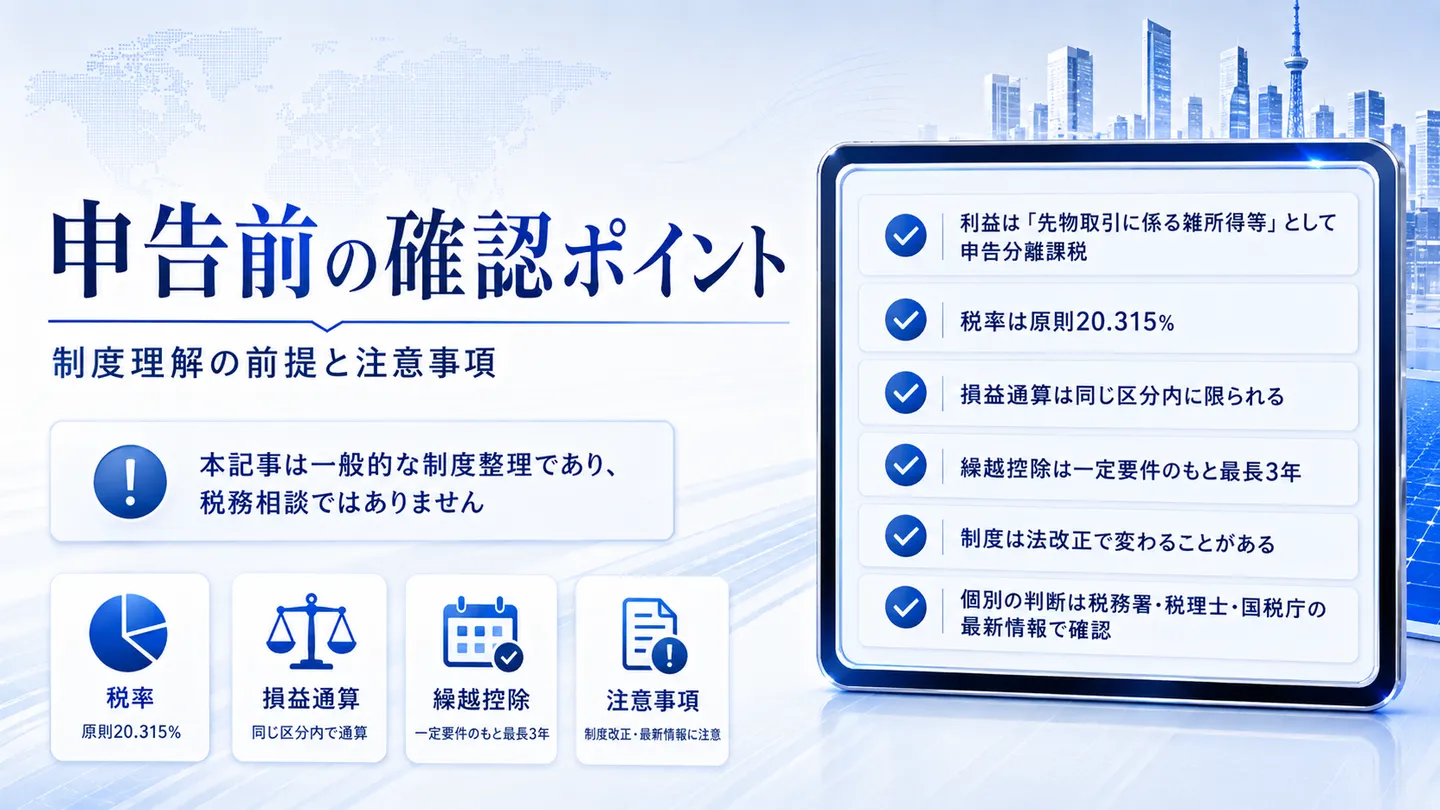
Profit or loss arising from 差金等決済 in FX conducted in Japan (both over-the-counter FX and exchange-traded FX) is stated to be treated separately from other income such as salary, as 先物取引に係る雑所得等, and to be subject to separate self-assessment taxation. The tax rate is flat regardless of the size of the profit: 20.315% in total, being 15% income tax, 0.315% 復興特別所得税 and 5% 住民税 combined. Of these, 復興特別所得税 is stated to be a time-limited measure running until 令和19年 (2037). Where a loss arises, there are the mechanisms of offsetting gains and losses within the same category of 先物取引に係る雑所得等, and of loss carry-forward over the three years from the following year onwards where certain requirements are met; for loss carry-forward to be received, requirements such as filing tax return forms without a break are stated to apply. FX taxation has these two sides — the taxation of profits, and the offsetting and carrying forward of losses — and this article neither recommends either one of them nor indicates that tax can be saved or that anything is advantageous. Rules such as tax rates, the requirements for deductions and whether a return is required may change through amendments to the law, and the relationship with 扶養 and with other income, as well as the calculation of a specific amount of tax, differ according to each person’s circumstances. Because this article is a general explanation of the rules and is neither tax advice nor investment advice, please always confirm the actual treatment with the tax office, a tax accountant, or the latest information from the National Tax Agency.
Note that the mechanism by which FX is divided into over-the-counter trading (店頭FX) and exchange trading (取引所FX) is organised separately in The difference between over-the-counter and exchange-traded FX. The basic way of thinking about the risks of trading is also organised in Risks of FX trading and points worth checking.
Official information referred to
- National Tax Agency, 「No.1521 外国為替証拠金取引(FX)の課税関係」 (https://www.nta.go.jp/taxes/shiraberu/taxanswer/shotoku/1521.htm)
- National Tax Agency, 「No.1522 先物取引に係る雑所得等の課税の特例」 (https://www.nta.go.jp/taxes/shiraberu/taxanswer/shotoku/1522.htm)
- National Tax Agency, 「No.1523 先物取引の差金等決済に係る損失の繰越控除」 (https://www.nta.go.jp/taxes/shiraberu/taxanswer/shotoku/1523.htm)
- National Tax Agency, 「No.2260 所得税の税率」 (https://www.nta.go.jp/taxes/shiraberu/taxanswer/shotoku/2260.htm)
- National Tax Agency, 「No.1900 給与所得者で確定申告が必要な人」 (https://www.nta.go.jp/taxes/shiraberu/taxanswer/shotoku/1900.htm)
This article has been prepared on the basis of official information confirmed as at 8 June 2026. Rules such as tax rates, the requirements for deductions and whether a return is required may change through amendments to the law, and the calculation of a specific amount of tax and the treatment of individual cases differ according to each person’s circumstances. Because this article is a general explanation of the tax rules and is neither tax advice nor investment advice, please always confirm the actual treatment with the latest information from the National Tax Agency, the tax office, or a tax accountant.
Always check the latest trading conditions, fees and campaigns on each company’s official site. The information on this page is as at the time it was written.