
The basics of regular instalment investing (dollar-cost averaging)
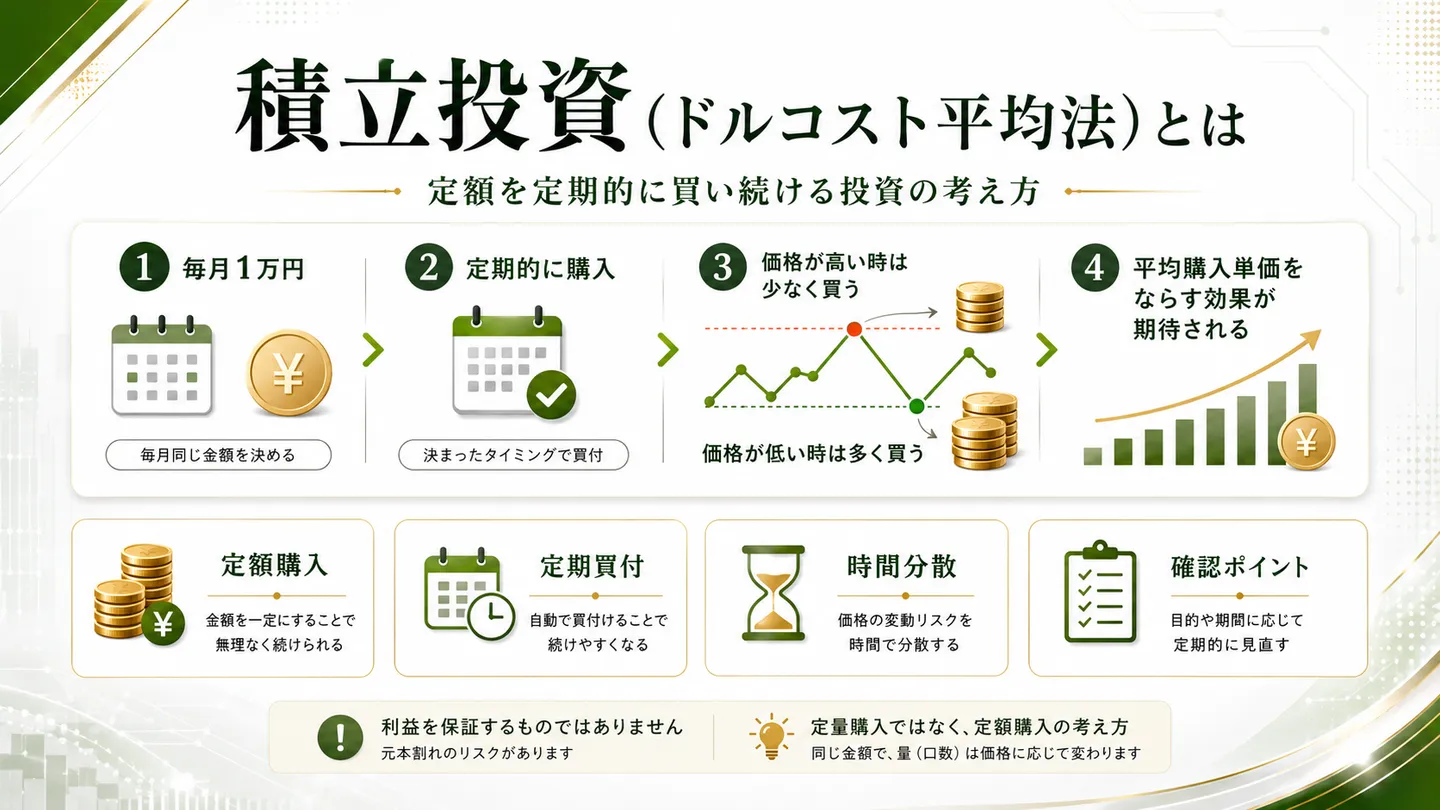
Regular instalment investing (積立投資), also called dollar-cost averaging (ドルコスト平均法), is a method of investing a predetermined amount of money, at regular intervals, on a continuing basis. Buying in the manner of “10,000 yen of an investment trust (投資信託) every month” falls under it. Because a product that moves in price is bought continuously for a fixed amount, less is bought when the price is high and more is bought when the price is low.
This way of buying does not, however, guarantee a profit, and it is not necessarily advantageous. If the price keeps falling, a loss may arise. This article organises how regular instalment investing works, together with its limits as well as its merits, neutrally and on the basis of official information from the Financial Services Agency (金融庁) and the 財務局 (the regional finance bureaus of the Ministry of Finance). It is intended to be read not as an answer to whether instalment buying is the better deal, but as an outline map for checking by what mechanism, and in which market phase, what happens.
One point to note: the regular instalment investing covered here is purely a matter of how to buy — a technique for dividing the timing of investment. It can be used inside the NISA scheme, but it is not the case that it can only be used there. The basics of investment trusts as a product, and the details of the NISA scheme, are organised in separate articles (please see “Articles to read next” at the end).
What regular instalment investing (dollar-cost averaging) is
Regular instalment investing is a method of investing a predetermined amount of money, at regular intervals, on a continuing basis. The common form is one in which the timing and the amount of the purchase are decided in advance — buying a fixed amount on a fixed day each month, for example — and the purchases are then made automatically.
This method is also called dollar-cost averaging (public bodies write the Japanese term with a middle dot, as 「ドル・コスト平均法」). What characterises it is that a product which moves in price is bought continuously for a fixed amount of money, regardless of the price at the time. The features generally cited for it are that there is no need to prepare a large sum at once, and that it can be started with small amounts.
Regular instalment investing (dollar-cost averaging) is a method of buying continuously for a fixed amount of money each time. It differs in its approach to buying from a method of buying a fixed number of units (口数), that is a fixed quantity, each time. This article is organised on the premise of the method of buying continuously for a fixed amount.
How the mechanism works (less when the price is high, more when it is low)
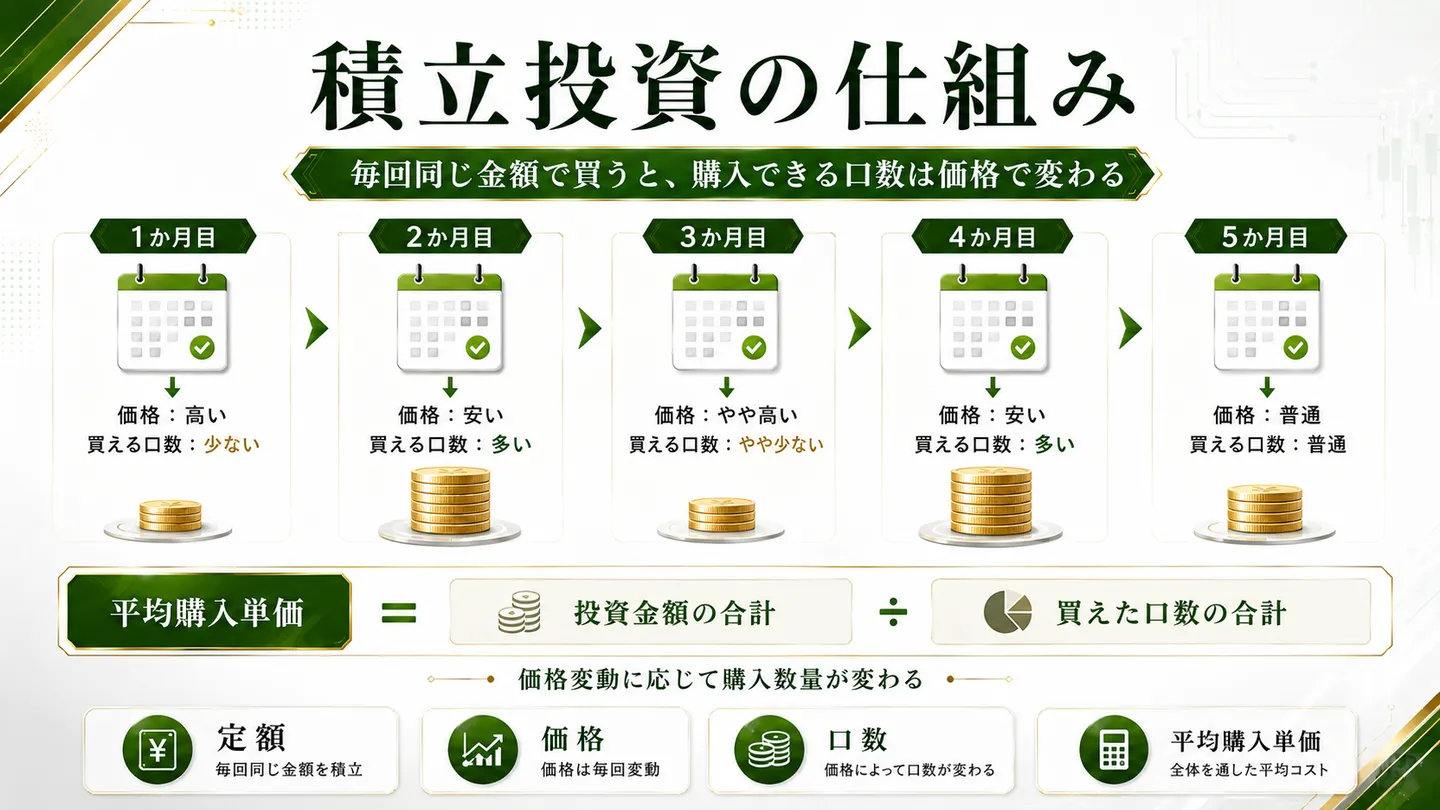
When a fixed amount is used for each purchase, the quantity purchased — the number of units (口数) — varies with the price at that time. When the price is high, fewer units can be bought; when the price is low, more units can be bought.
One aspect of this property is that it becomes easier to avoid concentrating purchases at a time when the price is high, or missing the chance to buy when the price is low. Official information from the Financial Services Agency and the 財務局 explains that this way of buying can be expected to have the effect of lowering the average purchase price.
The point to note here is that the wording goes no further than saying that this effect can be expected. It is not the case that the average purchase price will necessarily fall. In a phase in which the price keeps falling, the holdings also include the portion bought at a relatively high price, so even where the average purchase price falls, the valuation can still come to less than the amount invested — loss of principal. It is important to keep two things apart: the point that, as a matter of mechanism, one ends up buying less when the price is high and more when it is low, and the claim that a gain is therefore certain.
The average purchase price seen through numerical examples
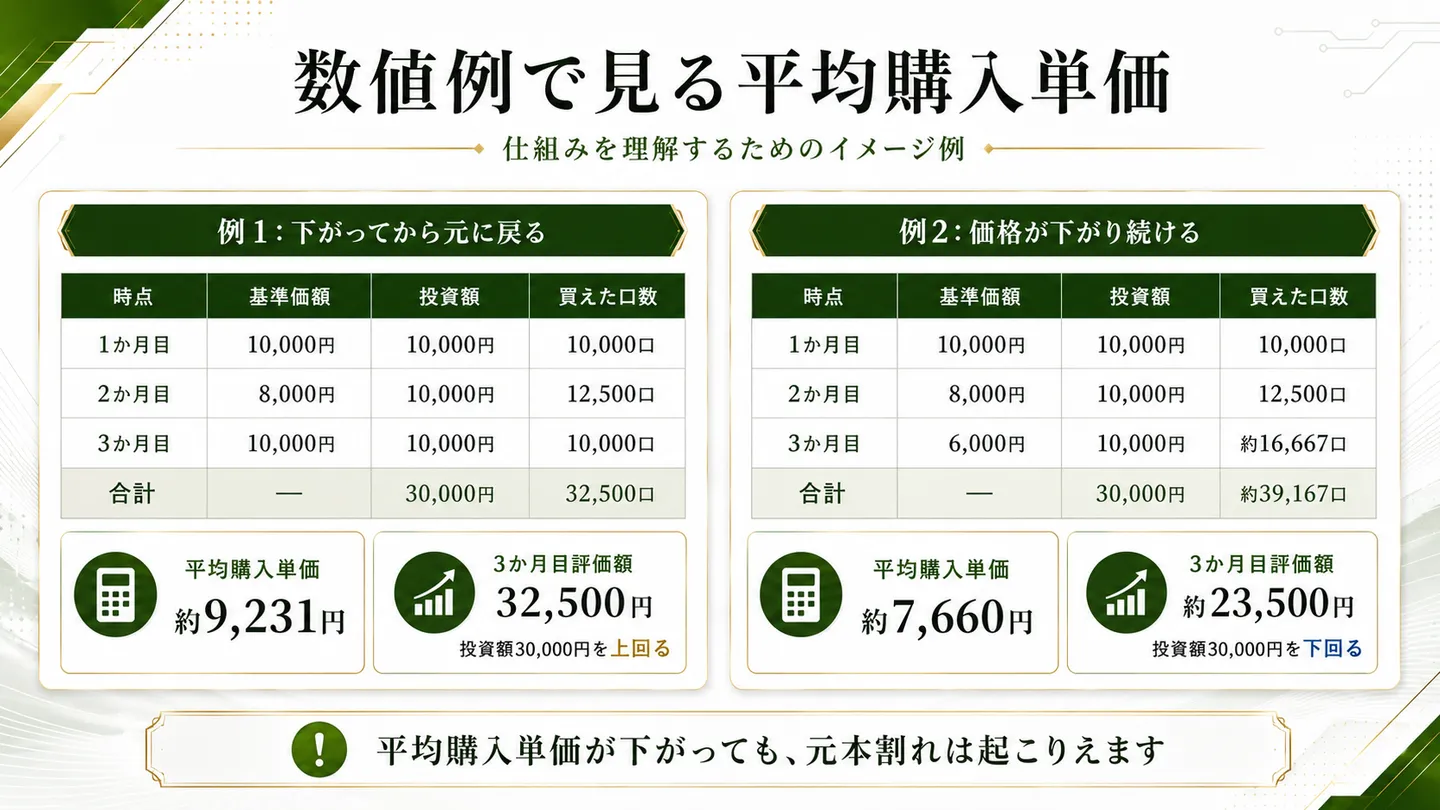
To get a feel for the mechanism, let us look at simple numerical examples. The following are calculation examples for buying the same investment trust continuously, 10,000 yen each month, over three months. They show how the number of units that can be bought and the average purchase price change according to how the net asset value (基準価額 — the price of an investment trust; here taken as the amount per 10,000 units) moves from month to month.
The figures below are an example prepared in order to show the approach to the calculation. They neither indicate future investment results nor suggest any particular outcome. Actual price movements will not follow them. Alongside a phase that looks advantageous, an example of a phase in which the price keeps falling is also shown.
The average purchase price is calculated as “the total amount invested ÷ the total number of units purchased” (here it is converted to an amount per 10,000 units for display).
Example 1: where the price falls and then returns to its original level
This is a case in which the net asset value moves 10,000 yen → 8,000 yen → 10,000 yen.
| Point in time | Net asset value (per 10,000 units) | Amount invested | Units purchased |
|---|---|---|---|
| Month 1 | 10,000 yen | 10,000 yen | 10,000 units |
| Month 2 | 8,000 yen | 10,000 yen | 12,500 units |
| Month 3 | 10,000 yen | 10,000 yen | 10,000 units |
| Total | — | 30,000 yen | 32,500 units |
In this case the average purchase price works out as “30,000 yen ÷ 32,500 units × 10,000 units”, that is approximately 9,231 yen per 10,000 units. Because more units could be bought when the price fell part-way through, the average purchase price is lower than the simple average of the monthly prices. Valued at the third month’s net asset value of 10,000 yen, the holdings come to 32,500 yen, which is more than the 30,000 yen invested.
Example 2: where the price keeps falling
Now let us look at a case in which the net asset value keeps falling: 10,000 yen → 8,000 yen → 6,000 yen.
| Point in time | Net asset value (per 10,000 units) | Amount invested | Units purchased |
|---|---|---|---|
| Month 1 | 10,000 yen | 10,000 yen | 10,000 units |
| Month 2 | 8,000 yen | 10,000 yen | 12,500 units |
| Month 3 | 6,000 yen | 10,000 yen | approx. 16,667 units |
| Total | — | 30,000 yen | approx. 39,167 units |
In this case the average purchase price is approximately 7,660 yen per 10,000 units. Because the price fell, even more units could be bought than in Example 1, and the average purchase price is lower as well. Valued at the third month’s net asset value of 6,000 yen, however, the holdings come to approximately 23,500 yen, which is less than the 30,000 yen invested. Even where the average purchase price falls, if the final price is lower still, the valuation comes to less than the amount invested and loss of principal arises.
What this example shows is that a fall in the average purchase price does not, in itself, mean that no loss is incurred. In a phase in which the price keeps falling, the valuation can decrease even where buying for a fixed amount continues.
Example 3: where the price keeps rising (a comparison with lump-sum investment)
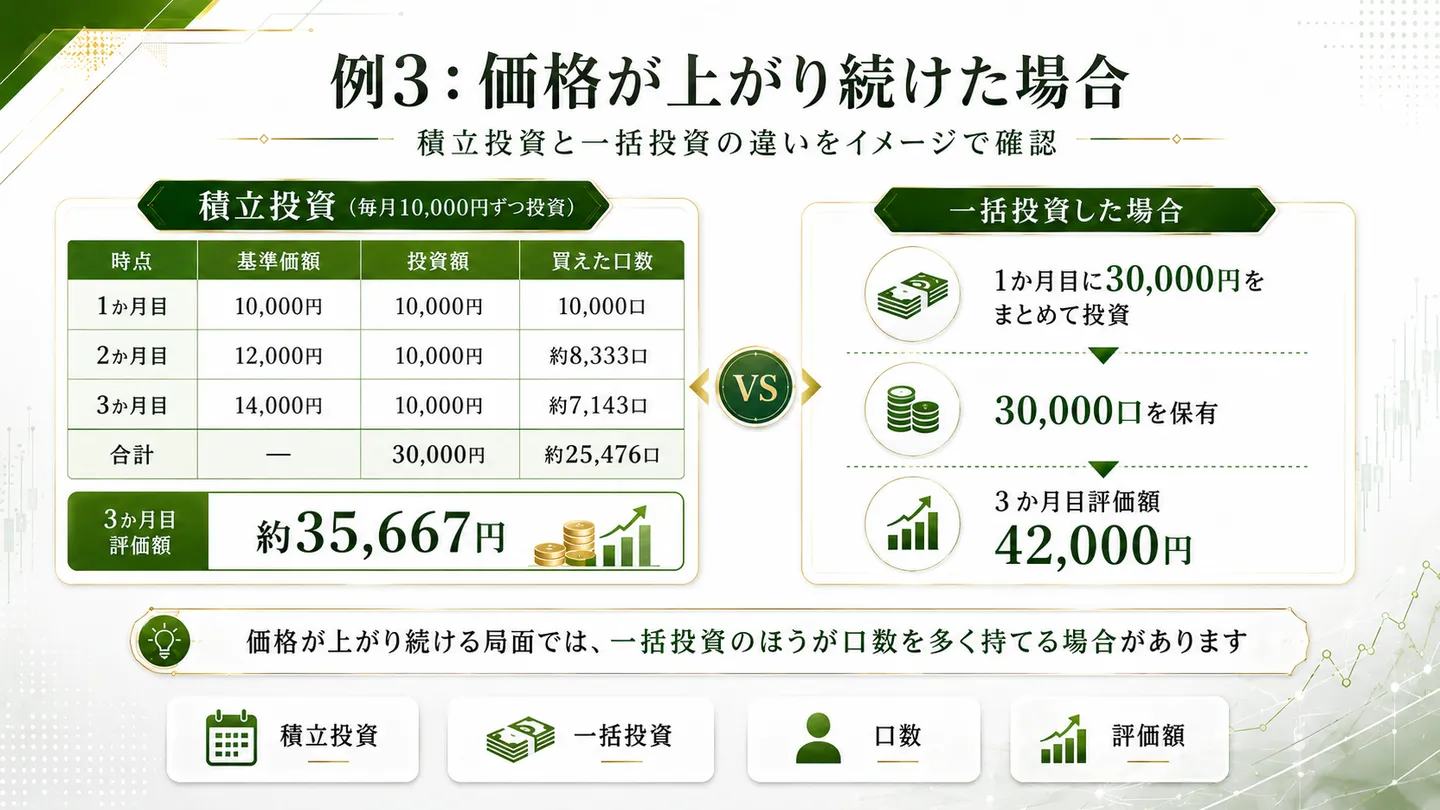
Conversely, this is a case in which the net asset value keeps rising: 10,000 yen → 12,000 yen → 14,000 yen. The higher the price rises, the fewer units can be bought.
| Point in time | Net asset value (per 10,000 units) | Amount invested | Units purchased |
|---|---|---|---|
| Month 1 | 10,000 yen | 10,000 yen | 10,000 units |
| Month 2 | 12,000 yen | 10,000 yen | approx. 8,333 units |
| Month 3 | 14,000 yen | 10,000 yen | approx. 7,143 units |
| Total | — | 30,000 yen | approx. 25,476 units |
In this case the total number of units purchased is approximately 25,476, and valued at the third month’s net asset value of 14,000 yen the holdings come to approximately 35,667 yen. If, instead, the whole 30,000 yen had been invested in the first month, 30,000 units could have been bought at 10,000 yen, so the valuation at the same third month would be 42,000 yen. In a phase in which the price kept rising, investing the whole sum at an earlier point turns out to have left the investor holding more units.
Thus, in a phase in which the price keeps rising, the method of buying continuously for a fixed amount may in some cases be at a disadvantage, in terms of the number of units, compared with the method of investing the whole sum at once. Which way of buying turned out to be advantageous is something that becomes clear only by looking at the price movement afterwards; it is not something that can be judged in advance, before buying.
Merits and limits
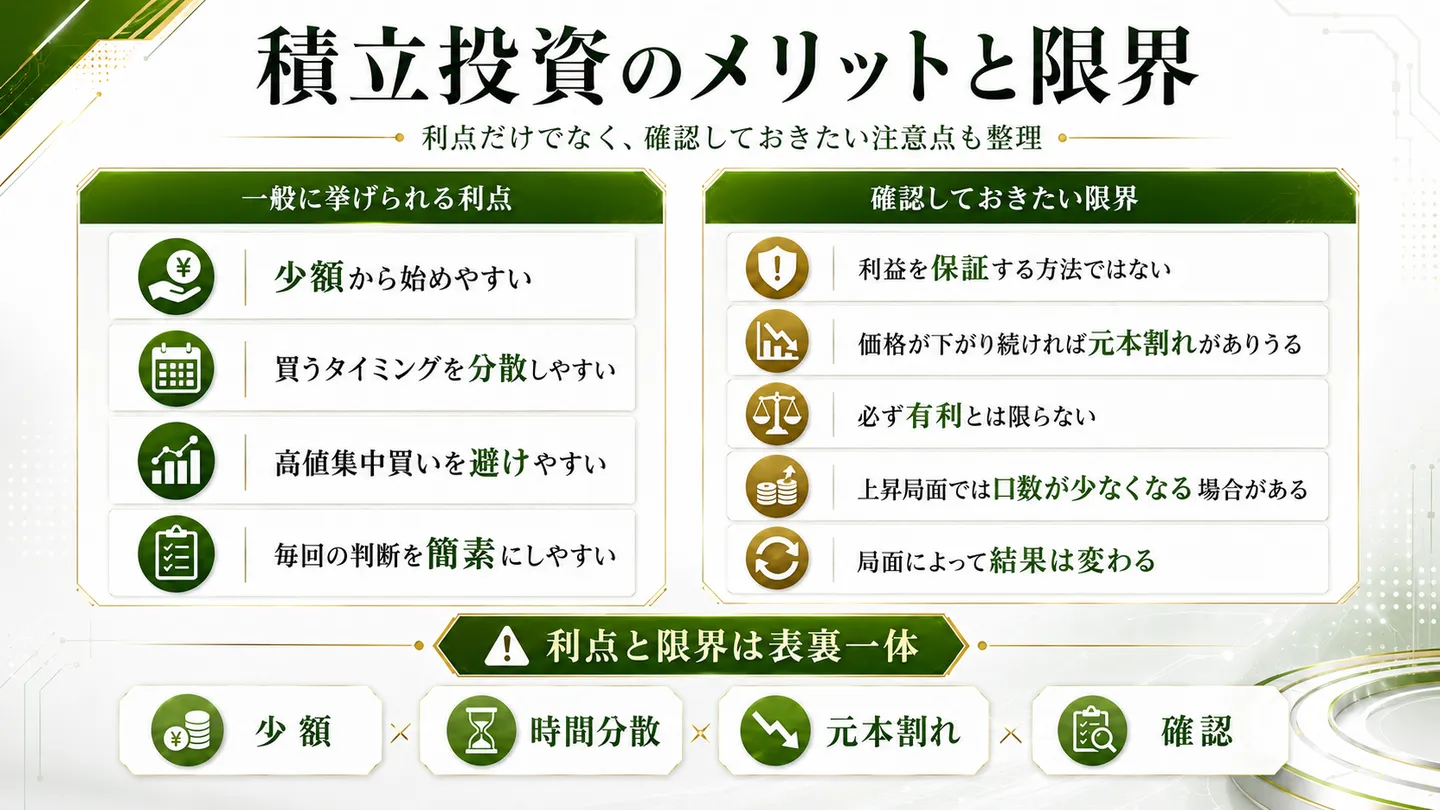
On the basis of the mechanism described so far, the following organises the advantages generally cited for regular instalment investing (dollar-cost averaging), together with the limits worth checking alongside them. With this technique it is particularly important not to judge by looking at the advantages alone.
Advantages generally cited
- Easy to start with small amounts: it can be continued with a fixed amount, without preparing a large sum.
- The timing of purchases can be spread out: compared with buying the whole sum at once, the result is less liable to be governed by the price at one particular point in time. One aspect of this is that it becomes easier to avoid concentrating purchases when the price is high, or missing the chance to buy when it is low.
- The effort of continuing to buy is easier to keep down: because the amount and the timing are decided in advance, there is an aspect in which each individual decision is easier to keep simple.
Limits worth checking
The Financial Services Agency indicates, with regard to regular instalment investing (dollar-cost averaging), that it does not guarantee a profit, that it is not necessarily advantageous, and that a loss may arise if the price keeps falling.
- It is not something that prevents loss of principal: even where buying for a fixed amount continues, if the price keeps falling, the valuation may come to less than the amount invested — loss of principal (see Example 2).
- It is not necessarily advantageous: the effect of lowering the average purchase price is described as something that can be expected, but it is not the case that the price will necessarily fall.
- In a phase of continued rises, the number of units may be smaller: in a phase in which the price keeps rising, the number of units that can be acquired may be smaller than where the whole sum was invested at an earlier point (see Example 3).
- The behaviour changes with the market phase: the result varies according to whether the phase is one of rises, of falls or of sideways movement. Which it will be cannot be known in advance.
The advantages and the limits are two sides of the same thing. That the timing of purchases can be spread out also means, seen from the other side, that in a phase in which the price keeps rising the number of units may end up smaller than with investing the whole sum at once. Not judging by looking at only one of the two is the basic approach.
How it differs from lump-sum investment
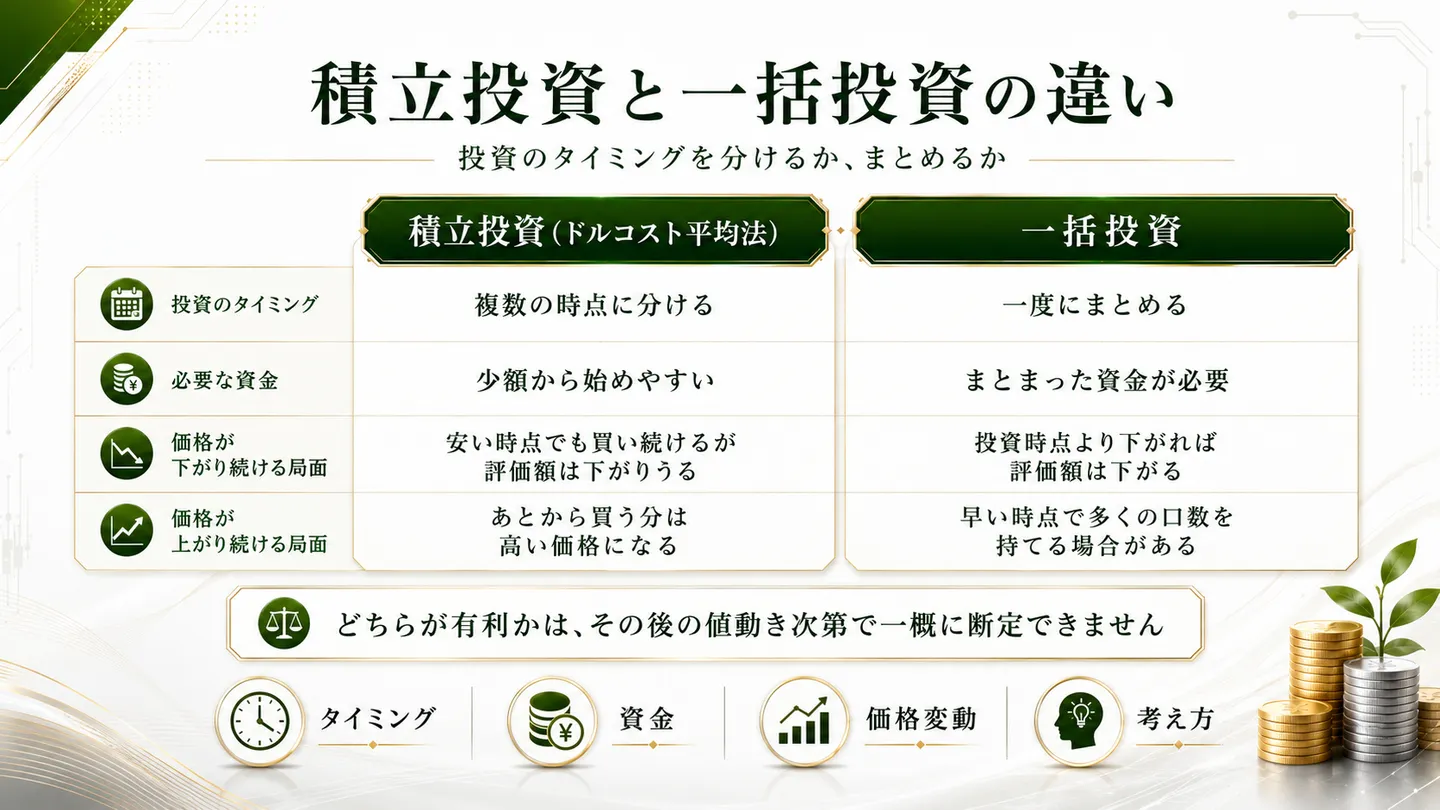
What regular instalment investing is most often contrasted with is lump-sum investment. Lump-sum investment is a method of investing the funds all at once. The difference between the two lies in whether the timing of the investment is divided up or combined into a single occasion.
| Aspect | Regular instalment investing (dollar-cost averaging) | Lump-sum investment |
|---|---|---|
| The timing of investment | Divided across several points in time | Combined into a single occasion |
| The funds required | Easy to start even with small amounts | A large sum is required |
| A phase in which the price keeps falling | Buying continues at the cheaper points as well, but the valuation can fall | If the price falls below the level at the time of investment, the valuation falls |
| A phase in which the price keeps rising | The portions bought later are bought at higher prices | In some cases more units are already held from an earlier point |
Which of the two methods turns out to be advantageous varies with the price movement that follows, and cannot be asserted in general terms. In a phase in which the price kept rising, lump-sum investment may have ended up holding more units; in a phase in which the price fell and then recovered, regular instalment investing may have kept the average purchase price lower. Both are things that become clear only on looking back afterwards. As to which suits one’s own circumstances and way of thinking, there is a view that this is to be judged after checking for oneself such points as the funds required, how easy it is to keep going, and how one takes price fluctuations.
Frequently checked points
Does regular instalment investing necessarily produce a profit?
No. Regular instalment investing (dollar-cost averaging) does not guarantee a profit. The Financial Services Agency likewise indicates that it is not necessarily advantageous and that a loss may arise if the price keeps falling. Even where buying for a fixed amount continues, because this is investment, loss of principal may occur.
Is regular instalment investing free of risk?
No. Regular instalment investing is a technique for spreading out the timing of purchases; it does not remove price fluctuation itself. The investment trusts and similar products that are bought move in price, so if the price falls the valuation falls as well, and loss of principal may arise. Spreading out the timing and being free of risk are two different matters.
Which is better, lump-sum investment or regular instalment investing?
This article does not assert which of the two is superior. Which turns out to be advantageous varies with the price movement that follows, and is not something that can be judged in advance, before buying. There is a view that the judgement is to be made after checking for oneself such points as the funds required, how easy it is to keep going, and how one takes price fluctuations.
Is it the same as NISA’s つみたて投資枠?
Regular instalment investing (dollar-cost averaging) is a way of buying — a technique for dividing the timing of investment — whereas NISA is a scheme. The つみたて投資枠 (the regular-instalment investment allowance) of NISA assumes investment in regular instalments, but regular instalment investing is a technique that can be used outside NISA as well. The allowances of the NISA scheme and how the tax exemption works are organised in a separate article (please see “Articles to read next” at the end).
Terms organised
Among the terms covered in this article, those worth checking are organised below.
- Regular instalment investing (積立投資, accumulation investment): a method of investing a predetermined amount of money, at regular intervals, on a continuing basis. It is also called dollar-cost averaging.
- Dollar-cost averaging (ドルコスト平均法): a technique of purchasing a product that moves in price for a fixed amount of money at regular intervals, regardless of the price. It means buying less when the price is high and more when it is low. Public bodies write the Japanese term with a middle dot, as 「ドル・コスト平均法」.
- Average purchase price (平均購入単価, average acquisition cost): the unit price obtained by dividing the total amount invested by the total number of units purchased.
- Time diversification (時間分散): the idea of dividing the timing of investment across several points in time.
- Lump-sum investment (一括投資): a method of investing the funds all at once.
- Net asset value (基準価額, NAV): what corresponds to the price of an investment trust. In the numerical examples it is used as the amount per 10,000 units.
Summary
This article has organised the basics of regular instalment investing (dollar-cost averaging) on the basis of official information from the Financial Services Agency and the 財務局. Regular instalment investing is a way of buying in which a predetermined amount is used to buy continuously at regular intervals, which means buying less when the price is high and more when it is low. This is said to allow the effect of lowering the average purchase price to be expected, but it is not necessarily advantageous.
The point worth checking is that regular instalment investing does not guarantee a profit, and that loss of principal may arise if the price keeps falling. The result varies according to whether the phase is one of rises, of falls or of sideways movement, and which of it and lump-sum investment is advantageous is likewise something that becomes clear only by looking at the price movement afterwards, not something that can be asserted in advance. We hope this article may be used as an outline map for judging whether the approach suits your own circumstances and way of thinking, after checking both the advantages and the limits. Final judgements should be made after checking for yourself official information from bodies such as the Financial Services Agency and the Ministry of Finance (財務省), and the prospectus (目論見書) of the investment trust concerned.
Official information referred to
- Financial Services Agency, 「資産形成の基本」 on its NISA特設ウェブサイト (its dedicated NISA website) — the approach to regular instalment investing and the effect of diversification https://www.fsa.go.jp/policy/nisa2/invest/
- Financial Services Agency, 「教えて虫とり先生(第3回)」 on the same website — the explanation concerning the limits of regular instalment investing https://www.fsa.go.jp/policy/nisa2/attention/01/01_03.html
- 財務省中国財務局 (the Chugoku regional finance bureau of the Ministry of Finance), 「投資のリスクを減らす方法【積立投資】」 — the definition of regular instalment investing and its effect on the average purchase price https://lfb.mof.go.jp/chugoku/kinyusyouken/kin3/tumitatetoushi.html
Articles to read next
As a reference when taking your checking of regular instalment investing further, please also see the following articles.
- Basics to check before starting with investment trusts
- Points to check before starting with NISA
- Basic points to check before choosing a securities company
Always check the latest trading conditions, fees and campaigns on each company’s official site. The information on this page is as at the time it was written.