
Basics to check when redeeming an investment trust (the settlement date and the 信託財産留保額)
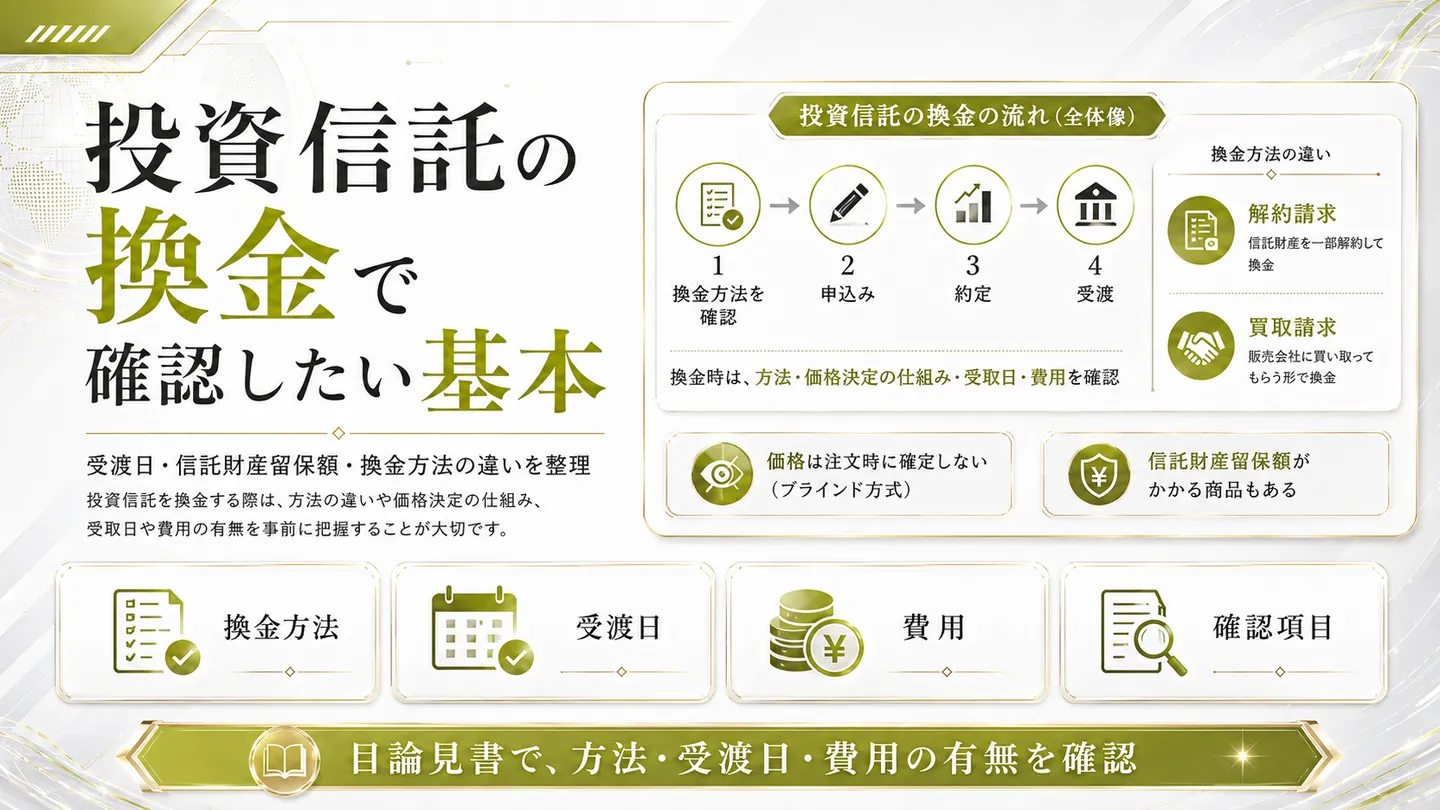
When you set about redeeming an investment trust (selling it and turning it into cash), what is worth checking falls broadly into three things: which method you redeem it by, when the money actually reaches you, and whether there is a cost that is deducted at the time of redemption.
This article organises, neutrally and on the basis of official information, the practical side of redeeming an investment trust, from the viewpoints of the difference between 解約請求 and 買取請求, the mechanism under which the price of the transaction is not fixed at the point when the order is placed (the blind method, ブラインド方式), the relationship between the execution date and the settlement date, and the 信託財産留保額. It is intended to be read not as a guide to when it pays to sell, but as an outline map for knowing what to check when redeeming. Because the number of days until settlement and the level of the costs differ by product, in the end please check the prospectus (目論見書) and the information of each company and of the official bodies concerned for yourself.
The basics worth checking before buying — how an investment trust works, the overall picture of its costs, and how to view the net asset value (基準価額) — are organised in Basics to check before starting with investment trusts. On the basis of those, this article confines itself to checking the practical side of redemption, that is, of the exit.
There are two methods of redeeming an investment trust
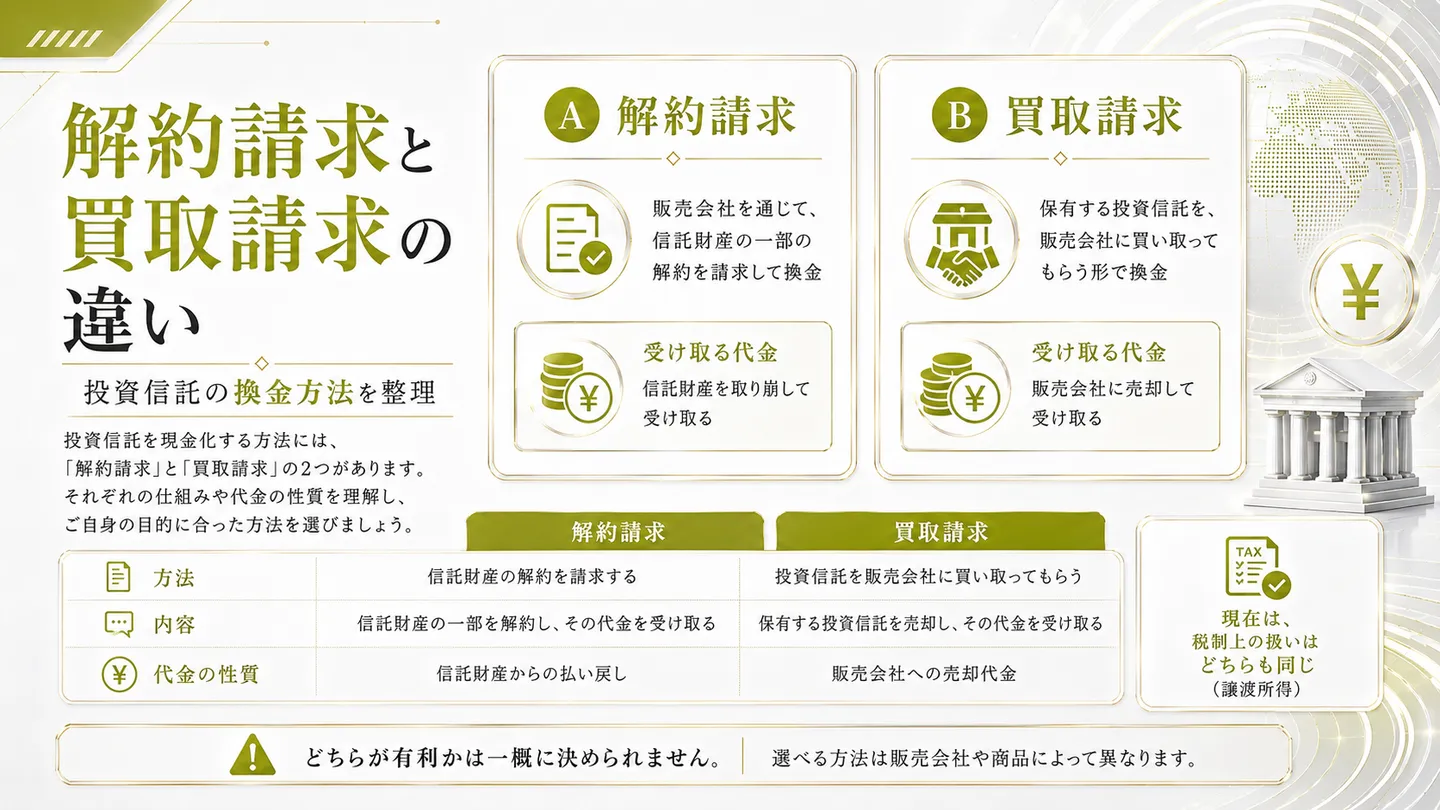
There are two methods of redeeming an investment trust before its term is up: 解約請求 and 買取請求. The official information of the Investment Management Association of Japan (一般社団法人 資産運用業協会, established in April 2026 by the merger of 投資信託協会 and 日本投資顧問業協会) explains each of them as follows.
| Method | Content | Nature of the proceeds received |
|---|---|---|
| 解約請求 | A method of redeeming by requesting, through the distributor (販売会社), the cancellation of part of the trust assets | Received by drawing down the trust assets |
| 買取請求 | A method of redeeming in which the distributor buys back the investment trust you hold | Received by selling to the distributor |
What 解約請求 is
解約請求 is a method of redemption in which you request, through the distributor, the cancellation of part of the trust assets and receive the proceeds. It takes the form of drawing down part or all of the investment trust you hold.
What 買取請求 is
買取請求 is a method of redemption in which the distributor buys back the investment trust you hold. Rather than cancelling the trust assets, it takes the form of a sale to the distributor.
In practice, which of the two methods you can choose, and which is actually used, differs by distributor and by product. Which method can be chosen at the distributor you use is a matter to be checked in that company’s information.
The treatment for tax purposes is now the same for both
There was a time when the treatment for tax purposes differed between 解約請求 and 買取請求. Now, however, since 2009 (平成21年, Heisei 21), a gain obtained by redeeming a 公募株式投資信託 (a publicly offered equity investment trust) is stated to be the same in that, whichever method is used, it is treated as 譲渡所得 (capital gains income). The money received on redemption is organised as being included in the revenue amount of 譲渡所得.
Because the treatment for tax purposes is now the same for both, which of 解約請求 and 買取請求 is more advantageous cannot be settled uniformly. The methods available and the procedures differ by distributor. For the specific calculation of tax and for filing, please check with the information of the National Tax Agency (国税庁), the tax office (税務署), or a professional such as a tax accountant (税理士).
At the point when the order is placed, the price of execution is not determined (the blind method)
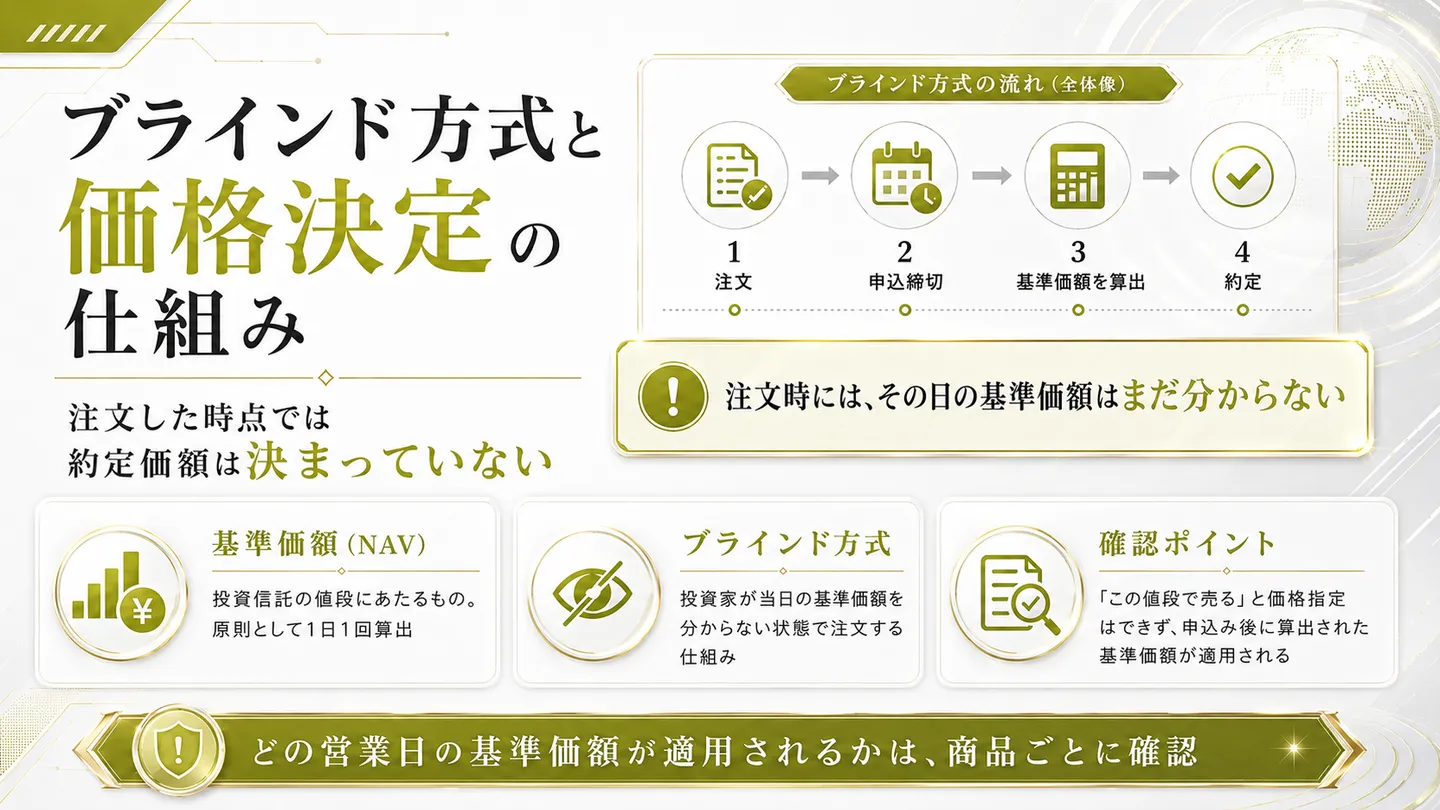
What is worth understanding when redeeming an investment trust is that, at the point when the order is placed, the price at which the transaction will be concluded is not yet fixed.
As also touched on in Basics to check before starting with investment trusts, the net asset value (基準価額, NAV), which is what corresponds to the price of an investment trust, is as a rule calculated once a day. It is not something that moves in real time during trading hours as a share price does. At the point when a redemption order is placed, that day’s net asset value is normally not yet published.
A mechanism of this kind, in which the investor places an order without knowing that day’s net asset value, is called the blind method (ブラインド方式). The net asset value is published after that day’s applications have been closed.
A redemption order is placed without knowing the price at which you will be able to sell. The net asset value at which the transaction is executed is the price calculated after the applications have been closed. Which business day's net asset value applies differs by product.
The blind method is explained as being adopted in order to maintain fairness with the investors who already hold the fund. If it were possible to buy and sell after seeing that day’s net asset value, only those who knew the price would gain an advantage, and there would be a risk of the existing holders suffering a disadvantage.
Seen from the side of the person redeeming, it is necessary to note that it is not possible to place an order specifying a price, as in wanting to sell at this price. The net asset value that actually applies is calculated after the order.
From redeeming to the money arriving (the execution date and the settlement date)
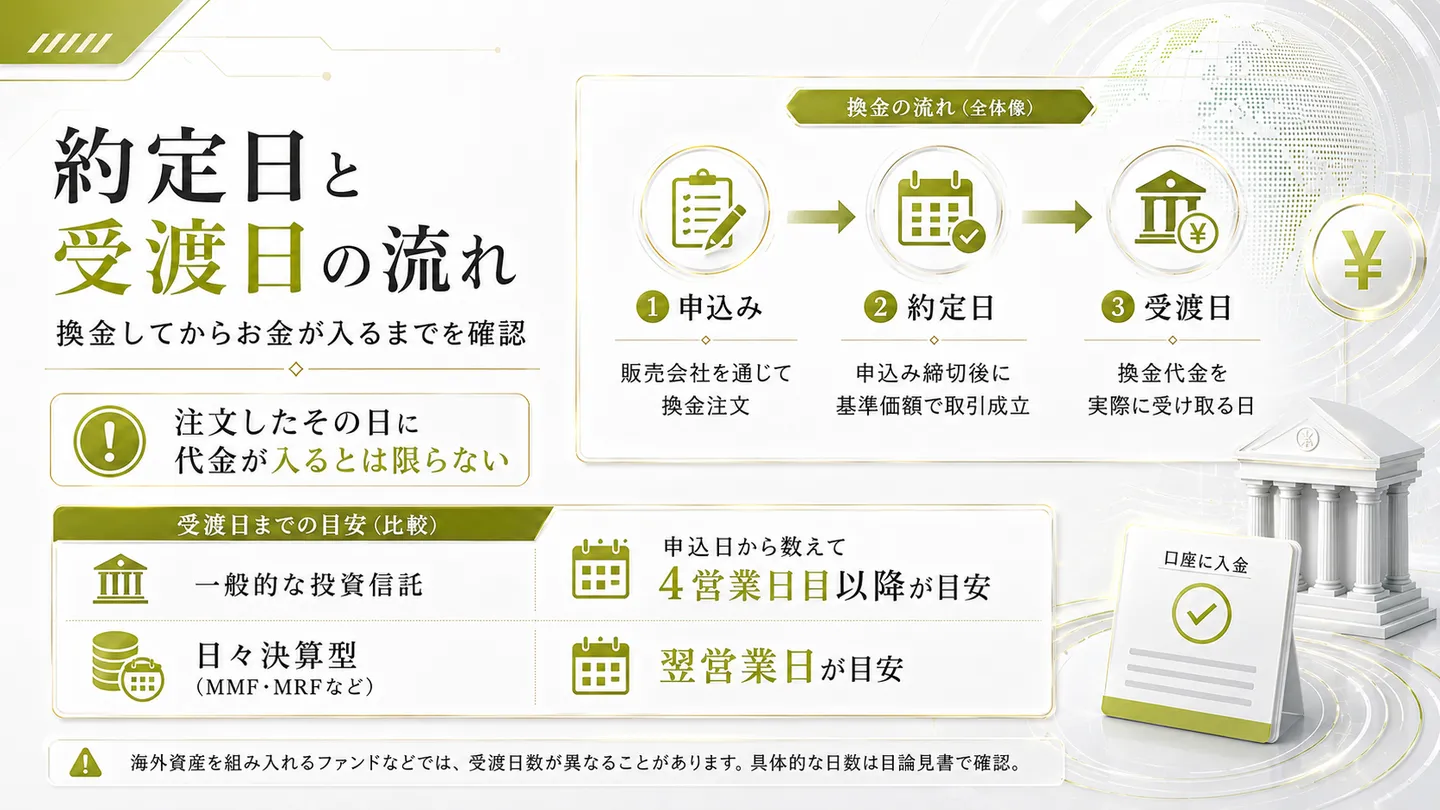
Between placing a redemption order and the proceeds actually reaching you, there are several stages. Organised, the flow is application, execution and settlement.
- Application to redeem (placing an order for 解約請求 or 買取請求 through the distributor)
- Execution (the transaction is concluded at the net asset value calculated after the applications have been closed. This day is called the 約定日, the execution date)
- Settlement (the proceeds of the redemption are actually received. This day is called the 受渡日, the settlement date)
The 約定日 (yakujobi, the execution date) is the day on which the order is concluded and the transaction becomes fixed. The 受渡日 (ukewatashibi, the settlement date) is the day on which those proceeds can actually be received. The proceeds do not arrive on the day the order is placed; normally they come several business days later.
In the case of a general investment trust, the official information of the Investment Management Association of Japan explains that the proceeds can be received from the fourth business day onwards, counting from the day of the application to redeem. For products that carry out their accounting daily (日々決算型, the daily-accounting type), such as MMFs and MRFs, on the other hand, the proceeds are stated to be receivable on the following business day.
How many business days it takes until settlement differs by product. In particular, with funds that include overseas assets, the number of days may differ from the case where only domestic assets are included. Please check the specific number of days in the prospectus for the product concerned. This article does not state any particular number of days as definitive.
In other words, it is not necessarily the case that redeeming turns a holding into cash straight away. Where you plan to apply the money to living expenses or to some other payment, the basic step is to check in advance, in the prospectus or in the distributor’s information, when the proceeds will arrive.
The cost that may be deducted on redemption (the 信託財産留保額)
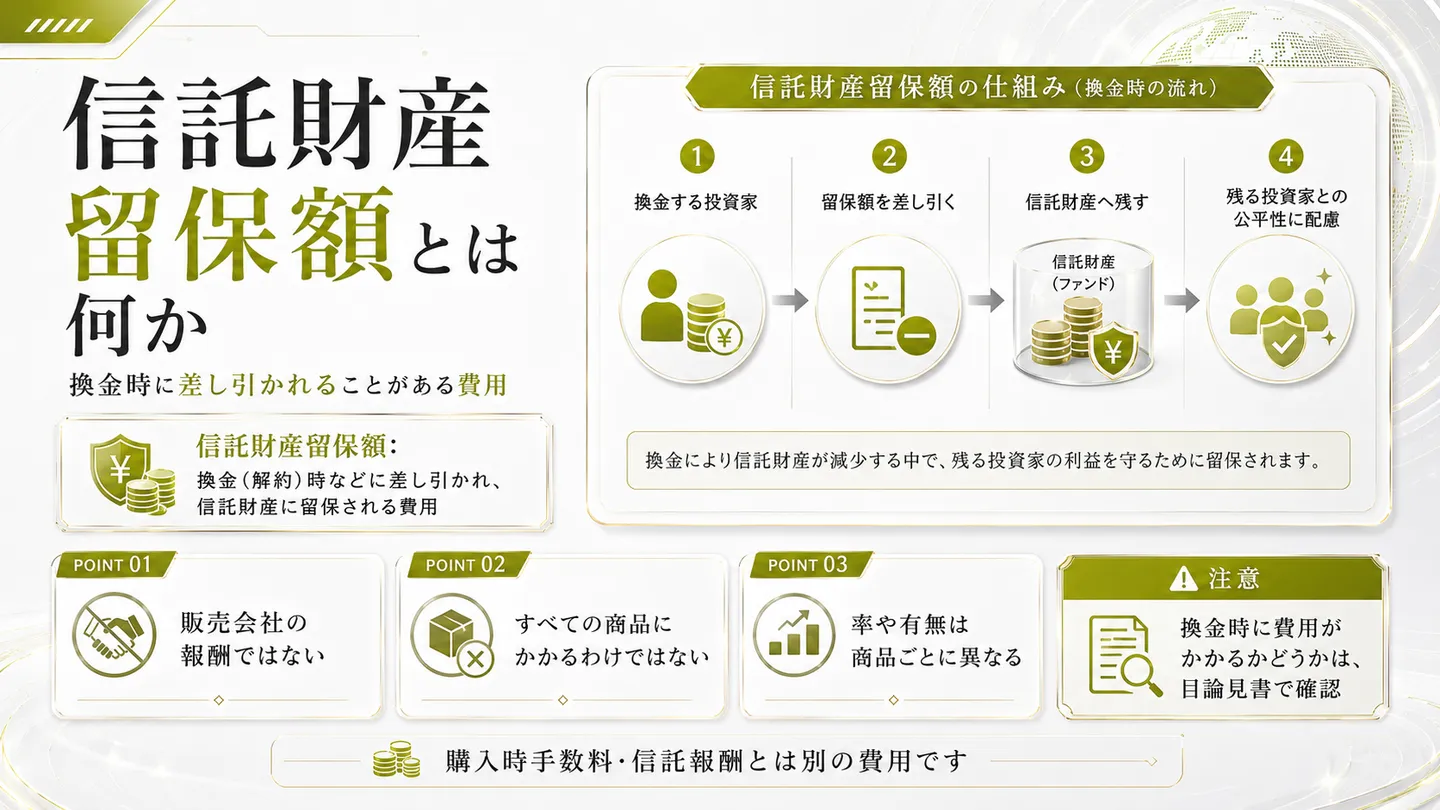
On redemption, a cost may be deducted. The representative one is the 信託財産留保額.
What the 信託財産留保額 is
The 信託財産留保額 (shintaku-zaisan-ryuhogaku, an amount retained in the trust assets) is a cost that is deducted on such occasions as redemption (解約, cancellation) and retained in the trust assets. According to the official information of the Investment Management Association of Japan, it is not a fee received by the distributor; it is stated to be a cost of a kind that is borne by the person cancelling and left in the trust assets for the benefit of the investors who continue to hold the fund.
When an investor redeems, the fund has to respond by such means as selling the corresponding assets. It is provided on the thinking that, by having the person who redeems bear to a certain degree the costs that may arise at that point, fairness with the investors who remain in the fund is maintained.
There are also products on which it is not incurred
The 信託財産留保額 is not incurred on every investment trust. The official information of the Investment Management Association of Japan also explains that there are products from which it is deducted and products from which it is not.
Whether a 信託財産留保額 is incurred, and the level (the rate) where it is, differs by product. This article does not give any particular rate. Please check in the prospectus for the product concerned whether a cost is deducted at the time of redemption.
Besides the 信託財産留保額, the costs incurred on an investment trust include the 購入時手数料 (the fee charged at the time of purchase) and the trust fee (信託報酬, also shown as 運用管理費用), which is incurred while the fund is held. The organisation of the costs as a whole is also covered in Basics to check before starting with investment trusts.
Other points worth checking before redeeming
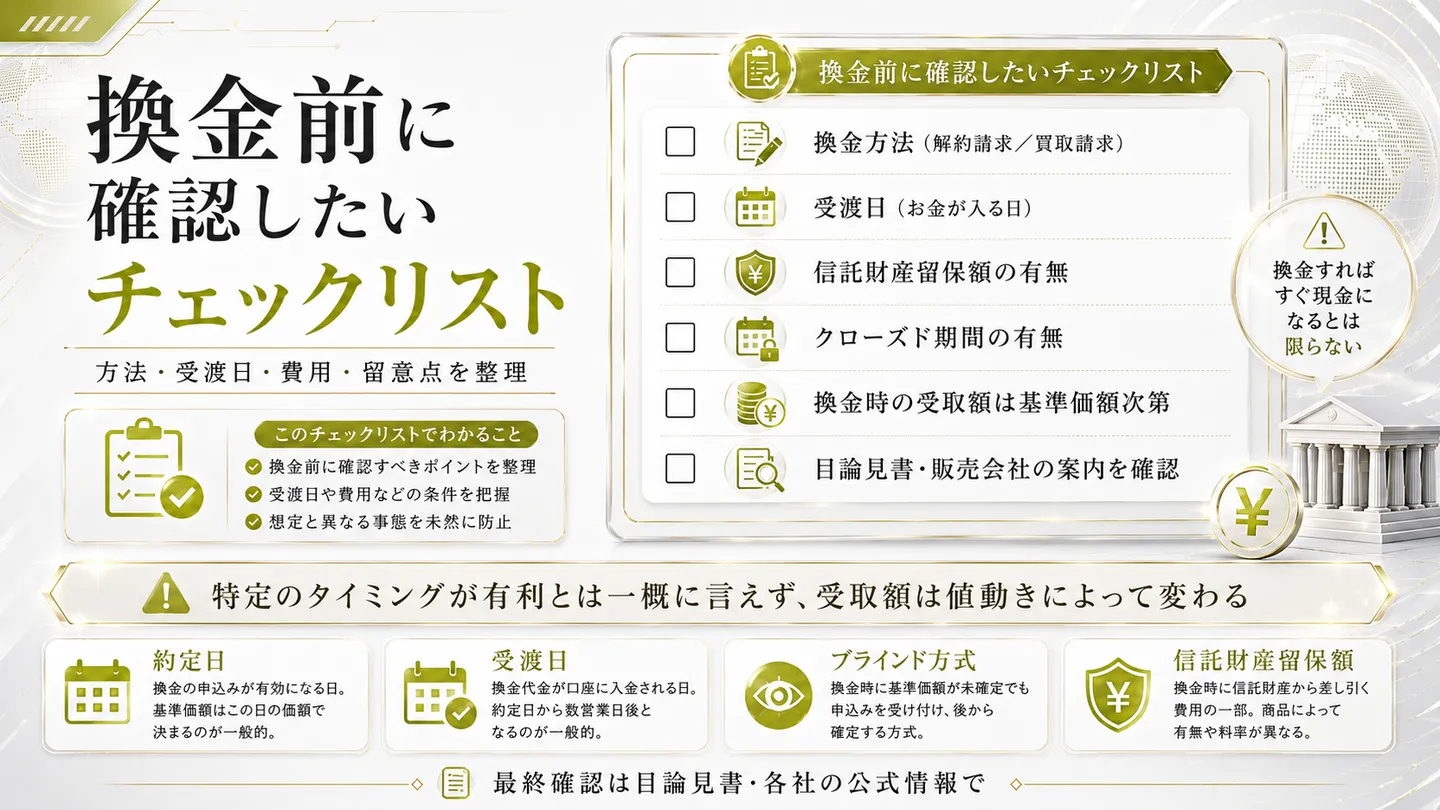
Besides the method of redemption, the settlement date and the costs, there are points worth checking depending on the product.
- クローズド期間 (a closed period): with some products, a period during which cancellation is not possible (a クローズド期間) is set. Because redemption is not possible during this period, it is necessary to check in advance, in the prospectus, from when redemption becomes possible.
- The amount received changes with the timing of the redemption: the net asset value of an investment trust moves. The amount you receive changes according to the net asset value at the point when you redeem. If the net asset value has fallen below its level at the time of purchase, the amount can come to less than the amount invested (loss of principal).
When it pays to sell is not something that can be judged in advance. The net asset value fluctuates with market conditions, and at the point of redemption it may come to less than the amount invested. Redemption is a matter to be judged in the light of your need for the money and your own circumstances; it cannot be stated as definite that any particular timing is advantageous.
Frequently checked questions
Which should I choose, 解約請求 or 買取請求?
This article does not state as definite which is more advantageous. Since 2009, a gain from redeeming a 公募株式投資信託 has been treated as 譲渡所得 whichever method is used, and the treatment for tax purposes is stated to be the same. Which method you can actually choose, and what the procedure is, differs by distributor, so it is a matter to be checked in the information of the distributor you use.
When does the money arrive after redeeming?
It differs by product. For a general investment trust, the official information of the Investment Management Association of Japan explains that the proceeds can be received from the fourth business day onwards, counting from the day of the application to redeem. For the 日々決算型, the daily-accounting type (MMFs, MRFs and the like), it is stated to be the following business day. With funds that include overseas assets, however, the number of days may differ. Please check the specific settlement date in the prospectus for the product concerned.
Are there costs on redemption as well?
There are products on which they are incurred and products on which they are not. One cost that may be deducted at the time of redemption (解約, cancellation) is the 信託財産留保額. This is not a fee for the distributor; it is a cost of a kind that is retained in the trust assets. It is not incurred on every investment trust, and the level where it is incurred also differs by product, so it is a matter to be checked in the prospectus.
Can I sell at the price on the day I place the order?
At the point when the order is placed, the net asset value that will apply is not yet fixed. With investment trusts, a mechanism is adopted under which the investor places the order without knowing that day’s net asset value (the blind method, ブラインド方式), and the net asset value is published after the applications have been closed. For that reason, it is not possible to place an order specifying a price, as in selling at this price; the transaction is concluded at the net asset value calculated after the application.
Terms organised
Among the terms covered in this article, those worth checking are organised below.
- 換金 (redemption): selling the investment trust you hold and turning it into cash. It is also called 解約, cancellation.
- 解約請求: a method of redeeming by requesting, through the distributor, the cancellation of part of the trust assets.
- 買取請求: a method of redeeming in which the distributor buys back the investment trust you hold.
- ブラインド方式 (the blind method): a mechanism under which the investor carries out the transaction without knowing that day’s net asset value. The net asset value is published after the applications have been closed.
- 基準価額 (NAV, net asset value): what corresponds to the price of an investment trust. As a rule it is calculated once a day.
- 約定日 (yakujobi): the day on which the order is concluded and the transaction becomes fixed.
- 受渡日 (ukewatashibi, the settlement date): the day on which the proceeds of the redemption are actually received.
- 信託財産留保額 (shintaku-zaisan-ryuhogaku): a cost deducted on such occasions as redemption (解約) and retained in the trust assets. It is not a fee for the distributor, and there are products from which it is deducted and products from which it is not.
- クローズド期間: a period during which cancellation is not possible. It is set with some products.
- 譲渡所得: the classification for tax purposes of a gain arising from redemption. Since 2009, a gain on the redemption of a 公募株式投資信託 has been treated as 譲渡所得 regardless of the method of redemption.
Summary
This article has organised the basics worth checking when redeeming an investment trust, on the basis of official information from the Investment Management Association of Japan and the National Tax Agency. The methods of redemption are 解約請求 and 買取請求, and the treatment for tax purposes is now stated to be the same for both. At the point when the order is placed, the net asset value that will apply is not yet fixed; a mechanism is adopted under which the transaction is concluded at the price calculated after the applications have been closed (the blind method).
What is worth checking is that it takes several business days from redeeming until the proceeds reach you, that the number of days differs by product, and that there are products from which a 信託財産留保額 is deducted at the time of redemption. Because the number of days until settlement and the level of the costs differ by product, the basic step in each case is to check them in the prospectus. The amount received on redemption also depends on the movement in the net asset value, and it cannot be stated as definite that any particular timing is advantageous. We hope it may be used as an outline map when you are considering a redemption. Please make your final judgement after checking the prospectus and the information of each company and of the official bodies concerned for yourself.
Official information referred to
- 一般社団法人 資産運用業協会 (the Investment Management Association of Japan, formerly 投資信託協会), 「換金の種類と手続き」 (the definitions of 解約請求 and 買取請求 / the treatment for tax purposes / the number of days until settlement / クローズド期間) https://www.imaj.or.jp/study/investmenttrust/process/sell.html
- 一般社団法人 資産運用業協会 (the Investment Management Association of Japan, formerly 投資信託協会), 「基準価額と分配金」 (the explanation of the blind method) https://www.imaj.or.jp/study/investmenttrust/about/navdividends.html
- 一般社団法人 資産運用業協会 (the Investment Management Association of Japan, formerly 投資信託協会), 「投資信託のコスト」 (the explanation of the 信託財産留保額) https://www.imaj.or.jp/study/investmenttrust/costtax/cost.html
- National Tax Agency, タックスアンサー No.1463 「株式等を譲渡したときの課税(申告分離課税)」 (money arising from the cancellation or the maturity redemption of an investment trust, and 譲渡所得) https://www.nta.go.jp/taxes/shiraberu/taxanswer/shotoku/1463.htm
Articles to read next
As a reference when taking your checking of investment trusts further, please also see the following articles.
- Basics to check before starting with investment trusts
- Basic points to check before choosing a securities company
- Points to check before starting with NISA
Always check the latest trading conditions, fees and campaigns on each company’s official site. The information on this page is as at the time it was written.