
The mechanism of FX automated trading of the リピート系 (repeat-type) kind, and the points to check
Among the forms of automated trading in FX (foreign exchange margin trading, 外国為替証拠金取引), there are those that repeat buying and selling at a fixed price interval — the type commonly called リピート系 (repeat-type automated trading). Many people will have heard the name without having organised what it is actually automating, or in what kind of market losses are liable to grow. This article organises, neutrally and on the basis of information published by public bodies, the mechanism of the automated trading called リピート系 and the thinking behind it. It does not decide which automated trading is superior, nor does it recommend the use of automated trading; its purpose is that readers check the mechanism, and the points worth confirming before use, as a premise for judging for themselves.
First, several premises. Firstly, automated trading is not something that earns money without effort just because it is automatic. As set out below, the Financial Services Agency is calling for caution about solicitation phrases of this kind. Automated trading does not guarantee profits, and depending on the state of the market, losses arise. Secondly, what this article deals with is the trading-mechanism side — what is being automated — and it does not deal with the operating environment for running an automated trading program (an EA) continuously, such as a home computer or a VPS. The operating environment is organised separately in The operating environment to check when using FX automated trading (EA), and the basics of a VPS. This article narrows its focus to the side one step before that: the mechanism of how automated trading places orders in response to the market.
First, the premise: automated trading is not something that earns money without effort
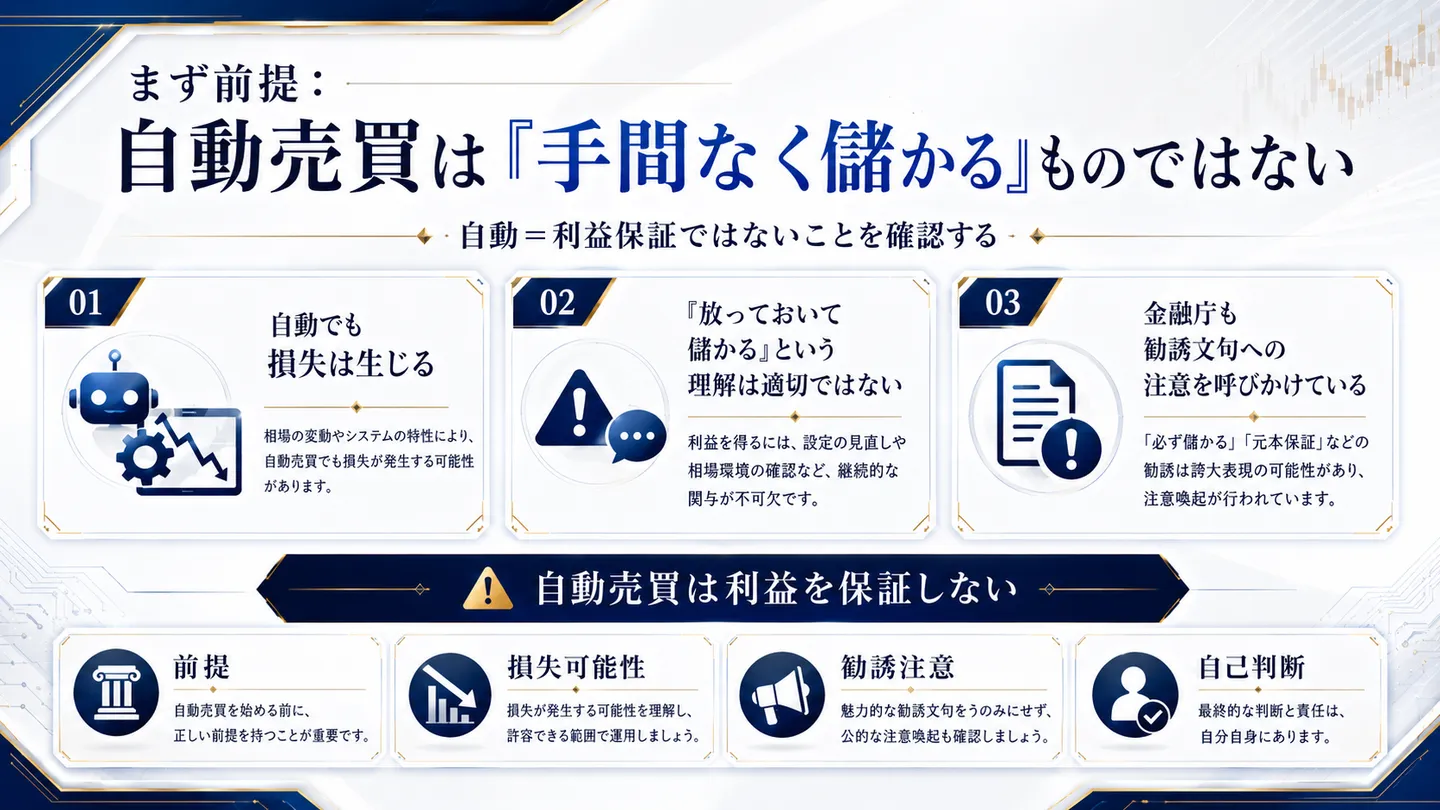
Before entering the discussion of the mechanism, the underlying premise is confirmed. Automated trading does not promise profits.
In an alert dated 4 April 2023 (令和5年) entitled 「『FX取引・暗号資産投資の勧誘』にご注意!!」 — a warning about solicitation for FX trading and crypto-asset investment — the Financial Services Agency states that cases have been arising for some time in which people are approached one-sidedly and urged to invest in FX, binary options, crypto-assets and the like, with claims to the effect that using automated trading software will make money without doing anything, and it calls for caution. In other words, wording to the effect that using automated trading software will make money without doing anything is a solicitation phrase that the Financial Services Agency names specifically in urging caution.
This does not amount to a denial of automated trading itself. However, it is necessary to grasp at the outset that it is not appropriate to understand it on the premise that, because it is automatic, it takes no effort and produces profits if left alone. Automated trading, too, is trading in which losses arise depending on the movement of the market. Below, on this premise, what the automated trading called リピート系 is automating is organised.
What リピート系 automated trading is automating
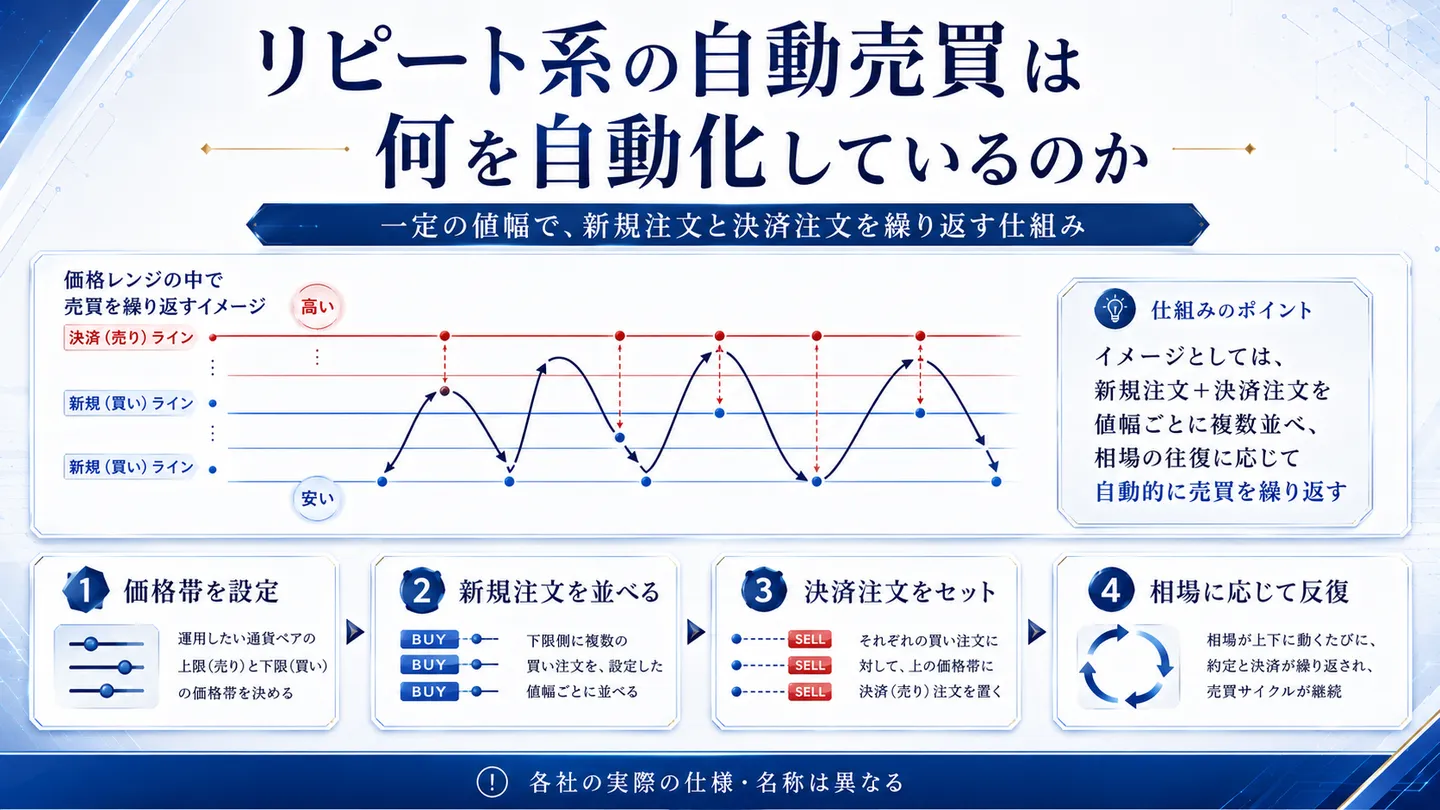
Names such as リピート系, リピート注文 and トラップ系 are common names used by companies, comparison sites and the like, and are not formal terms defined by a public body. This article, too, uses the name neutrally — not as a word indicating the specifications of any particular company, but as a common name referring to one type of automated trading that repeats buying and selling at a fixed price interval.
The automated trading called リピート系 is generally described as follows: for each predetermined width of price (値幅, a price interval), a new order and a closing order are placed as a set in advance, and in response to the movement of the market, that buying and selling is repeated automatically. For example, within a certain price band, the image is of buying where the market has fallen, closing where it has risen a little, and buying again when it falls — repeating this in accordance with the rules that have been set, rather than a person judging on each occasion.
The form of order placement being repeated here — putting out a new order and a closing order together as a set — is nothing special. The Financial Futures Association of Japan (一般社団法人 金融先物取引業協会, FFAJ) explains IFD orders (IFD注文, イフダン) as a method of ordering in which a new order and a closing order are placed at the same time. Broadly speaking, it is considered that リピート系 is easier to picture if understood as something that lines up many such orders pairing a new order with a closing order, one set for each chosen price interval, and repeats them automatically. This is strictly an outline for understanding the mechanism; it does not mean that it is the same mechanism as an IFD order, nor is it necessarily the same as each company’s actual order-placement specifications. On what the individual orders — market (成行), limit (指値), stop (逆指値), IFD and so on — involve as mechanisms, see Checking FX order types (market, limit, stop, IFD, OCO and IFO). This article addresses the higher-level mechanism of repeating those orders automatically at a fixed price interval.
Note that with order placement of this kind, the price assumed at the time of ordering and the price at which the trade is actually executed can diverge. The Financial Futures Association of Japan calls this divergence slippage, and explains it as the difference between the rate specified by the customer at the time of ordering and the rate at which the trade is actually executed. Even where buying and selling is repeated automatically, the premise does not change that each individual execution is not necessarily concluded at exactly the price specified.
What kind of market it is premised on, and where unrealised losses grow
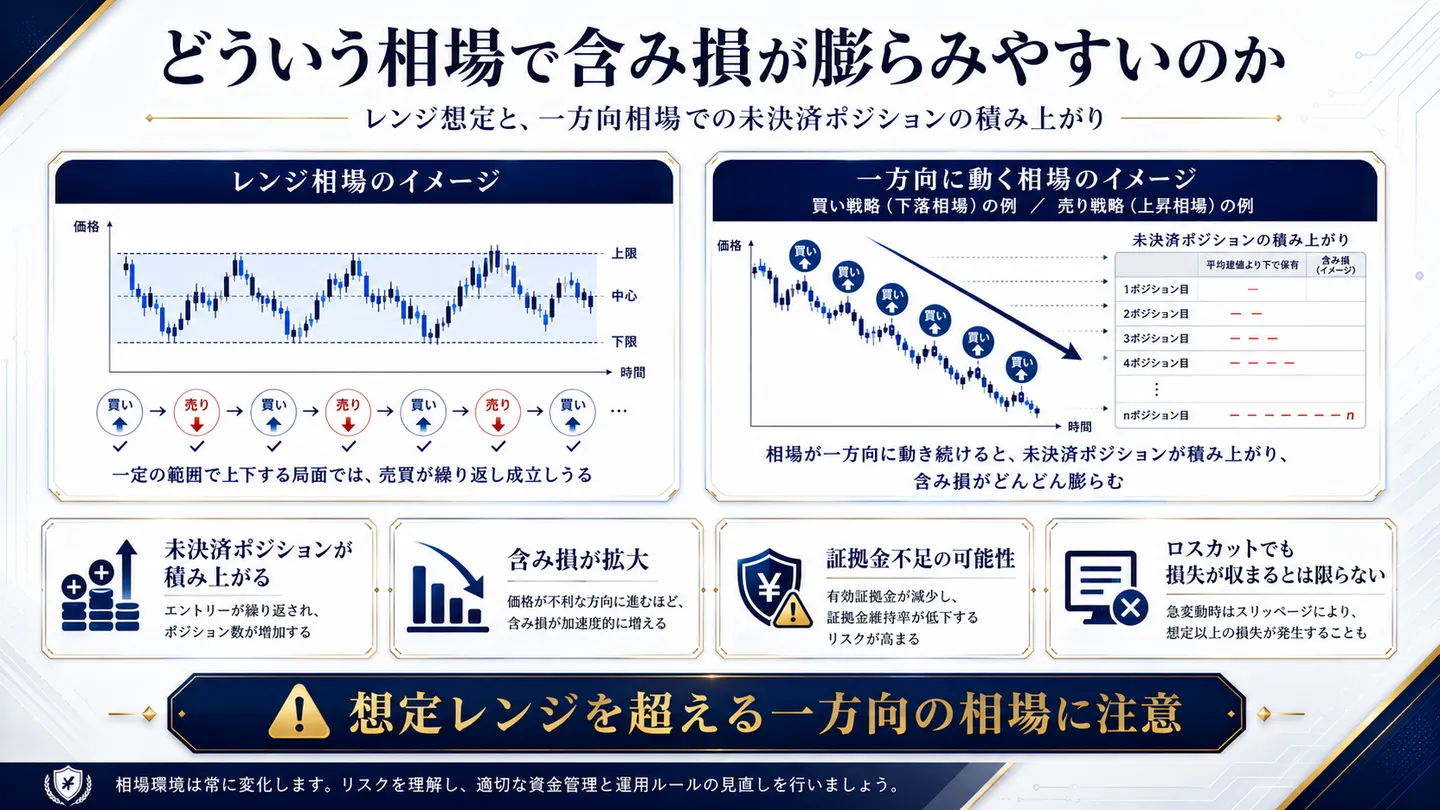
The most important point in understanding the mechanism of リピート系 is what kind of market the thinking is premised on.
The idea of repeating buying and selling at a fixed price interval can be organised as something premised on a phase in which the market moves up and down within a certain range (what is called a range-bound market, range). This is because, if the price is going back and forth within a fixed range, buying where it has fallen and closing where it has risen can be concluded repeatedly.
The problem is where the market moves beyond the range assumed and keeps going in one direction. Taking a buy-direction setting (buying where the market has fallen) as an example, where the market keeps moving downwards the new buy orders are executed one after another, while the conditions for closing them — where the market has risen a little — are not reached, so buy positions that are not closed accumulate. The more positions that are not closed increase, the more the loss in valuation terms (the unrealised loss) grows.
This is an explanation using a buy-direction setting as an example. リピート系 also includes sell-direction settings that enter from the sell side instead, and in that case, if the market keeps moving upwards, sell positions that are not closed accumulate and unrealised losses grow in the same way. With either setting the core is common: if the market keeps moving in one direction, against the direction set and beyond the range assumed, open positions that have not been closed accumulate.
This growth of unrealised losses is not a phenomenon peculiar to automated trading; it is one of the ways in which a risk common to FX trading — loss when the market moves contrary to expectations — appears. The Financial Futures Association of Japan explains, in respect of exchange rate fluctuation risk, that where the exchange market moves in the direction opposite to that expected, valuation profit and loss moves in a negative direction and a large loss may arise. In the case of リピート系, it is necessary to understand that, where the market keeps moving in one direction, this large loss when the market moves contrary to expectations can appear in the form of positions that are not closed accumulating.
Where unrealised losses grow, the margin needed in order to continue trading — the funds deposited as collateral for trading — may fall short. If the margin falls short, a forced closing of positions to curb the expansion of losses (a loss cut, ロスカット) may be carried out. What should be noted here is that, even where a loss cut operates, losses are not necessarily kept within the range of the margin. The Financial Futures Association of Japan explains, in respect of times of abrupt market change, that the loss cut function may not operate sufficiently and that in some cases a loss exceeding the margin deposited may arise, so that care is needed. It is not of such a nature that, because buying and selling is repeated automatically, it is fine to leave it alone: in a one-directional market, unrealised losses accumulate and can lead to a shortfall of margin and, in some cases, to losses exceeding the margin. That point is an indispensable premise for understanding リピート系.
On the mechanism of leverage (レバレッジ), the loss cut system, the protection of customer assets and the risks of FX trading in general, see the separate treatment in Risks of FX trading and points worth checking.
Points to note that are peculiar to automated trading
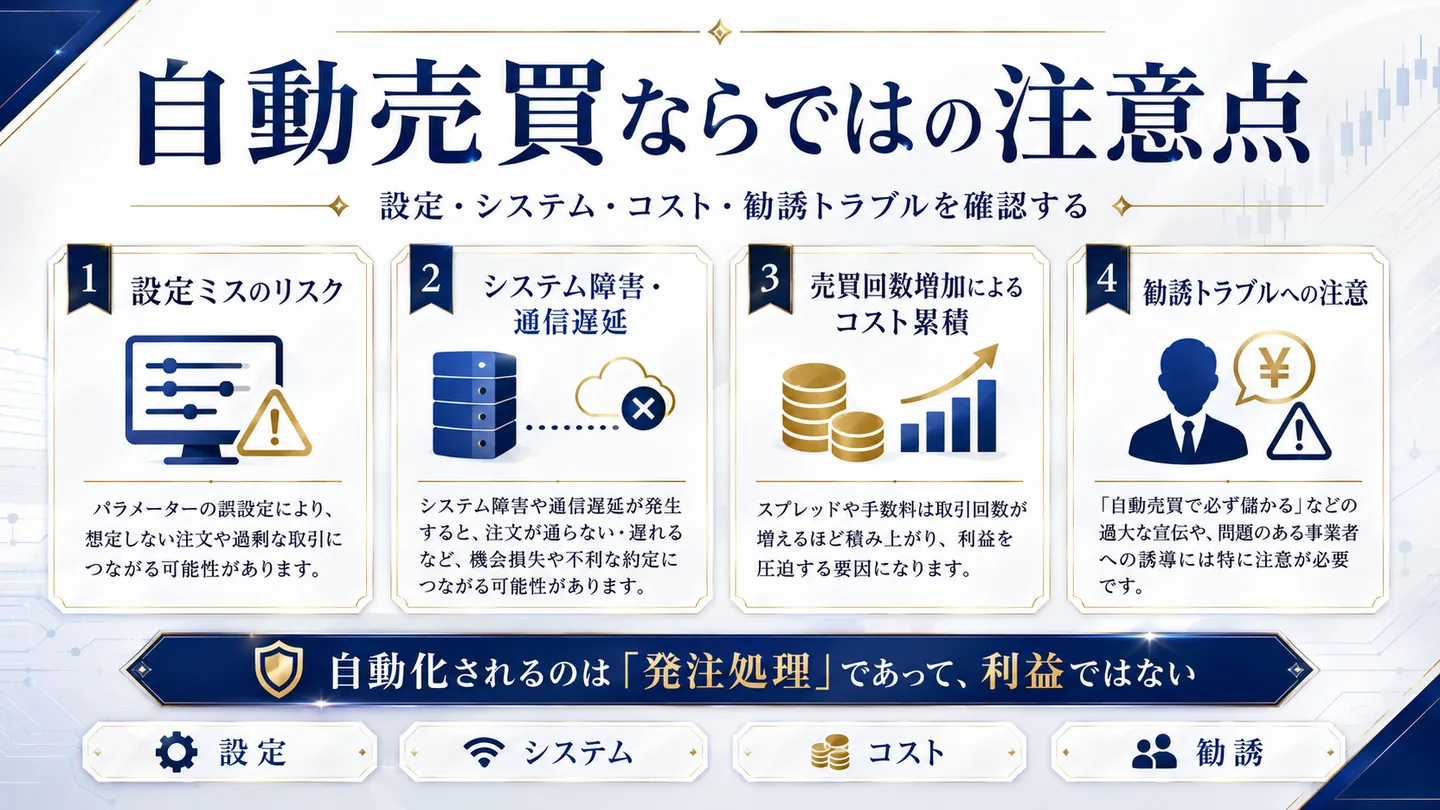
In addition to the risk arising from the direction of the market, there are also points to note that relate to the mechanism of automated trading itself.
Firstly, points arising from the settings and the mechanism. In automated trading, orders are processed automatically by a system in accordance with rules set in advance, rather than a person judging on each occasion. The Financial Futures Association of Japan explains, in respect of the system risk of online trading, that because processing from the receipt of an order through to execution is carried out automatically by the system without human intervention, an error in entering a buying or selling order can result in an unintended order being executed, and that trouble may occur such as being unable to trade temporarily or for a certain period, or trading processing being delayed. This is an explanation about online trading in general, but since automated trading operates automatically in accordance with the rules that have been set, the point that it can be affected by factors such as errors in the settings, system failures and communication delays is something to keep in mind as a premise for automated trading as well.
Secondly, the accumulation of costs as the number of trades increases. Because of the nature of リピート系, which repeats buying and selling at each price interval, the number of transactions tends to be large, and it is considered that costs such as the difference between the selling price and the buying price (the spread) and commissions can accumulate to that extent. On the meaning of the spread as a transaction cost and how to view it, see What an FX spread is and how to view it when comparing.
Thirdly, solicitation trouble surrounding automated trading. The Financial Futures Association of Japan urges caution in respect of automated trading software and the like, noting that in some cases the purchase of such software leads on to being guided into transactions with unregistered operators located overseas, resulting in trouble. Together with the alert of the Financial Services Agency mentioned above, an attitude of engaging cautiously with solicitation to the effect that using automated trading software will make money is to be hoped for. On points to note surrounding solicitation and operators in general, including caution about unregistered operators, see Risks of FX trading and points worth checking.
Points that differ by company, and what to confirm before use
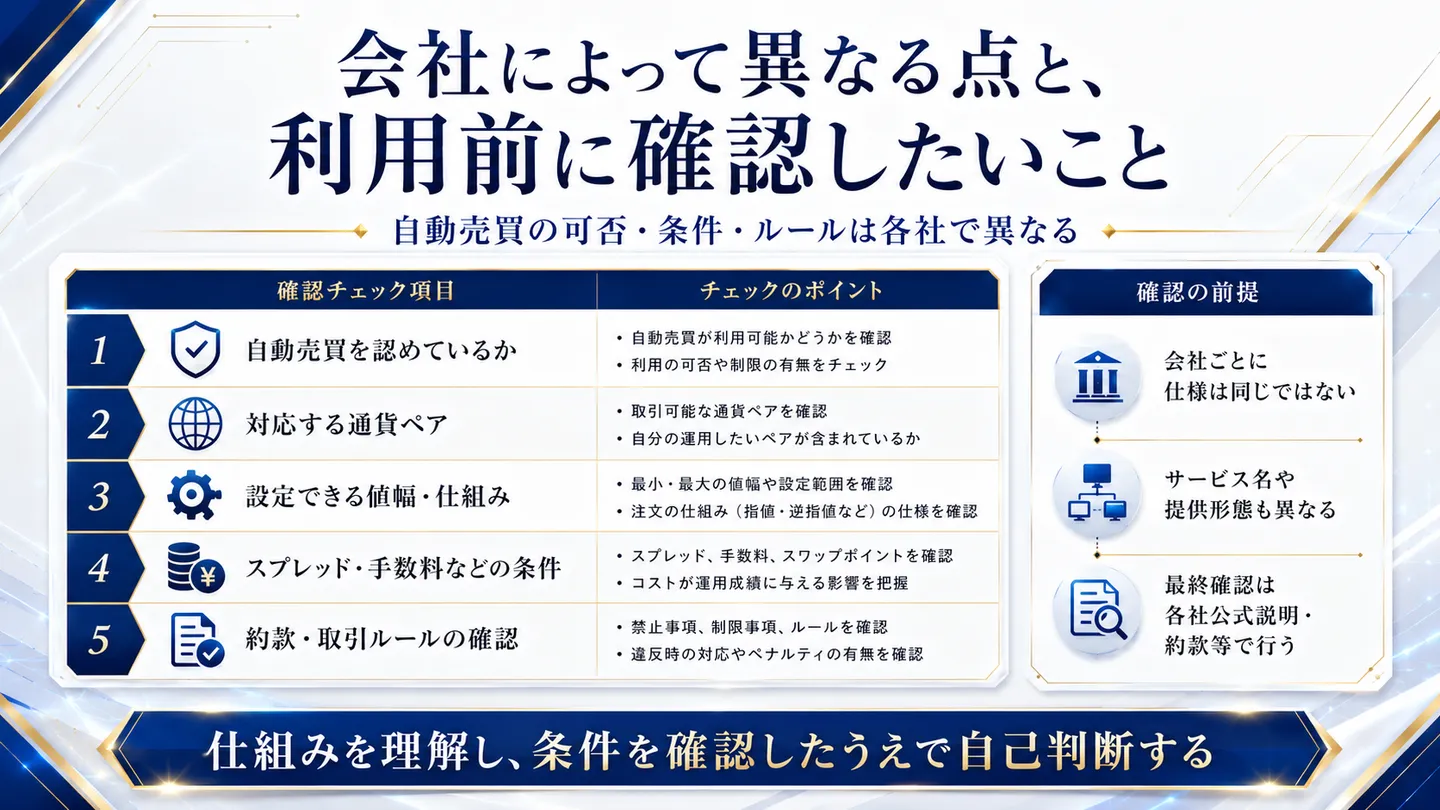
リピート系 automated trading cannot be used in the same way at every company.
First, there are companies that do not handle automated trading at all. The Financial Futures Association of Japan states that there are not a few FX trading operators that do not permit the use of automated trading software and the like, and that the position should be confirmed fully in advance, including by reading the contract terms (約款) of the FX trading operator with which one intends to trade. The Association also urges caution in respect of system trading, to the effect that it is essential to understand the mechanism of the trading, to research the risks accompanying the trading sufficiently, and to carry it out on one’s own responsibility, and that casual use, without sufficiently confirming the content of the software and the identity of its seller, must be avoided.
In addition, over-the-counter FX (店頭FX) is a bilateral transaction (相対取引) between the customer and the FX company, and the Financial Futures Association of Japan explains that in over-the-counter FX the trading conditions, such as the currency pairs that can be traded and the spreads, differ according to the FX operator that is the counterparty. In other words, not only whether automated trading is supported, but also the name given to the service, the currency pairs supported, the price interval that can be set, and conditions such as commissions and spreads, differ by company.
Accordingly, when considering リピート系 automated trading, it is a premise that whether the company permits automated trading, on what mechanism and conditions it provides it, and how matters will be treated in an unforeseen market, are ultimately confirmed in each company’s official explanations and trading rules (約款 and the like). This article organises the basic thinking behind the automated trading called リピート系 in common terms; it does not indicate the service or the specifications of any particular company.
Organising the terms
The main terms dealt with in this article are organised below.
- Automated trading (system trade): trading in which orders are placed automatically in accordance with rules set in advance. It is the term used in contrast to discretionary trading, where a person judges on each occasion.
- リピート系 (an industry common name): a common name referring to one type of automated trading in which, at a fixed price interval, new orders and closing orders are repeated automatically in response to the market. It is not a formal term defined by a public body.
- A range-bound market (range): a phase in which the market moves up and down within a certain range. リピート系 can be organised as thinking premised on a market of this kind.
- Unrealised loss: a loss in valuation terms arising on a position held, at the stage where it has not yet been closed. It grows as positions that are not closed accumulate.
- Margin: funds deposited as collateral in order to carry out trading. If it falls short, owing to unrealised losses or otherwise, a loss cut may be carried out.
- Slippage: the difference between the rate specified at the time of ordering and the rate at which the trade is actually executed.
Common questions to check
What is リピート系 automated trading?
It is a common name referring to one type of automated trading in which, at each fixed price interval, a new order and a closing order are placed as a set in advance, and that buying and selling is repeated automatically in response to the movement of the market. Names such as リピート系, リピート注文 and トラップ系 are ones used by companies, comparison sites and the like, and are not formal terms defined by a public body. This article uses the name neutrally, to refer to this type of mechanism rather than the specifications of any particular company.
Does automated trading make money without effort?
Not necessarily. On the contrary, wording to the effect that using automated trading software will make money without doing anything is a solicitation phrase that the Financial Services Agency names specifically, and calls for caution about, in its alert dated 4 April 2023 (令和5年). Automated trading does not guarantee profits, and depending on the state of the market, losses arise. It is not appropriate to think about it on the premise that, because it is automatic, profits arise even if it is left alone.
In what kind of market are losses liable to grow?
リピート系, which repeats buying and selling at a fixed price interval, is thinking premised on a phase in which the market moves up and down within a certain range (a range-bound market). For that reason, if the market keeps moving in one direction, against the direction set and beyond the range assumed, new positions that are not closed accumulate and unrealised losses become liable to grow. With a buy-direction setting this is in a phase where falls continue, and with a sell-direction setting in a phase where rises continue; in each case unrealised losses become liable to grow. The Financial Futures Association of Japan likewise explains that where the exchange market moves in the direction opposite to that expected, a large loss may arise. Where unrealised losses grow, the margin falls short, and this can lead to a loss cut and, in some cases, to losses exceeding the margin.
Can automated trading be used at any FX company?
Not necessarily. The Financial Futures Association of Japan states that there are not a few FX trading operators that do not permit the use of automated trading software and the like, and that the position should be confirmed fully in advance, including by reading the contract terms (約款) of the FX trading operator with which one intends to trade. Whether automated trading is supported, and on what conditions it is provided, differ by company, so it is a premise that these are confirmed in each company’s official explanations and trading rules (約款 and the like).
How does this differ from EAs and VPSs?
The リピート系 dealt with in this article concerns the trading mechanism — how orders are placed in response to the market, that is, what is being automated. The operating environment for running an EA (an automated trading program) continuously — where it is run, such as on a home computer or a VPS — is a separate matter. On the operating environment, see The operating environment to check when using FX automated trading (EA), and the basics of a VPS.
Summary
The automated trading called リピート系 is a common name referring to one type of automated trading in which, at each predetermined price interval, a new order and a closing order are placed as a set, and buying and selling is repeated automatically in response to the movement of the market. It is thinking premised on a range-bound market in which the market moves up and down within a certain range, and the core to be understood is that if the market keeps moving in one direction, against the direction set and beyond the range assumed (a phase where falls continue with a buy-direction setting, and a phase where rises continue with a sell-direction setting), positions that are not closed accumulate, unrealised losses grow, and this can lead to a shortfall of margin and, in some cases, to losses exceeding the margin. Automated trading is not something that earns money without effort, and the Financial Services Agency is calling for caution about solicitation phrases to the effect that using automated trading software will make money. Points arising from the settings and the system, and the accumulation of costs as the number of trades increases, are also worth keeping in mind. Whether automated trading is permitted, and its mechanism and conditions, differ by company, so when considering its use it is a premise that these are confirmed in each company’s official explanations and trading rules (約款 and the like).
Always check the latest trading conditions, fees and campaigns on each company’s official site. The information on this page is as at the time it was written.