
Checking the basics of REITs (J-REITs)
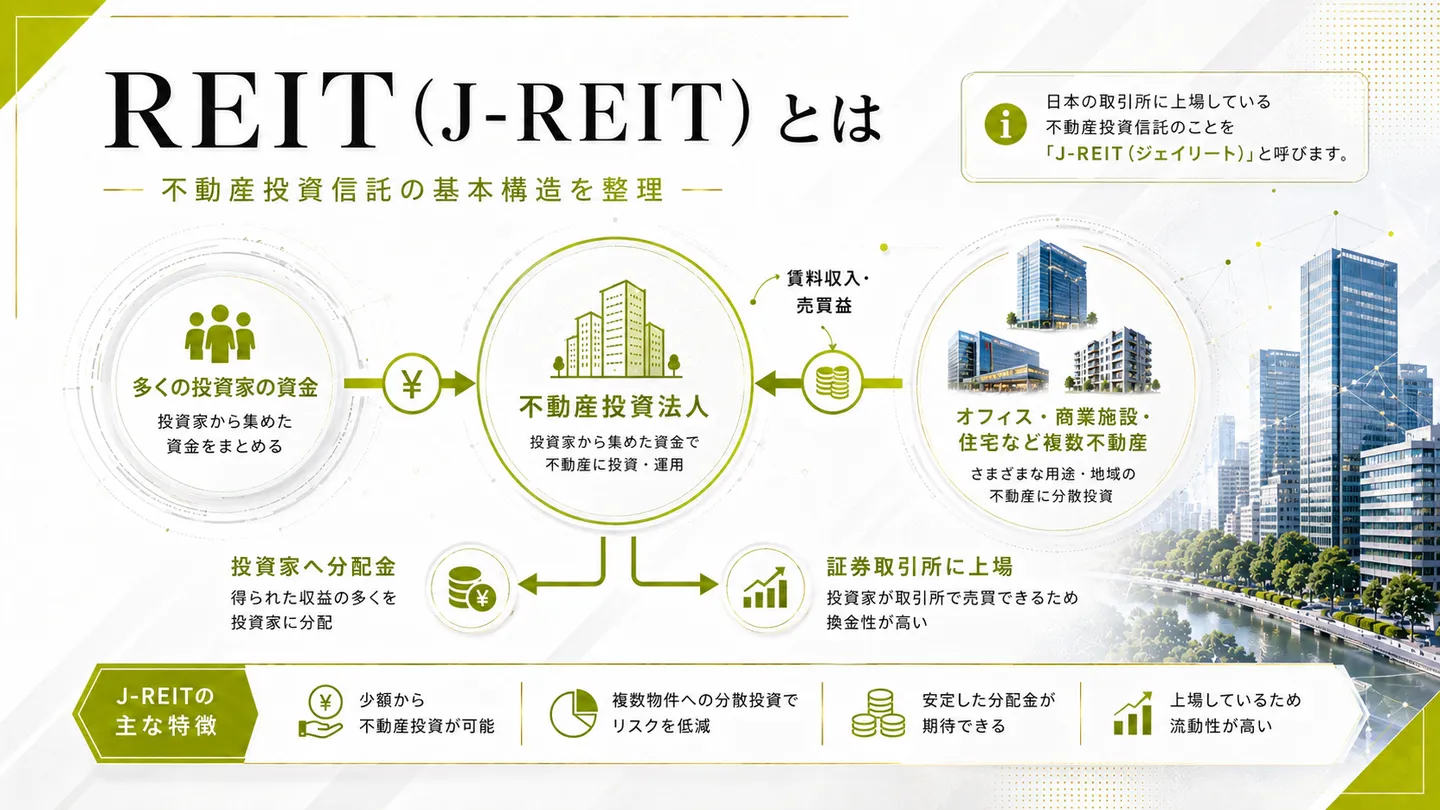
There are not a few people who are interested in investing in real estate but feel that holding physical property is difficult in terms of funds and of management. One thing that is sometimes heard of in that context is the REIT (real estate investment trust, 不動産投資信託). As the words 投資信託 (investment trust) in its name indicate, a REIT is a kind of investment trust whose object is real estate, but it has characteristics of its own, such as being listed on a securities exchange (証券取引所) and traded there.
This article organises, on the basis of official information, the basic items generally worth grasping when checking REITs (the ones listed in Japan are called J-REITs). It is intended to be read as an outline map for checking what a REIT is, how it works, how it differs from investing in physical real estate, and what risks it involves. The basics of investment trusts themselves are organised in Basics to check before starting with investment trusts.
What sort of product a REIT (不動産投資信託, J-REIT) is
REIT is an abbreviation of “Real Estate Investment Trust”, and in Japanese it is called 不動産投資信託. According to information from the Investment Management Association of Japan (資産運用業協会), a REIT is described as a product that uses money collected from a large number of investors to purchase a number of properties and the like — office buildings, commercial facilities, blocks of flats and so on — and distributes to the investors the rental income from them and the profits arising from buying and selling them. Of these, the ones listed on a securities exchange in Japan are called J-REITs.
In that investment in a number of properties, which would be difficult for one person alone, is carried out by pooling the money of a large number of investors, and the results are then distributed, it can be organised as a product that applies the thinking behind investment trusts to real estate. However, what is distributed is no more than the results of the management, and it varies with the rental income and with the state of the buying and selling of the properties. The point that distributions are not promised is one we check again below.
Checking how a J-REIT works
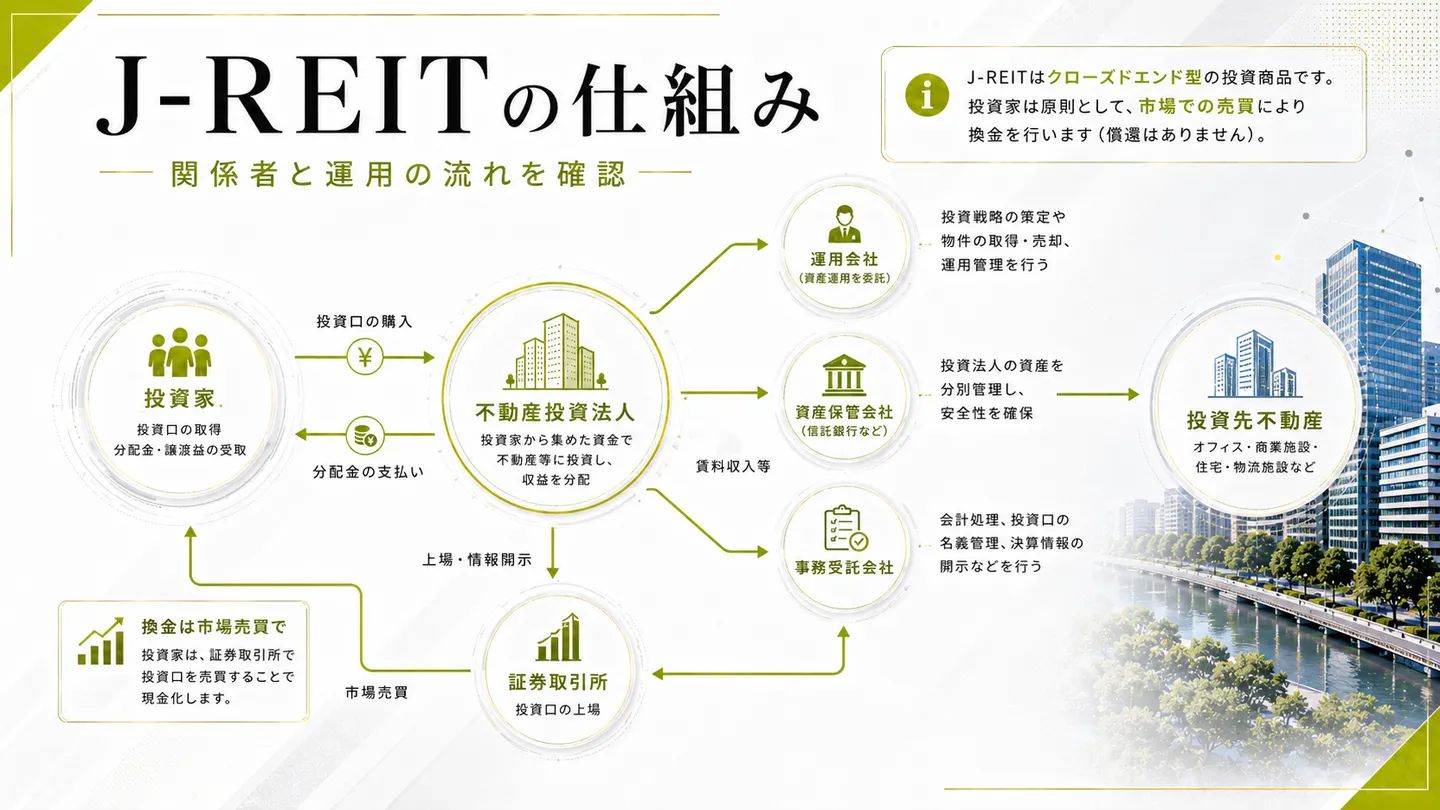
A J-REIT takes, under law, a form resembling a company, called a 不動産投資法人 (an investment corporation for real estate). Just as a company issues shares, a 不動産投資法人 issues 投資証券 (investment securities), and investors buy these 投資証券. The flow is that the money collected is invested in real estate and the like, and the rental income and the gains on sale are distributed.
It is said that, as ways of raising money, besides issuing 投資証券, a 不動産投資法人 may also borrow from financial institutions or issue 投資法人債, which correspond to corporate bonds (社債). The point that borrowing is used in the management also connects to the interest rate fluctuation risk checked below.
Entrusting the work to the 運用会社, the 資産保管会社 and the 事務受託会社
A J-REIT has a distinctive mechanism. According to information from the Investment Management Association of Japan, a J-REIT (a 不動産投資法人) is prohibited by law from carrying out the substantive work of investment management itself, and is described as taking a form in which that work is entrusted to outside parties. Specifically, the management of the assets is entrusted to the 運用会社 (the company that manages the assets), the custody of the assets to the 資産保管会社 (the company that holds the assets in custody, normally a trust bank), and administrative work such as accounting and tax payment to the 事務受託会社 (the company to which the administrative work is entrusted).
It is also explained that a J-REIT takes what is called the closed-end type (クローズドエンド型) form, under which it does not meet requests from investors to cancel their holdings, and that instead it secures liquidity by being listed on a securities exchange, so that investors can trade and cash in their holdings.
Checking the trading of J-REITs
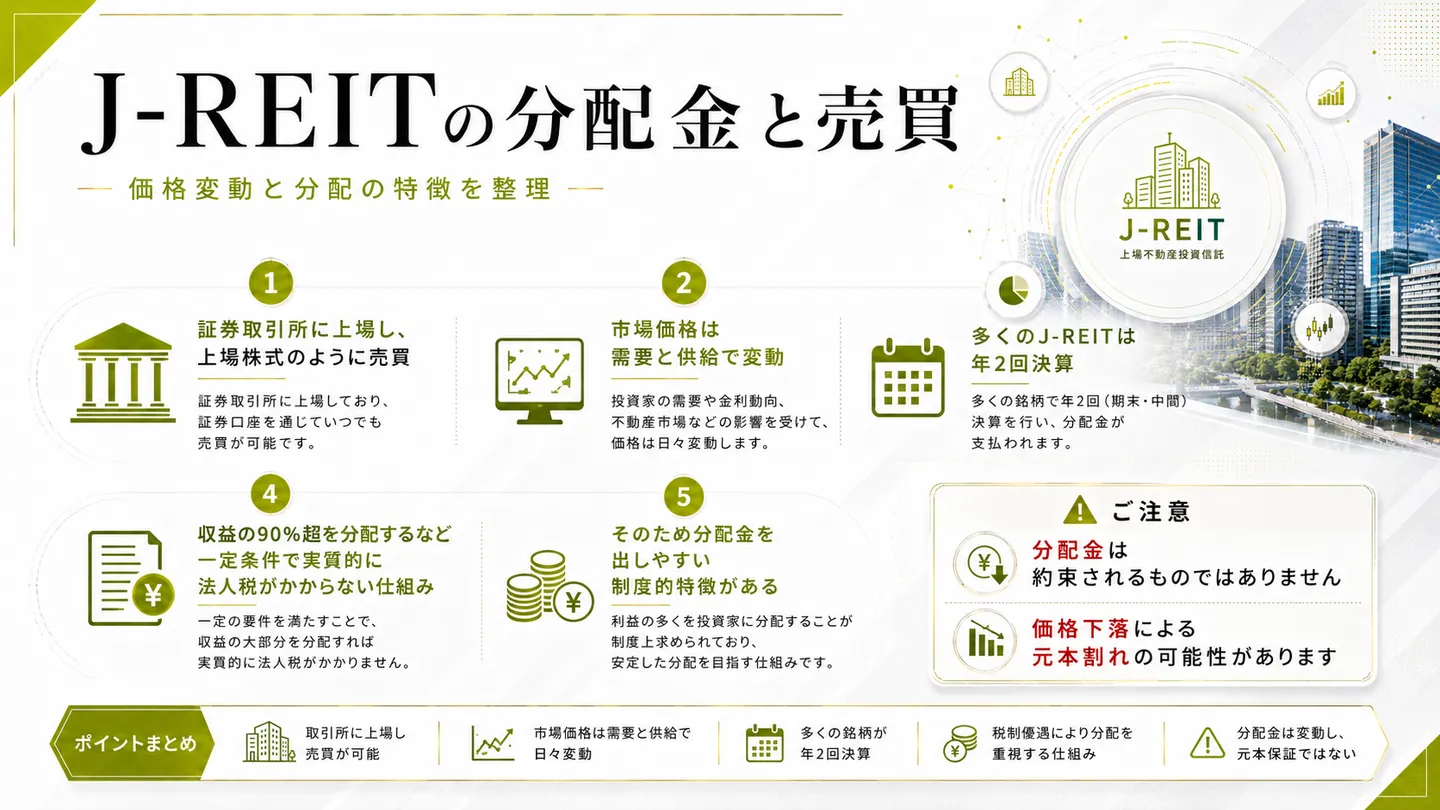
The 投資証券 of a J-REIT are listed on a securities exchange, and their price is determined by the demand and the supply of investors. According to information from the Investment Management Association of Japan, during trading hours they are traded on the market and the price moves from moment to moment, and the way the price is determined and the way trading is carried out are described as being the same as for listed shares (上場株式).
That is to say, a J-REIT is traded, in the same way as a listed share, as something that moves in price in real time on the market. As to the basics of buying and selling through a securities account, please also check Basic points to check before choosing a securities company.
Checking the characteristics of the distributions
With a J-REIT, the money paid to investors when the accounts are closed is called a distribution. This corresponds to the dividend on a share, and according to information from the Investment Management Association of Japan, many J-REITs close their accounts twice a year.
The distributions of a J-REIT have a characteristic that comes from the scheme. According to information from the Investment Management Association of Japan, where a J-REIT meets certain conditions, such as distributing more than 90% of its income, corporation tax is in substance not imposed, and since it also has no retained earnings, the mechanism is one in which the income comes out as distributions almost as it stands. It is explained that, because of this, it can be said to be a financial product from which distributions are easier to pay than from ordinary shares and the like.
What is worth checking here is that this characteristic of the scheme explains that it is a mechanism from which distributions are easier to pay; it does not mean that one will therefore make money, or that it is therefore favourable. Distributions vary with the rental income and with the state of the buying and selling of the properties, and they can decrease. Also, because the price of the J-REIT itself moves, loss of principal can arise if the price falls. The fact that a distribution is paid does not in itself necessarily mean that a profit is being made.
The difference from investing in physical real estate
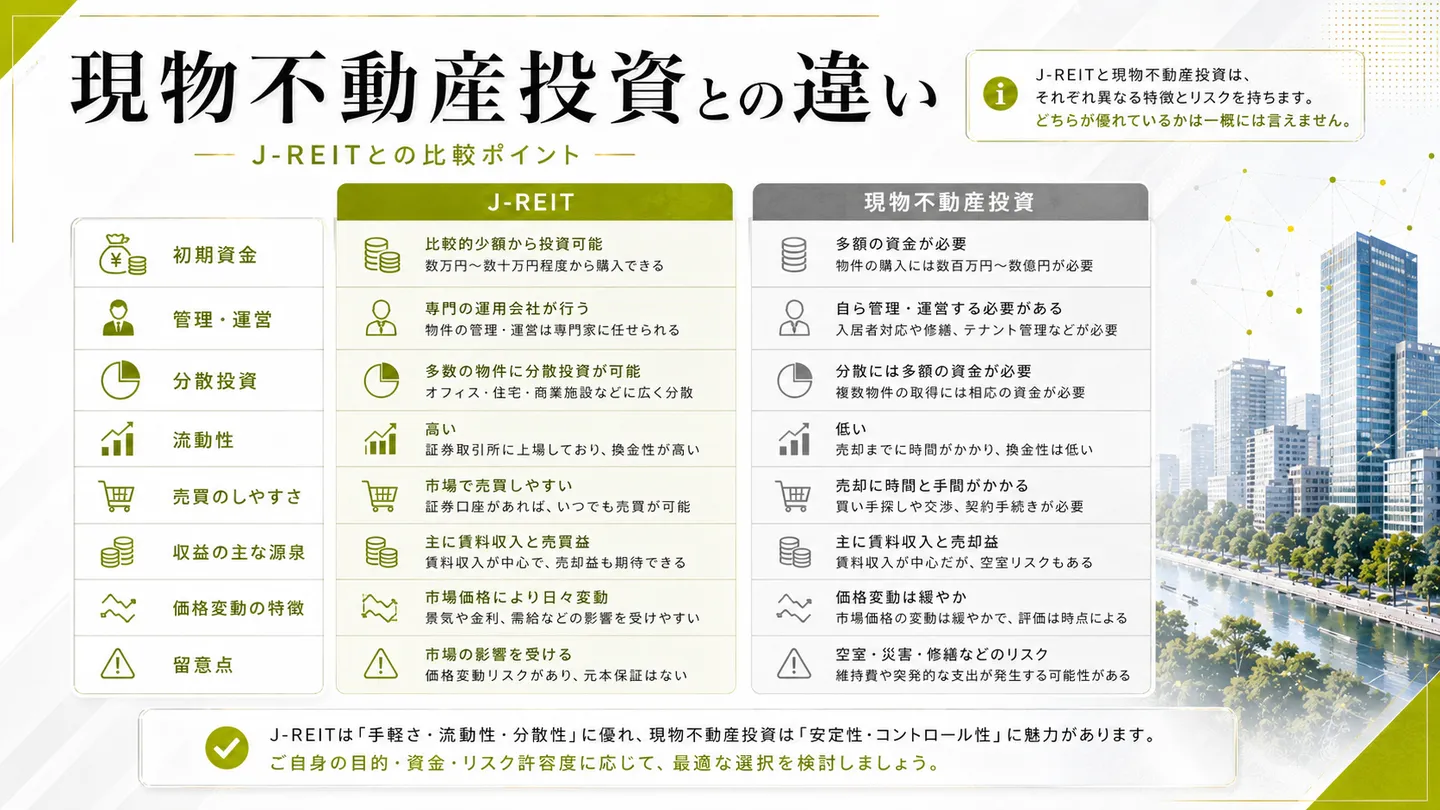
A J-REIT is said to have several characteristics that differ from those of investing directly in physical real estate. According to information from the Investment Management Association of Japan, whereas investment in physical real estate involves such difficulties as requiring a large amount of money, requiring the property to be managed, and taking time to sell, a J-REIT can be bought and sold on a securities exchange from a comparatively small amount, specialists carry out the selection and the management of the properties, and the investment is diversified over a number of properties; these and similar points are cited.
What should be noted here is that investment in physical real estate and J-REITs each have their own different characteristics and risks. The price of a J-REIT fluctuates on the market, and it involves the various risks described below. Which of the two suits you is a matter to be judged after checking the characteristics and the risks of each.
Checking the risks of a J-REIT
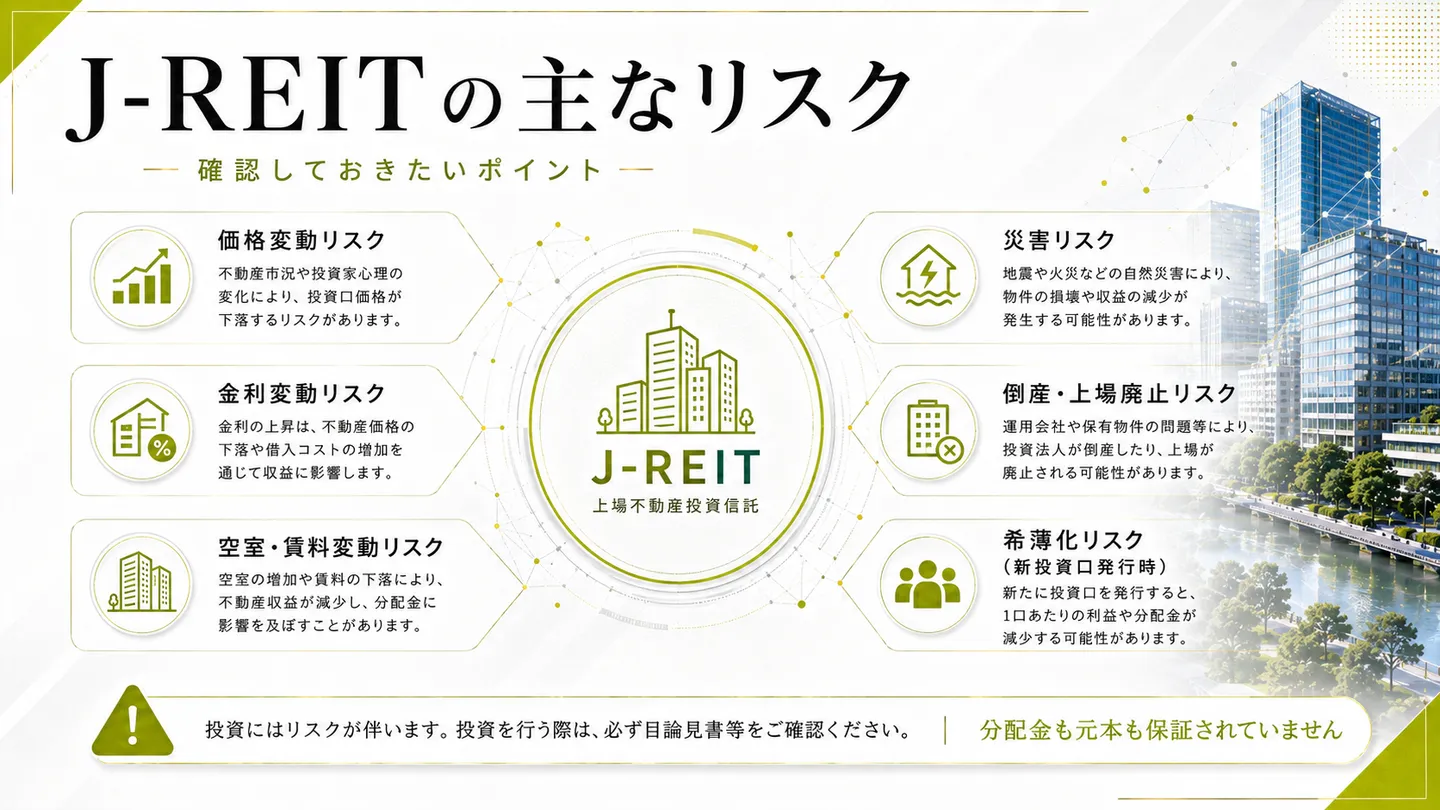
There are several risks of a J-REIT that are worth checking. We organise them on the basis of the information provided by the Investment Management Association of Japan and by the 不動産証券化協会 (ARES), an association concerned with the securitisation of real estate, on the sites they operate.
Price fluctuation risk
The price of a J-REIT fluctuates with movements in the real estate market, movements in interest rates, economic conditions and the like. If the prices of the properties invested in fall, or the rental income decreases, this can lead to a fall in the price of the J-REIT or to a decrease in its distributions. Neither the distributions nor the principal is guaranteed.
Interest rate fluctuation risk
A J-REIT may manage its assets using money borrowed from financial institutions. Because of this, it is said that if interest rates rise, the cost of the borrowing increases, which has an adverse effect on income and can lead to a fall in the price or to a decrease in the distributions.
Vacancy and rent fluctuation risk
The income of a J-REIT is supported by the rental income from the properties invested in. Rental income increases or decreases as tenants move in and out and as unit rents are changed, and the distributions can fluctuate accordingly.
Disaster risk / insolvency and delisting risk
Disasters such as earthquakes, floods and fires may damage the properties invested in and affect the price or the distributions. It is also said that there have been cases where the conditions of the borrowing deteriorated substantially, and cases in the past where the business failed and the J-REIT was delisted. Further, it is said that where new 投資証券 are issued and profit matching the increased number of units (口数) cannot be secured, the distribution per unit can decrease (dilution).
The risks common to securities transactions are organised in Checking the risks of securities transactions. Please check that as well.
Terms organised
Among the terms covered in this article, those worth checking are organised below.
- REIT (real estate investment trust, 不動産投資信託): a product that uses money collected from a large number of investors to invest in a number of properties and the like, and distributes the rental income and the gains on sale to the investors. It is an abbreviation of “Real Estate Investment Trust”.
- J-REIT: a REIT listed on a securities exchange in Japan.
- 不動産投資法人: the company-like form that a J-REIT takes under law.
- 投資証券: the securities issued by a 不動産投資法人. They correspond to the shares of a company, and investors buy them.
- 投資法人債: bonds issued by a 不動産投資法人, corresponding to corporate bonds (社債).
- Distribution: the money paid to investors when the accounts are closed. It corresponds to the dividend on a share. It varies with the rental income and with the state of the buying and selling of the properties.
- The closed-end type (クローズドエンド型): a form under which requests from investors to cancel their holdings are not met. A J-REIT secures the means of cashing in by being listed.
Frequently checked questions
What is the difference between a REIT and an ordinary investment trust?
A REIT is a kind of investment trust that takes real estate as its object of investment. Whereas ordinary investment trusts invest in such things as shares and bonds, a REIT invests in real estate such as office buildings, commercial facilities and blocks of flats, and distributes the rental income and the gains on sale. Also, the J-REIT, which is the form listed in Japan, is listed on a securities exchange, and the point that it can be bought and sold on the market in real time in the same way as a listed share is a further characteristic.
I hear that J-REITs pay large distributions and have a high yield. Are they a good deal?
It is said that where a J-REIT meets certain conditions, such as distributing more than 90% of its income, corporation tax is in substance not imposed, and since it has no retained earnings either, the mechanism is one in which the income comes out as distributions almost as it stands. However, this explains that it is a mechanism from which distributions are easier to pay; it does not mean that a profit is promised. Distributions vary with the rental income and with the state of the buying and selling of the properties, and they can decrease. The price of the J-REIT itself also moves, so loss of principal can arise if the price falls. Rather than judging by looking only at the amount of the distribution, it is necessary to check it together with the movement of the price and with the risks.
Are J-REITs safer than investing in physical real estate?
A J-REIT is said to have such characteristics as being tradable from a small amount, having specialists select and manage the properties, and being diversified over a number of properties, but its price fluctuates on the market and it involves various risks, including interest rates, vacancies, disasters and the failure of the issuer. Checking on the premise that investment in physical real estate and J-REITs each have their own different characteristics and risks is the basic step.
Is there a guarantee of principal with a J-REIT?
There is not. The price of a J-REIT fluctuates with the state of the real estate market, interest rates, economic conditions and the like, and a fall in the price or a decrease in the distributions can arise. Neither the distributions nor the principal is guaranteed, and it is said that there have been cases in the past where the business failed and the J-REIT was delisted. It is necessary to judge on the premise that the principal is not guaranteed.
Summary
This article has organised the basic items generally worth grasping when checking REITs (不動産投資信託, J-REITs). A REIT is a product that uses money collected from a large number of investors to invest in a number of properties and the like and distributes the rental income and the gains on sale to the investors, and the form of it listed in Japan is the J-REIT. A J-REIT takes the form of a 不動産投資法人 issuing 投資証券, entrusts work such as the management of the assets to outside parties, and secures liquidity by being listed on a securities exchange. It has a characteristic of the scheme that makes distributions easier to pay, but that is not something that promises a profit; it involves various risks, such as price fluctuation, interest rate fluctuation, vacancies and changes in rents, disasters and the failure of the issuer, and neither the distributions nor the principal is guaranteed. These mechanisms and these risks are all, as a basic matter, to be checked in official materials. We hope it may be used as an outline map for checking the products you yourself are interested in.
Articles to read next
As a reference when taking your checking of J-REITs further, please also see the following articles.
- Basics to check before starting with investment trusts
- Checking the risks of securities transactions
- Basic points to check before choosing a securities company
Always check the latest trading conditions, fees and campaigns on each company’s official site. The information on this page is as at the time it was written.