
Checking the risks of securities transactions
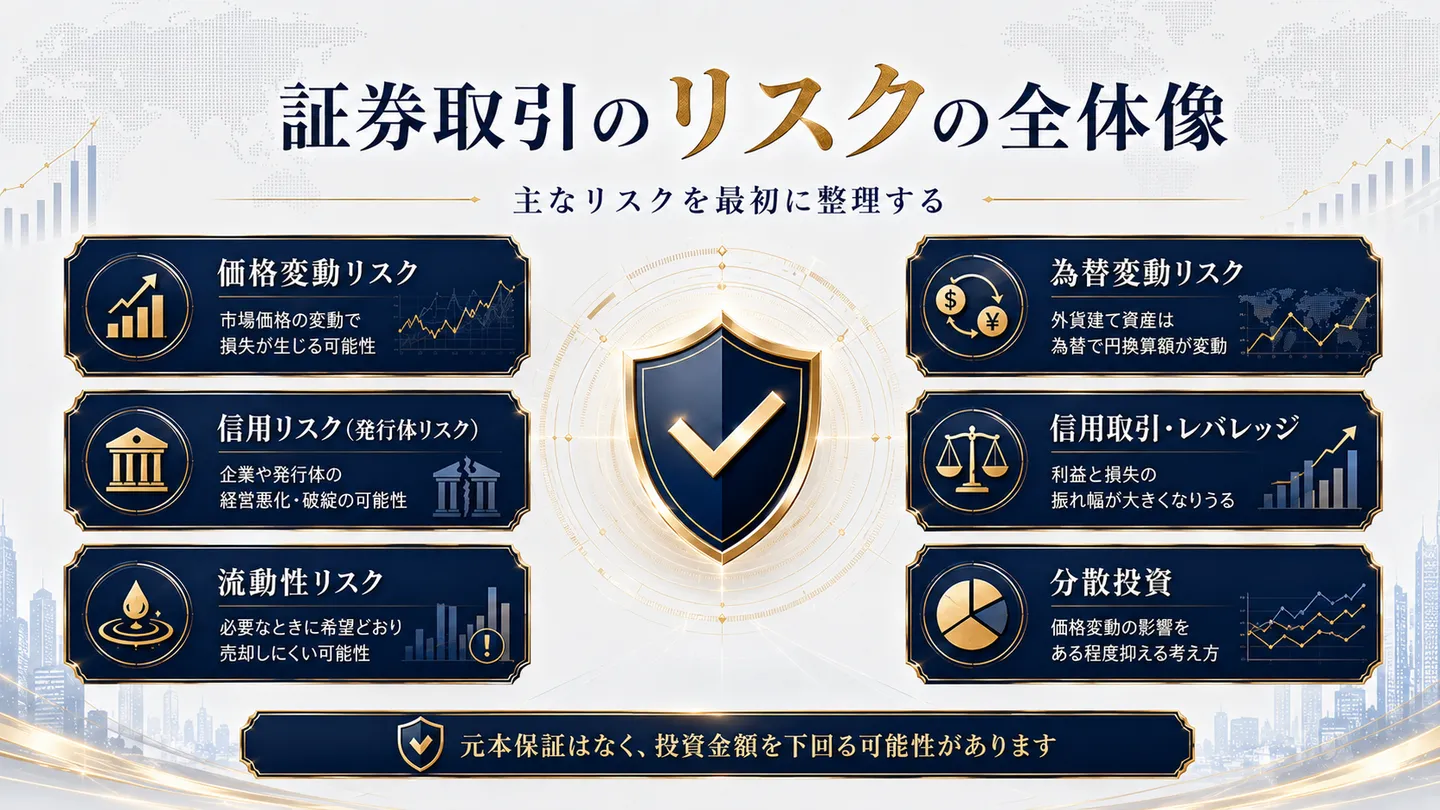
When investing in securities such as equities, investment trusts (投資信託) and bonds, what risks are involved? This article organises the main risks accompanying securities transactions, the relationship between risk and return that lies behind them, and the thinking about concentration and diversification, on the basis of information published by public authorities. There is no need to fear risk excessively, but neither is it appropriate to underestimate it. The purpose is to have readers confirm the facts that form the premise before they begin trading.
First, one premise of securities investment should be stated. With respect to investment products such as equities and investment trusts, the Financial Services Agency explains that, while a higher return than on deposits and savings may be expected, there is also a risk of loss of principal. In other words, securities transactions carry no guarantee of principal, and the value may fall below the amount invested. Below, on that premise, the representative risks worth checking are organised in turn. It should also be noted that the risks actually involved differ according to the product invested in (for bonds, for example, movements in interest rates), and that those listed here are not all of them.
Price fluctuation risk
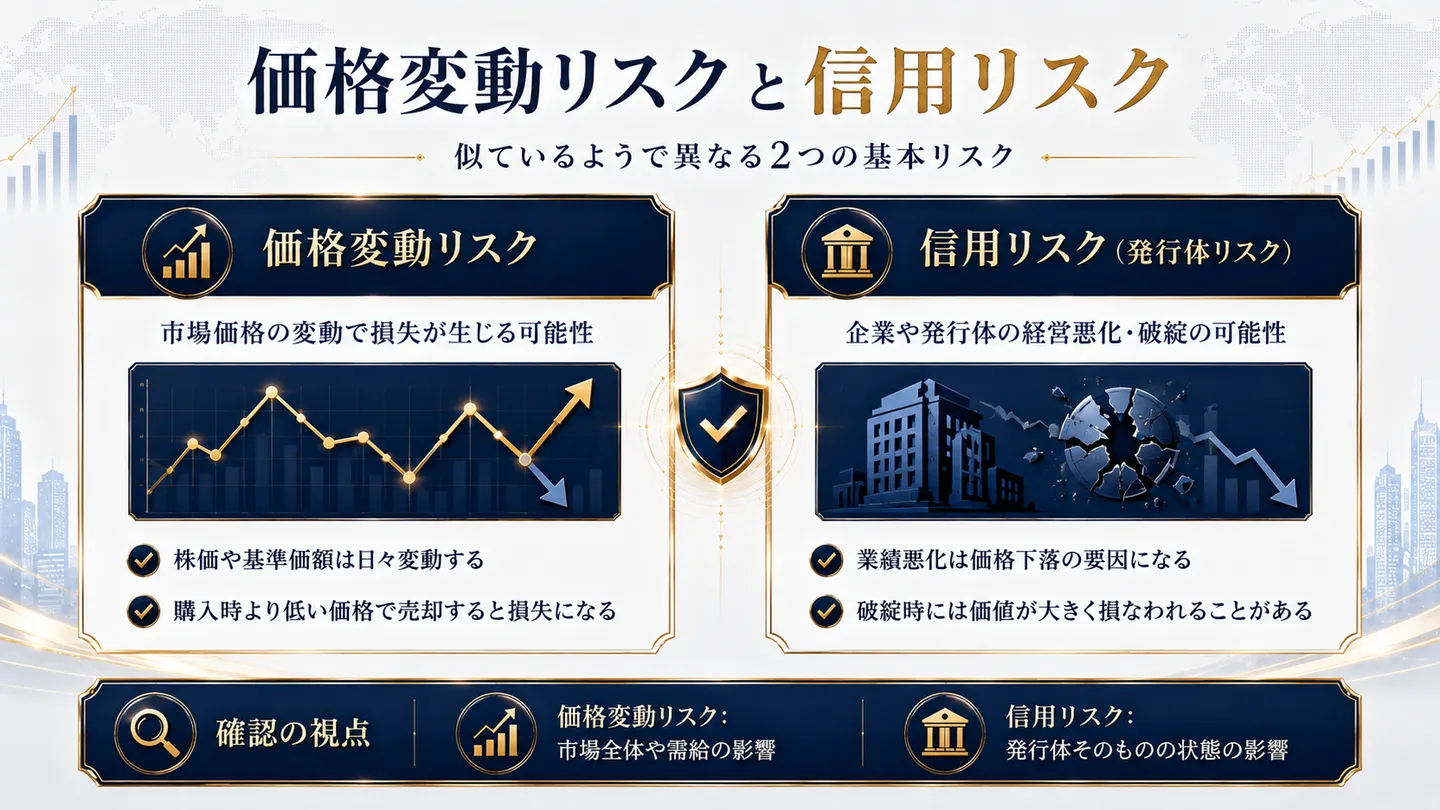
Price fluctuation risk is the most basic risk in securities investment. According to information published by The Central Council for Financial Services Information (金融広報中央委員会) — a body that was dissolved on 31 October 2024, its activities having been transferred in August 2024 to the Japan Financial Literacy and Education Corporation (J-FLEC, 金融経済教育推進機構) — price fluctuation risk refers to the possibility that prices move in the market as a result of matters such as the relationship between supply and demand, that the current market value becomes lower than the price at the time of purchase, and that a loss arises if the securities are sold.
For equities this means the share price, and for investment trusts the net asset value (基準価額), which fluctuate daily according to market conditions. The price may rise above the level at which the securities were bought, and it may also fall. If they are sold while the price has fallen, the proceeds fall below the amount paid at purchase and a loss arises. The reason that securities transactions carry no guarantee of principal is this price fluctuation. It cannot be taken for granted that “the price will certainly rise at some point”, or that “even if it falls, it will certainly return if one waits”; the matter needs to be understood on the premise that prices may move both up and down.
Credit risk (issuer risk)
Credit risk is also called issuer risk. According to information published by The Central Council for Financial Services Information, credit risk refers to the possibility of incurring a loss through a deterioration in the business of, or the failure of, a company that is the issuer of corporate bonds (社債), equities or similar instruments.
If, for example, the business of a company whose shares are held deteriorates, that becomes a factor in a fall in the share price. Should that company fail, the value of the shares held may be substantially impaired. The same applies to bonds: information provided on a site operated by J-FLEC lists the possibility that the issuer of a bond purchased may fail as a risk of bond investment. The creditworthiness of an issuer is not fixed and may change, and it is a risk worth checking alongside price fluctuation risk.
Liquidity risk
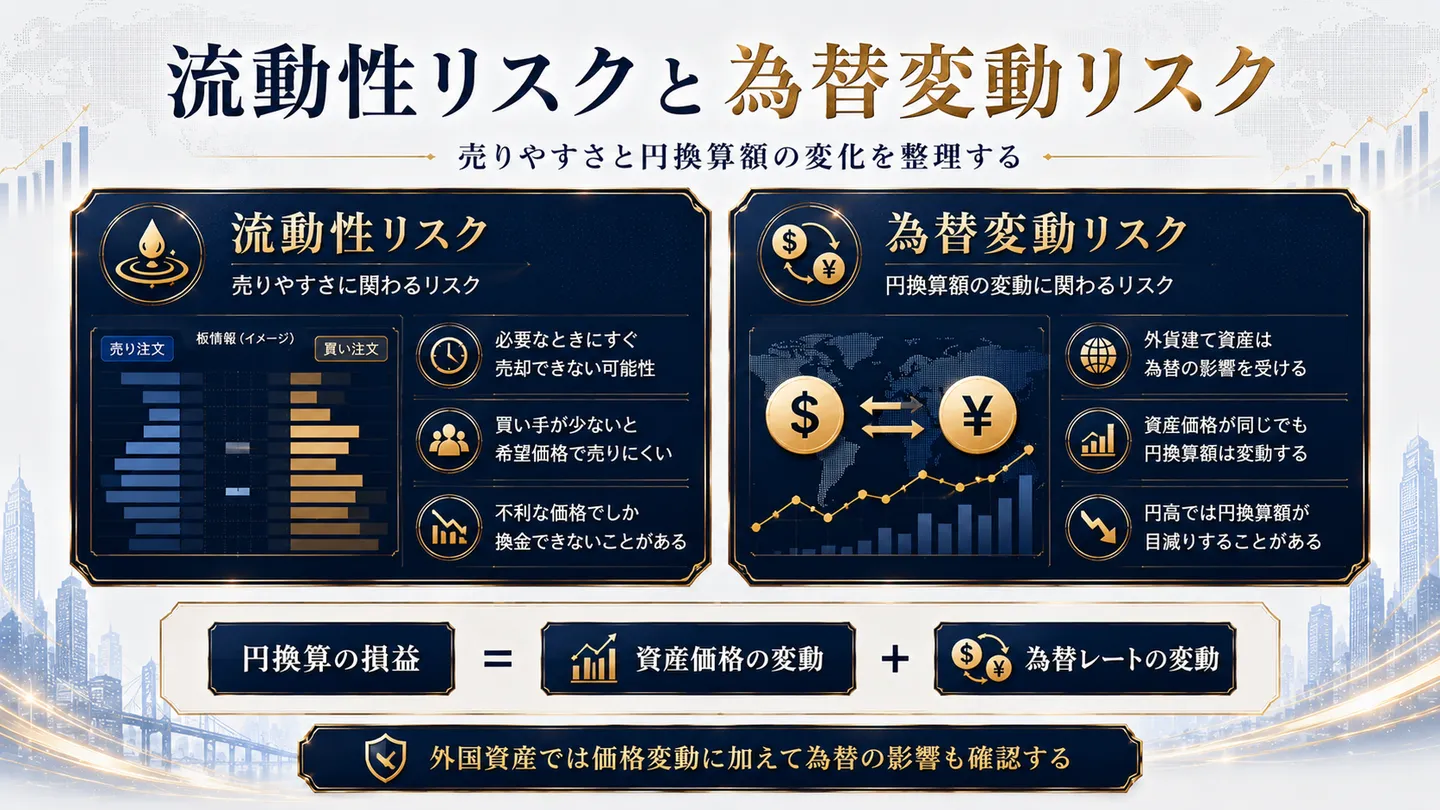
Liquidity risk, according to information published by The Central Council for Financial Services Information, refers to the possibility of not being able to realise cash or to sell immediately when necessary.
It is not always the case that securities can be sold at the desired price whenever one wishes to sell. With issues whose trading volume is small, buyers may be hard to find, so that it may not be possible to sell at the desired price, or the sale itself may take time. Depending on market conditions, situations also arise in which securities can be sold only at an unfavourable price. That it is not necessarily possible “to realise cash immediately, at the desired price, at any time” is another of the risks worth checking.
Exchange rate fluctuation risk
Where the investment is in securities denominated in a foreign currency, such as foreign equities (外国株式) or foreign bonds, exchange rate fluctuation risk is added. According to information published by The Central Council for Financial Services Information, exchange rate fluctuation risk refers to that part of price fluctuation risk which consists in the possibility of a loss arising specifically from movements in foreign exchange rates.
With securities denominated in a foreign currency, the value converted into yen increases or decreases through movements in the exchange rate between the yen and the foreign currency, even where the price of the security itself is unchanged. If, for example, the yen has strengthened at the time when the holding is cashed in, a loss may arise on the foreign exchange side (an exchange loss). When investing in foreign securities, it is necessary to proceed on the basis that, in addition to the price fluctuation of the security itself, movements in the exchange rate also affect profit and loss.
Points to check that are specific to foreign equities, such as foreign exchange and tax, are organised separately in Basics to check before starting with US stocks (foreign equities).
The relationship between risk and return
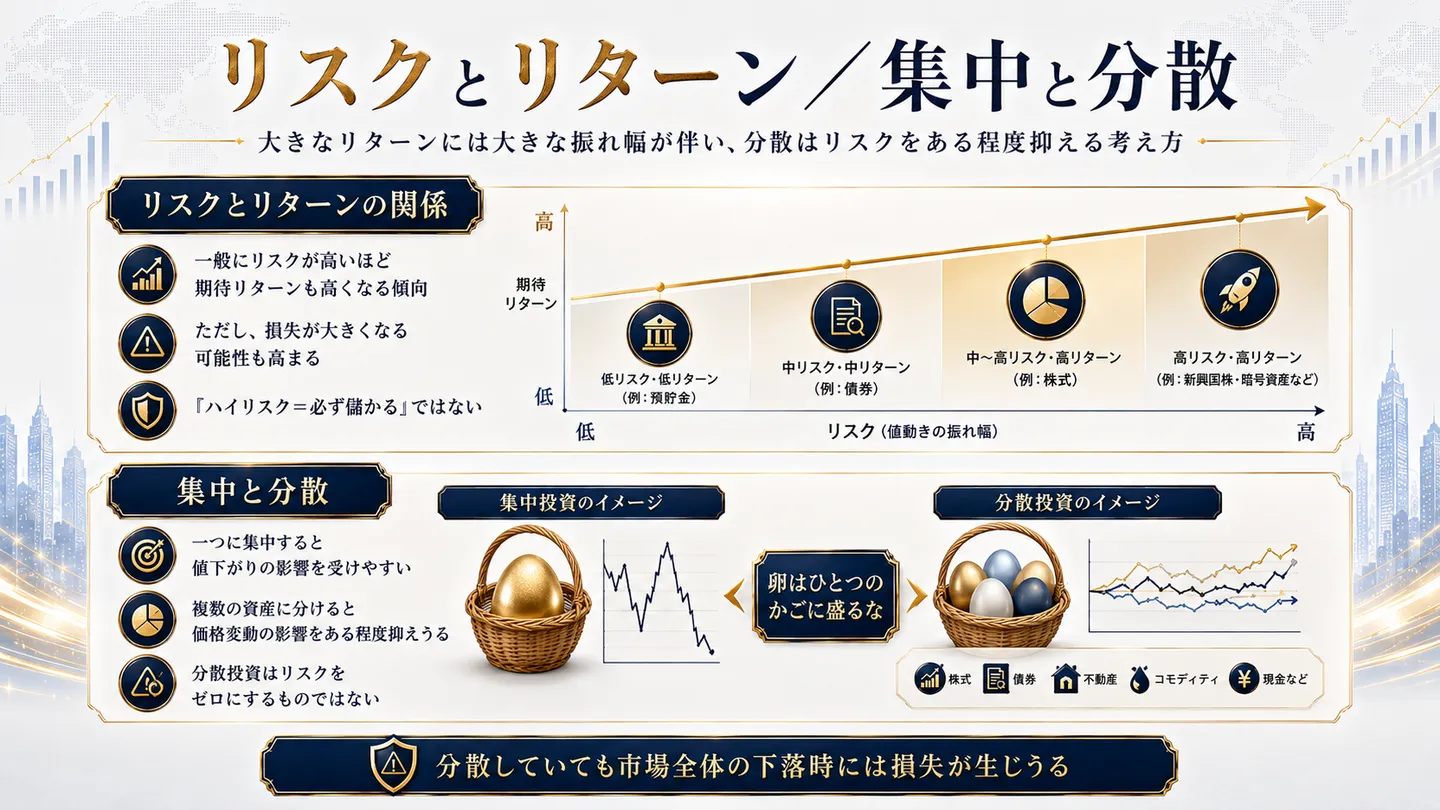
The relationship between the risks examined so far and the return that may be expected is also worth checking. According to information published by The Central Council for Financial Services Information, it is generally said that where risk is small the return is low (low risk, low return), and that where risk is large the return tends to be high (high risk, high return).
The point to note here is that this is no more than a general tendency, and does not mean that “taking on more risk is certain to produce a profit”. A transaction with large risk may offer the possibility of a high expected return, but it also carries a correspondingly greater possibility of a large loss. When encountering a proposition that advertises a high return, it is desirable to take the attitude of checking it calmly, on the premise that commensurate risk lies on the other side of it.
The thinking about concentration and diversification
If investment is concentrated in a single issue or a single asset, one is greatly exposed to the effect of a fall in the price of that asset. As a way of thinking that softens such effects, diversified investment is often introduced together with the saying that one should “not put all one’s eggs in one basket”.
However, it is not appropriate to take diversified investment as a method of reducing risk to zero. The Financial Services Agency explains that, by investing in a diversified manner across several assets whose prices move differently (domestic and overseas; equities, bonds, real estate and the like), the fluctuation in prices can be curbed to a certain extent and stable management can be aimed at. What matters is that the expression used is a cautious one — curbed to a certain extent. Diversification is a way of thinking that may soften the effect of price fluctuation, but it does not eliminate risk completely. The matter needs to be understood on the premise that, even where investments are diversified, a loss may arise in phases such as those in which the market as a whole falls.
Caution regarding 信用取引 (trading on credit) and leverage
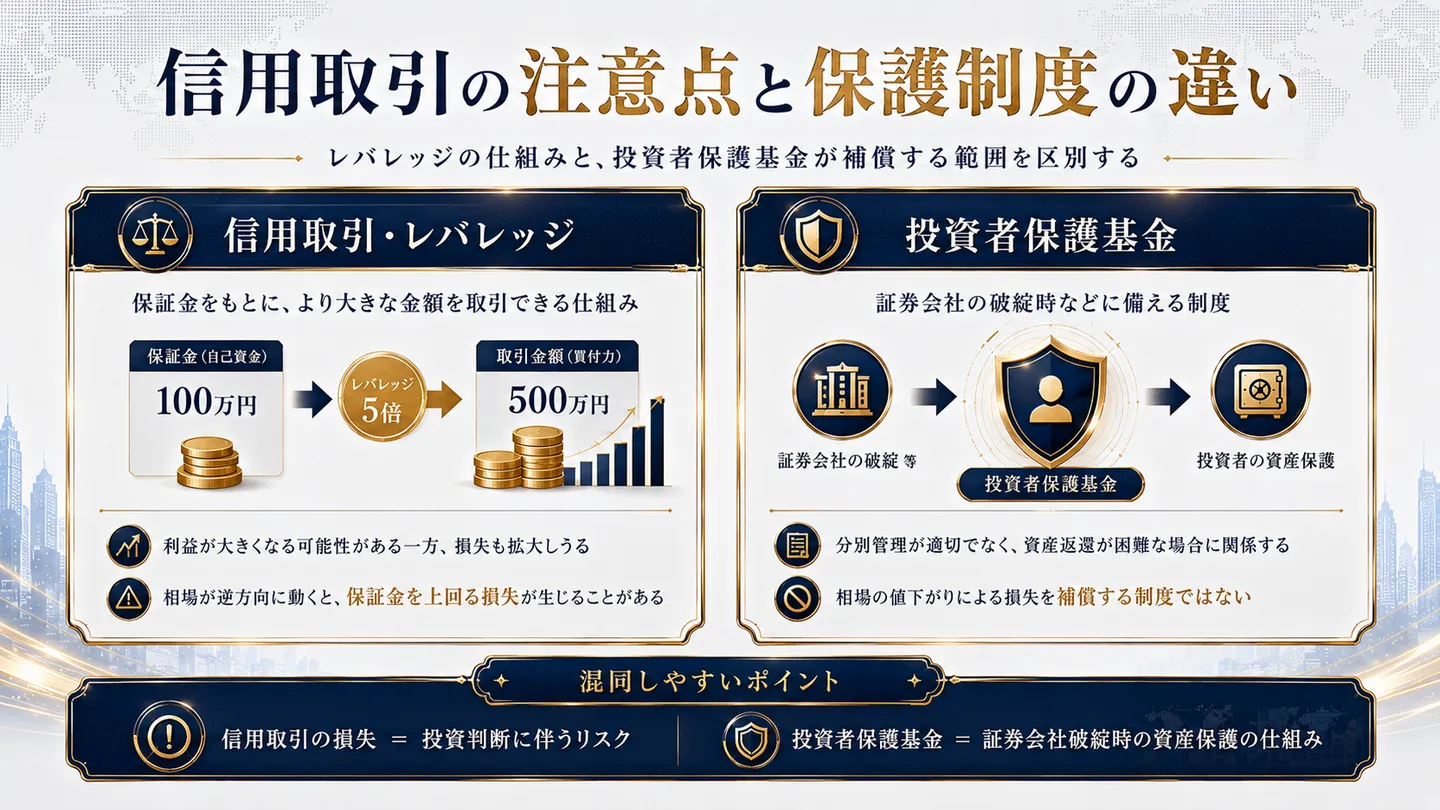
Securities transactions also include mechanisms under which an amount greater than one’s own funds can be traded. The representative one is 信用取引 (trading on credit extended by a securities company), a mechanism under which, by depositing 保証金 (guarantee money, that is, collateral), a transaction of several times that amount becomes possible (leverage, レバレッジ).
Under this mechanism, if the market moves as expected the profit becomes larger, while if the market moves in the opposite direction the loss may exceed the 保証金 deposited. In other words, it is a mechanism that may magnify both profit and loss, and a transaction in which risk may expand. Because the mechanism, the level of 保証金 required and the rules change with the scheme and with the point in time, the premise when considering use is to check the official information of each securities company and of bodies such as Japan Exchange Group.
Matters specific to FX (foreign exchange margin trading, 外国為替証拠金取引), such as the leverage regulation and the limits of the loss cut (ロスカット), are organised separately in Risks of FX trading and points worth checking.
The relationship with the investor protection fund
As a mechanism for protection when assets are deposited with a securities company, there is the investor protection fund (投資者保護基金). The one point worth checking here is that the investor protection fund does not compensate for losses arising from investment decisions, such as falls in price.
The investor protection fund is a scheme that provides against the case where a securities company fails and the return of assets becomes difficult because segregated management (分別管理) was not carried out appropriately; it is a separate matter from losses caused by market movements. The details of the schemes that protect assets are organised in Basic points to check before choosing a securities company.
Glossary
The main terms dealt with in this article are organised below.
- Price fluctuation risk: the possibility that prices move through matters such as supply and demand in the market and that, on sale, the price falls below the price at the time of purchase, so that a loss arises.
- Credit risk (issuer risk): the possibility of incurring a loss through a deterioration in the business of, or the failure of, a company that is the issuer of equities or bonds.
- Liquidity risk: the possibility of not being able to realise cash or to sell immediately when necessary.
- Exchange rate fluctuation risk: in relation to securities denominated in a foreign currency, the possibility of a loss arising through movements in foreign exchange rates.
- Diversified investment: dividing investment among several assets whose prices move differently. It is a way of thinking that may curb the effect of price fluctuation to a certain extent, but it does not eliminate risk completely.
Frequently checked questions
Is there a guarantee of principal in securities investment?
There is not. With respect to investment products such as equities and investment trusts, the Financial Services Agency explains that there is also a risk of loss of principal. Through price fluctuation, the value may fall below the amount invested. While a higher return than on deposits and savings may be expected, it is necessary to judge on the premise that principal is not guaranteed.
Is one safe if one invests in a diversified manner?
Diversified investment is not a method of completely eliminating risk. The Financial Services Agency explains that, by investing in a diversified manner across several assets whose prices move differently, the fluctuation in prices can be curbed to a certain extent and stable management can be aimed at. It is a way of thinking that may soften the effect of price fluctuation, but a loss may also arise in phases such as those in which the market as a whole falls. It is not appropriate to take it as meaning that “diversification makes one safe”.
Does greater risk mean greater profit?
Not necessarily. It is generally said that the greater the risk, the higher the return that may be expected tends to be, but this is no more than a general tendency. With a transaction of large risk, the possibility of a large loss also becomes correspondingly higher. Care is needed on the point that it is not the case that “taking on risk is certain to produce a profit”.
What changes when investing in foreign equities or bonds?
Securities denominated in a foreign currency involve exchange rate fluctuation risk in addition to price fluctuation risk. Even where the price of the security itself is unchanged, the value converted into yen increases or decreases through movements in the exchange rate between the yen and the foreign currency. If the yen has strengthened at the time of cashing in, a loss may arise on the foreign exchange side.
信用取引 is said to carry high risk — what does that mean?
信用取引 is a mechanism under which 保証金 is deposited and an amount several times that figure can be traded (leverage). If the market moves in the opposite direction, the loss may exceed the 保証金 deposited, and it is a transaction that may magnify both profit and loss. Because the mechanism and the rules change with the point in time, the premise when considering use is to check the official information of each securities company and of bodies such as Japan Exchange Group.
Summary
Securities transactions involve main risks such as price fluctuation risk, credit risk (issuer risk), liquidity risk and exchange rate fluctuation risk, all of which presuppose that principal is not guaranteed. In general, risk and return stand in a relation in which the greater the risk the higher the expected return tends to be, but that means that the possibility of a larger loss also increases. Diversified investment is a way of thinking that may curb the effect of price fluctuation to a certain extent, but it does not eliminate risk completely. In transactions that use leverage, such as 信用取引, the loss may exceed the 保証金 deposited.
Always check the latest trading conditions, fees and campaigns on each company’s official site. The information on this page is as at the time it was written.