
How to look at fees when comparing securities companies
When you want to compare securities companies on their fees, do you ever find yourself unsure what to look at and how to look at it? This article organises how to look at securities companies’ fees when comparing them, with the aim of handing the reader a way of comparing them correctly for themselves.
One premise comes first. This article does not deal with specific fee amounts, or with company-specific information such as whether a particular company is free of charge or low in cost. This is because fees are revised from one point in time to another, and because the products and trading conditions covered differ by company, so the most accurate and current information needs to be confirmed in each company’s official information. What this article presents is a framework for comparison: which viewpoints to look at, and how to align them when viewing them side by side.
The basic items involved in choosing a securities company, and where the structure of fees sits among them, are organised in Basic points to check before choosing a securities company. This article confines itself to one part of that, namely how to look at fees when comparing them.
Fees come in several kinds
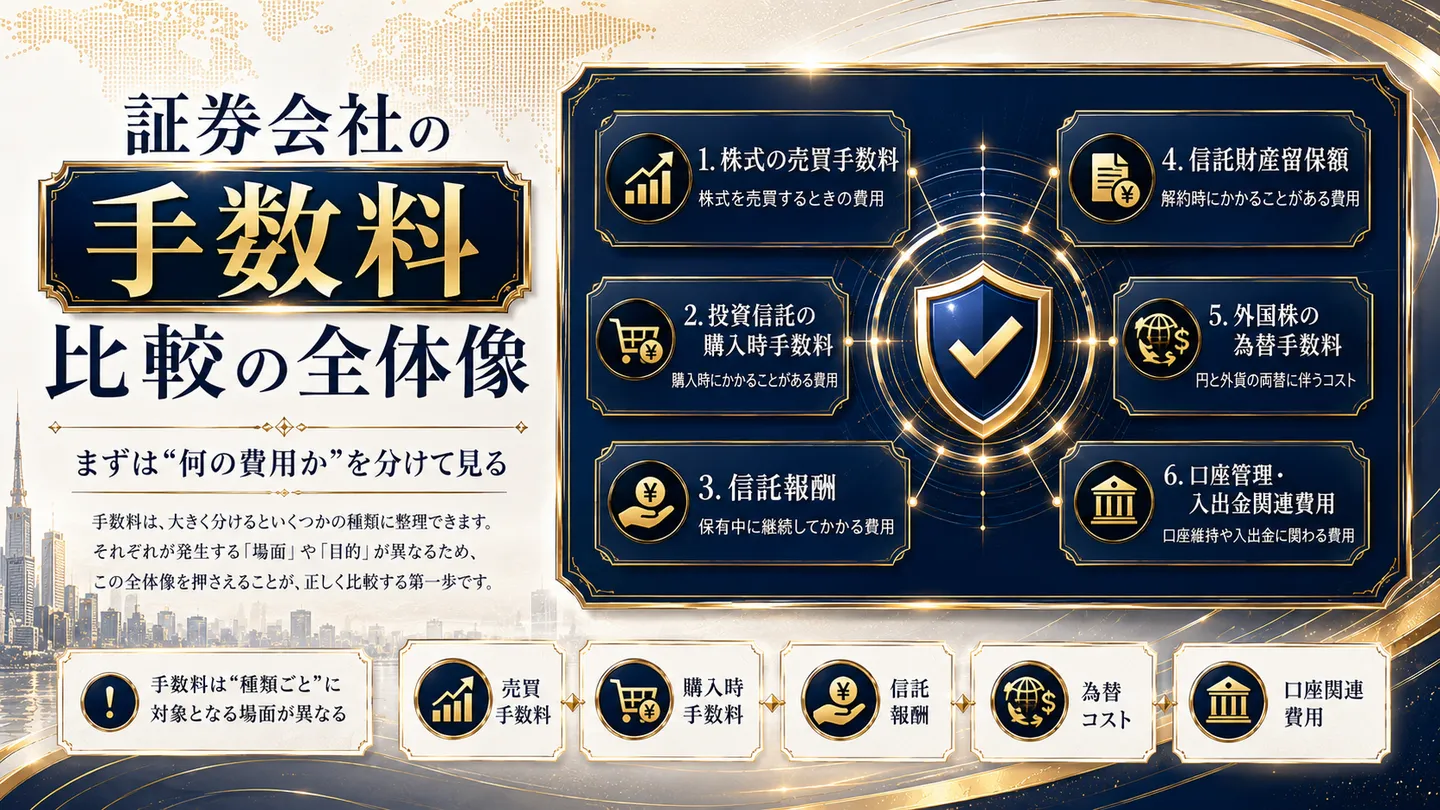
In comparing securities companies’ fees, the first thing worth grasping is that fees come in several kinds, and that the situations to which each kind applies differ. Although the single word “fee” is used, what the cost is charged on differs. Organising the representative ones gives the following.
- The trading commission on shares (売買手数料): the fee charged when shares are bought and sold.
- Fees on an investment trust (投資信託): with an investment trust there is the 購入時手数料(販売手数料), the fee charged at the time of purchase; the 運用管理費用, that is, the trust fee (信託報酬), which is charged throughout the period of holding; and the 信託財産留保額, an amount retained in the trust assets, which may be charged when the holding is cancelled and cashed in. Each is a separate cost belonging to a separate situation.
- The currency exchange fee on foreign equities (外国株式): where foreign equities are traded, a currency exchange fee (為替手数料) for converting between yen and a foreign currency is added, separately from the trading commission on the shares, as an effective cost.
- Costs relating to account administration and to deposits and withdrawals: there may be costs for maintaining an account or for depositing and withdrawing funds, and these too differ by company.
In this way, the situations to which fees apply each differ: when shares are bought and sold, while an investment trust is held, when it is cancelled, when currency is exchanged, and so on. When comparing, being conscious of which kind of fee it is that you will be paying is the starting point.
The detailed mechanics of each fee, and where they sit within the choice of a securities company, are organised in Basic points to check before choosing a securities company. The currency exchange fee on foreign equities is also touched on in Basics to check before starting with US stocks (foreign equities).
Fee structures differ by company
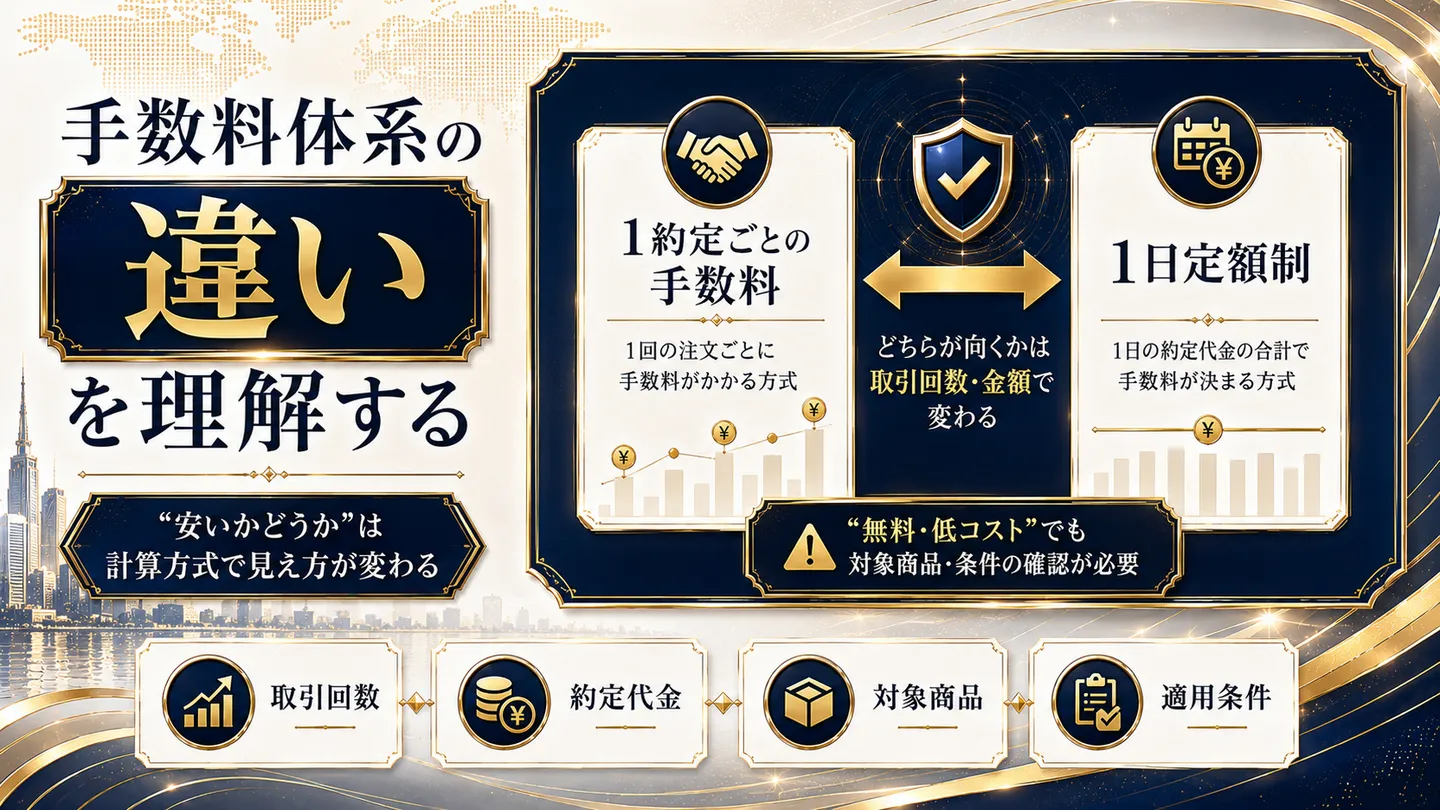
Fees differ by company not only in their amount but also in their structure, that is, in how they are calculated.
The brokerage commission (委託手数料) charged on the buying and selling of shares was liberalised in the past, and each securities company has since been able to set its own fees freely. This is the background to fee structures differing by company. It means that, even for the same trade, which method of calculation applies may differ from one company to another.
Two well-known examples of differences in structure are the following.
- A per-execution fee (1約定ごとの手数料): a structure under which a fee is charged on each order (each execution, 約定).
- A daily flat-rate fee (1日定額制): a structure under which the fee is determined according to the total executed value (約定代金) for the day.
Which of them suits you changes according to the frequency of your trading and the amount per trade. The organising point is that the structure likely to be favourable may differ between someone who trades many times and someone who trades few. It is not something settled uniformly as one being superior to the other.
In recent years, some companies put forward freedom from charges, or low costs, for the trading commission on domestic equities. However, the products and trading conditions that fall within the scope of what is free of charge or low in cost differ by company, so it is considered necessary to check in each company’s official information whether the conditions under which you trade are included within that scope. Rather than taking up the single word “free” and deciding on a company by that alone, checking the conditions under which it is free is considered desirable.
Comparing with the conditions aligned

As seen so far, fees come in several kinds, and their structures differ by company as well. For that very reason, the most important thing when comparing fees is to align the conditions of the comparison. This is because lining up fees whose conditions are not aligned does not allow a correct comparison.
Specifically, checking them with the following four conditions aligned is the basic approach.
- Align the product traded: domestic equities, an investment trust, or foreign equities. Where the product differs, the kinds of fee that apply differ. The trading commission on shares and the trust fee on an investment trust are costs belonging to different situations in the first place, so they cannot be mixed together and compared.
- Align the trade amount (the executed value): fees often change according to the band into which the executed value falls. Unless they are compared within the same band of amounts, one may be misled by apparent cheapness.
- Align the trading method: the fee that applies may change according to whether trading is done online or face to face, and according to how the order is placed.
- Align the trading frequency in your thinking: as stated above, which of per-execution and daily flat-rate is favourable changes with the number of trades. It is necessary to view the matter with your own trading frequency as the premise.
This is the backbone of the thinking involved in comparing fees. If figures alone are lined up without aligning the conditions, one may end up comparing things that cannot properly be compared. Taking your own way of trading as a single benchmark, and viewing companies side by side under the same conditions, is the premise for comparing correctly.
Fees alone do not settle the matter

Fees are an important viewpoint in choosing a securities company, but the cheapness of fees alone does not settle which company it is to be. When looking at fees, there is a perspective of looking at elements other than fees together with them.
For example, there are the following viewpoints.
- The range of products handled: whether the products you want to trade are handled.
- Trading tools and applications, and information services: whether you find them easy to use.
- Support arrangements, trading hours and the minimum investment amount: whether they suit your own way of trading.
- Costs incurred while holding: this is a point that is particularly easy to overlook. Even where the trading commission is low, the trust fee on an investment trust is charged throughout the period of holding, so where it is held for the long term, the difference in the burden may accumulate. The explanatory material of the Financial Services Agency also organises the point that the costs of an investment trust include those incurred at the time of purchase, those incurred while holding and those incurred at the time of cancellation, and that costs incurred while holding have a larger effect the longer it is held.
In other words, there is a perspective of viewing matters in the round, including the costs incurred by continuing to hold, rather than looking only at the fees incurred at the time of buying and selling. How to check each of these elements in detail is organised in Basic points to check before choosing a securities company.
Fees change from one point in time to another
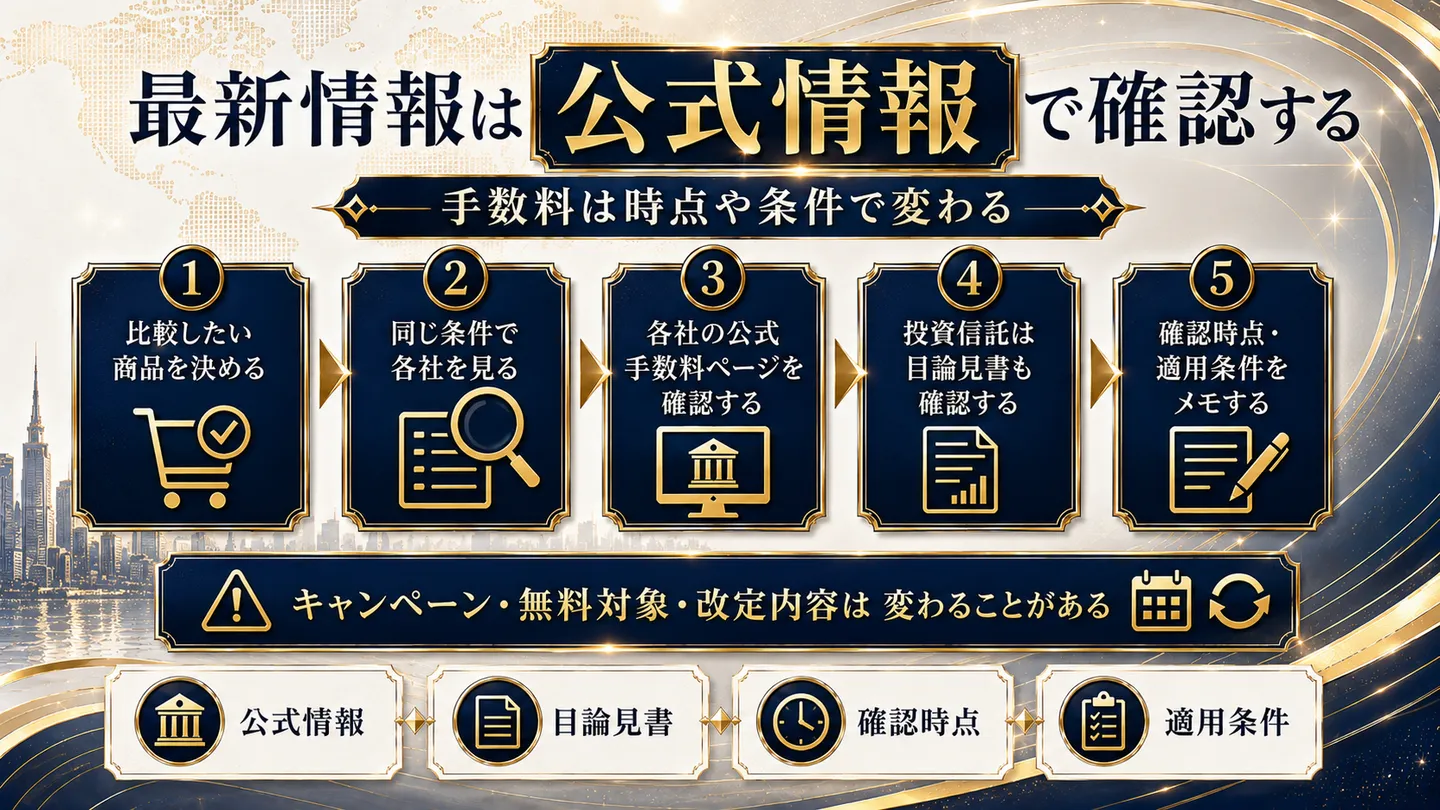
The last thing worth bearing in mind is that fees change from one point in time to another. Each company’s fee structure, the scope of what is free of charge or low in cost, and the various campaigns may be revised.
For that reason, information on fees that have been compared always carries with it the question of as at what point in time, and under which conditions, it stands. The organisation in this article is as at 6 June 2026, but each company’s conditions may change thereafter. When comparing, it is considered desirable to confirm the information each company officially discloses, aligned to points in time that are as close together as possible. Specific fee amounts, and the costs of an investment trust, can be confirmed in each company’s official information and, in the case of an investment trust, in the prospectus (目論見書).
Terms organised
The following organises the terms used in this article that a first-time reader may wish to check.
- Brokerage commission on share trading (株式売買委託手数料): the fee charged when the buying and selling of shares is entrusted to a securities company. It was liberalised in the past, and each company can set it freely.
- Per-execution / daily flat-rate (1約定ごと/1日定額): the classification of structures for the trading commission on shares. There is a method under which a fee is charged on each order, and a method under which it is determined according to the total executed value for the day.
- 購入時手数料(販売手数料): the fee paid to the distributor when an investment trust is purchased. Even for the same investment trust, it may differ from one distributor to another.
- 運用管理費用(信託報酬), the trust fee: the cost charged throughout the period for which an investment trust is held. It is deducted from the trust assets.
- 信託財産留保額: a cost that may be charged when an investment trust is cancelled and cashed in. There are also ones on which it is not charged.
- ノーロード(ノーロードファンド): an investment trust on which no 購入時手数料 is charged.
- Currency exchange fee (為替手数料): the effective trading cost incurred when exchanging yen and a foreign currency, in foreign equities and similar products.
- Prospectus (目論見書): the official document in which the costs and the content of an investment trust can be checked.
Frequently checked questions
Which securities company has the cheapest fees?
Fee structures differ by company, and they also change according to the product, the trade amount, the trading method and the trading frequency concerned. They are also revised from one point in time to another, so this article does not assert where the cheapest is. When comparing, please align the product, the amount, the method and the frequency with which you trade, and then check each company’s official information. It is considered that lining up figures alone, without aligning the conditions, does not allow a correct comparison.
Is it enough to choose a company whose trading commission on domestic equities is free of charge?
Some companies do put forward freedom from charges or low costs, but the products and trading conditions that this covers differ by company. The basic step is to check in each company’s official information whether the conditions under which you trade are included within the scope of what is free of charge. Fees are also one element in choosing a company, and it is considered that there is a perspective of viewing matters in the round, including the products handled and the costs incurred while holding.
What should be looked at for the fees on an investment trust?
The costs of an investment trust include costs belonging to different situations: the 購入時手数料(販売手数料), charged at the time of purchase; the 運用管理費用(信託報酬), charged throughout the period of holding; and the 信託財産留保額, which may be charged at the time of cancellation. The trust fee in particular accumulates in its effect the longer the holding is continued. For the specific costs, please check the prospectus and each company’s official information.
Which is better, per-execution or daily flat-rate?
Which of them suits you changes according to the frequency of your trading and the amount per trade, so it cannot be settled uniformly as one being better. It can be organised as follows: the structure likely to be favourable may differ between someone who trades many times and someone who trades few. The basic step is to take your own way of trading as the premise and check each company’s official information.
Where can the figures for fees be confirmed?
For specific figures for fees, the information each company officially discloses is the primary source. As regards the costs of an investment trust, they can also be confirmed in the prospectus. This article does not deal with specific figures. When comparing, it is considered desirable to confirm each company’s official information aligned by the same product, the same amount and the same trading method, and at points in time that are as close together as possible.
Summary
This article has organised how to look at securities companies’ fees when comparing them. That fees come in several kinds, and that the situations to which each kind applies differ. That fee structures differ by company, and that the scope of what is free of charge or low in cost differs between companies as well. That when comparing, viewing them with the conditions of the product, the amount, the method and the frequency of trading aligned is the backbone. That there is a perspective of viewing matters in the round, including the products handled and the costs incurred while holding, and not the cheapness of fees alone. And that, because fees change from one point in time to another, each company’s official information is to be confirmed aligned to points in time that are as close together as possible. We hope you will use these as a map for comparing correctly for yourself.
Articles to read next
As a reference when taking forward the checking of securities companies’ fees, the following articles may also be of use.
- Basic points to check before choosing a securities company
- Basics to check before starting with US stocks (foreign equities)
- Points to look at when comparing FX companies (as a reference for the idea of aligning the conditions of a comparison)
Always check the latest trading conditions, fees and campaigns on each company’s official site. The information on this page is as at the time it was written.