
How to read TradingView's economic calendar (displayed items, filtering, importance indicators, time display and revisions to past values)
An economic calendar is a list, arranged in order of date and time, of such things as the release schedules of each country’s economic statistics and the meeting dates of central banks. The screen lines up items such as the date and time, the country, the name of the indicator, the importance, and the previous value, the forecast and the result; what each of those columns means, however, can be hard to tell simply by looking at the screen.
This article checks the items displayed on the screen of an economic calendar, and what operations such as filtering by country or by period actually do. On that basis, it separates out and organises how much of the information lined up on the same screen corresponds to what the publishing body releases, and from where it is something added by the provider of the calendar. It does not recommend any particular financial instrument or transaction.
What this article deals with is the displayed items and the operations of the calendar as a screen. It does not deal with what statistic each individual indicator measures, or with how the market moves before and after a release. Indicators themselves are organised in The basics of FX and economic indicators (price movement at the time of a release, and points of caution). The division is that indicators themselves belong there, and the calendar screen and its operations belong here.
What an economic calendar is a list of
The release schedules lined up in an economic calendar correspond to what each publishing body itself makes public in advance.
For example, the Cabinet Office’s Economic and Social Research Institute publishes, in list form, the release schedule for the Quarterly Estimates of GDP (四半期別GDP速報), including the period covered, the release date and the release time. The Bank of Japan maintains a page headed 「公表予定」 (its release schedule). In the United States, the Board of Governors of the Federal Reserve System publishes the meeting dates of the Federal Open Market Committee (FOMC), and the U.S. Bureau of Economic Analysis (BEA) publishes the release schedule for economic indicators, each in list form.
An economic calendar can be organised as these schedules — published separately by each publishing body — rearranged side by side, across bodies, in order of date and time.
Not everything lined up on the screen, however, corresponds to what the publishing body releases. As described below, information added by the provider of the calendar, such as the importance indicator and the forecast figures, is lined up on the same screen. It is therefore not the case that all of the information appearing in a calendar can be traced back to official information from the publishing body. Which items correspond to what the publishing body releases, and which items are additions by the provider, need to be looked at separately.
Lists of this kind are provided by securities companies, financial information services and others. This economic calendar is one such example (the link goes to TradingView’s site). Whichever service is used, the release dates and times and the institutional basis dealt with in this article come from official information published by each publishing body, and are not based on what any particular service displays.
On the other hand, which items are displayed on the screen and what filtering is possible are matters of that service’s own specification. On this point alone, this article refers to the explanations in the official help pages published by the provider. What is referred to extends only to explanations of functions, screen composition and operations; it is not used as the basis for facts such as release dates and times, institutional arrangements or revisions to statistics.
Calendars of this kind may also come with lists covering such things as company earnings and dividends, in addition to economic indicators. What this article deals with is the list covering economic indicators.
Note that a schedule published in advance is not a fixed promise. The Cabinet Office’s release schedule carries a note to the effect that the schedule shown is the schedule as at the present time and may change. The Bank of Japan’s release schedule likewise carries a note to the effect that release dates and release times may be changed. The Bank of Japan also states that, as a rule, it aims to publish the following year’s scheduled meeting dates at around the middle of the year. How far ahead a calendar shows future dates depends on how far ahead each publishing body has published its schedule at that point in time.
What the items lined up in a calendar mean
The names of the items on the screen and the order in which they are arranged differ depending on the service, and the same content may be called by a different name. Of what follows, the description of the screen composition and the operations is based on the explanations in the official help pages published by the provider of the economic calendar to which this article links. Screen displays may change, and the appearance also differs depending on the device and the screen width, so this article does not assert any particular screen wording or layout.
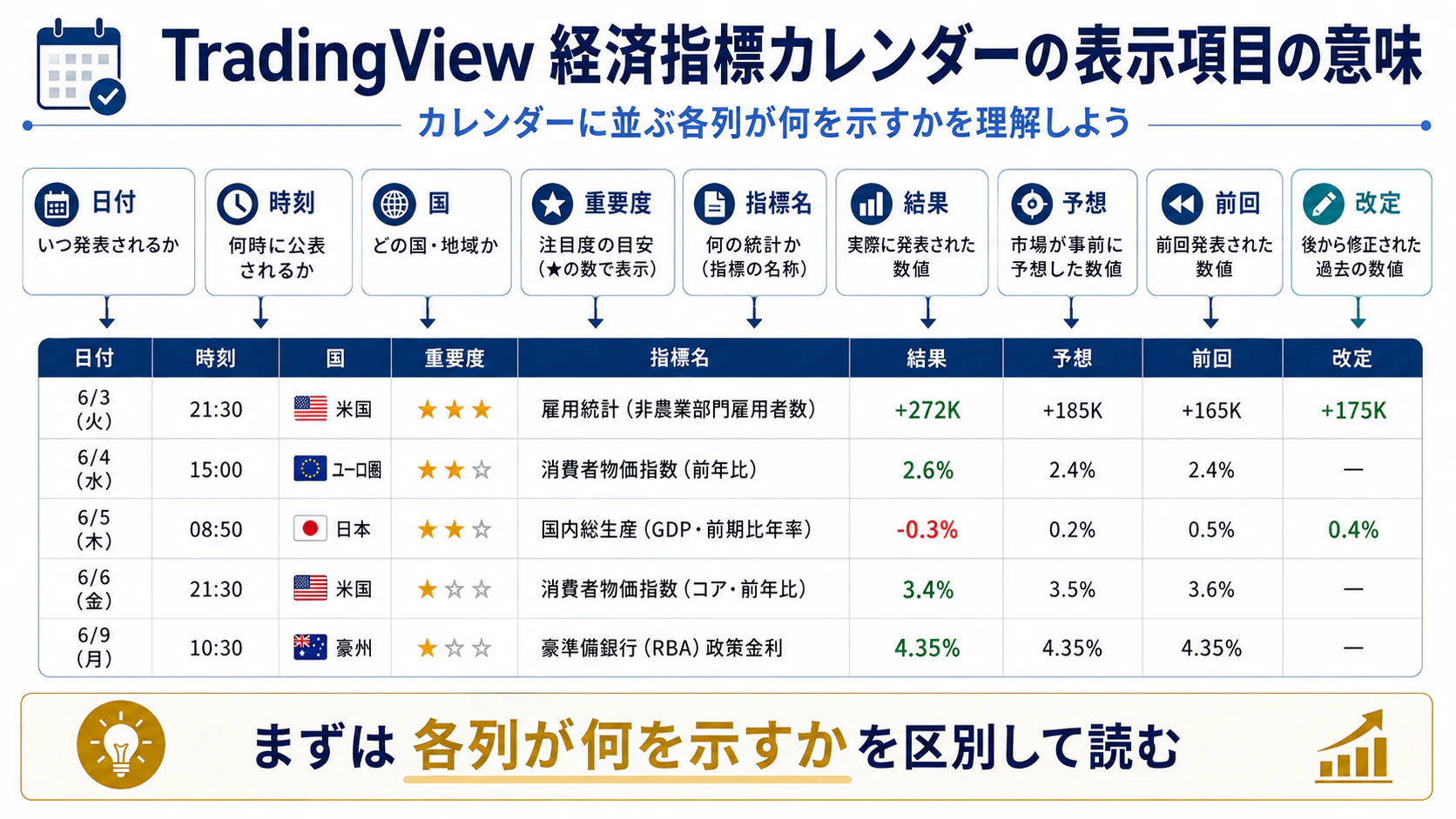
The provider’s official help explains that the list has a column for the time, a column for the country and a column for the event name, and that an indication of the importance of the event is placed alongside the display of the country. Separately from these, three columns corresponding to 「結果」「予測」「前回」 are described, and in the English-language help these are labelled Actual, Forecast and Prior respectively. Because the wording actually used on the screen is not necessarily the same as this, this article organises matters not by the names of the columns but by what each column shows.
| Displayed item | What it shows |
|---|---|
| Date and time | The day and time on which the statistic is scheduled to be released, or on which the meeting is scheduled to be held. What time is displayed changes, in many cases, according to the time zone setting for the display |
| Country/region | The country or region to which the body releasing the statistic or the decision belongs |
| Name of the indicator | The name of the statistic being released or of the meeting being held. The formal name used by the publishing body and the name used in the market can differ |
| Importance | A classification that the provider of the calendar has set up on its own. Whether it is something attached by the publishing body could not be confirmed within the range checked for this article |
| Previous value | The value released on the previous occasion for the same statistic. It may be revised later |
| Forecast | A figure presented as the value expected before the release. It is not something released by the public body that publishes the statistic |
| Result | The value actually released |
The formal name of an indicator and the name it is known by can differ
Even for the same statistic, the formal classification name used by the publishing body and the name widely used in the market may not coincide. The Consumer Price Index (消費者物価指数), for example, has several classifications covering different ranges of items, and the Statistics Bureau attaches a formal classification name to each. Where the wording in a calendar is an abbreviation or an informal name, which classification it refers to is something to be confirmed in official information from the publishing body.
The correspondence between formal names and the names indicators are known by is organised in The basics of FX and economic indicators (price movement at the time of a release, and points of caution).
The three figures: the previous value, the forecast and the result
These three differ in character.
- The previous value: the value released on the previous occasion for the same statistic. As described below, however, past figures may be revised, and may not match a value seen earlier.
- The forecast: a figure presented as the value expected before the release. Within the range of official information from public bodies checked for this article, no statement was found that the publishing body releases this figure. Nor was any explanation found in the provider’s official help as to where this figure comes from. Because information showing who compiles it, and how, has not been confirmed, this article does not identify who compiles it. Note that a publishing body may itself release a projection — as the Bank of Japan does with 「経済・物価情勢の展望(展望レポート)」 (its report on the outlook for economic activity and prices) — but that is the central bank’s own projection, and differs in character from the figure placed in a calendar’s forecast column.
- The result: the value actually released. As described below, however, there are also statistics for which the same subject is released in several instalments, so a single release does not necessarily settle the figure.
This article does not present any relationship such as the larger the gap between the forecast and the result, the more the market moves. The relationship between releases and price movement is organised in The basics of FX and economic indicators (price movement at the time of a release, and points of caution), including the point that the direction is not determined by a single indicator alone.
Filtering and switching the display
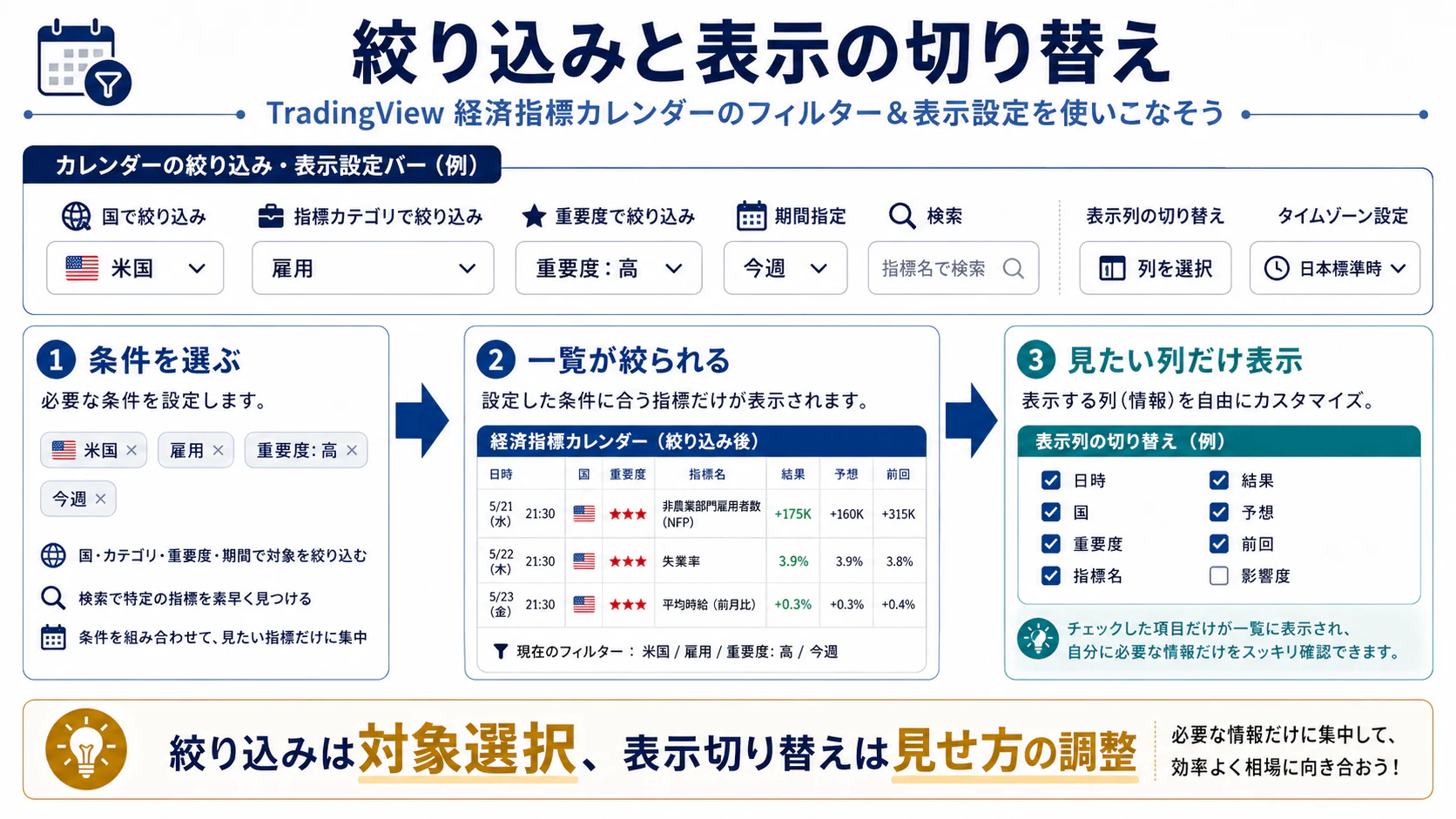
The events lined up in the list can be filtered by specifying conditions. The provider’s official help explains filtering of the following kinds.
| Filter | What is explained |
|---|---|
| Country | You can select the countries for which you receive event information. Several countries can be selected, and a setting covering the whole world can also be chosen |
| Period | The display can be switched between divisions such as upcoming events, what was released on the previous day, and the current day, the next day or the current week |
| Category | Filtering is possible by category, such as interest rates, inflation and bonds (these are the examples given in the official help, and do not represent the whole set of categories) |
| Importance | A switch is available that displays only those events treated as having the highest importance |
| Time zone | A time zone can be selected |
While a filter is set, releases that fall outside the conditions are not displayed on the screen. The fact that something is not displayed does not mean that there is no release scheduled. Filtering by importance in particular is based on a classification set up by the provider of the calendar, as described below, so the filtered result also depends on that classification. Whether a release takes place, and its date and time, are to be checked in official information from each publishing body.
What you can do when you open an event in the list
The provider’s official help explains that selecting an event in the list presents three operations: opening a chart, moving to an overview page for the subject concerned, and adding the event as a scheduled item to an external calendar.
What the official help explains extends only to an outline of each destination. It cannot be assumed that past movements or an explanation of the indicator can be checked at the destination. Backing for figures and dates is to be checked in official information from each publishing body.
What the publishing body releases, and what the calendar side adds
Even where items are lined up on the same screen in the same style, where the information comes from differs from item to item. What has been checked so far is organised below, divided into what corresponds to the content released by the publishing body and what is added by the provider of the calendar.
| The item on the screen | Where the information comes from | Where it can be traced back to |
|---|---|---|
| Date and time | It is the publishing body that determines the date and time of release. What time is displayed on the screen, however, changes in many cases according to the display time zone setting on the calendar side. | The release schedule of each publishing body |
| Country/region | An attribute corresponding to the body that releases the statistic or the decision. | Official information from each publishing body |
| Name of the indicator (event name) | The name in the list is the calendar side's wording. It does not necessarily coincide with the formal classification name used by the publishing body. | Official information from each publishing body |
| Importance | A display attached by the provider of the calendar. No explanation of its criteria or of who determines it was found in the provider's official help. Nor was any classification attaching a rank of importance to indicators found in the information released by the publishing bodies checked for this article. | No corresponding publication by a publishing body was found within the range checked for this article |
| Forecast | A figure attached by the provider of the calendar. It is not something released by the public body that publishes the statistic. Nor was any explanation of where the value comes from found in the provider's official help. | No corresponding publication by a publishing body was found within the range checked for this article |
| Result | It corresponds to the value actually released. How this column is explained on the screen, however, is a description on the calendar side. | The materials released by each publishing body |
| Previous value | It corresponds to the value released on the previous occasion for the same statistic. It may, however, be revised later by the publishing body. | The materials released by each publishing body |
This division is the premise for reading a calendar. The date and time, the result and the previous value can be traced back to, and checked against, what the publishing body releases. For the importance and the forecast, on the other hand, no publication to trace them back to could be found within the range checked for this article. In other words, even where items are lined up on the same screen, they differ in whether there is anywhere to check them against.
How to read the importance indicator, and its limits
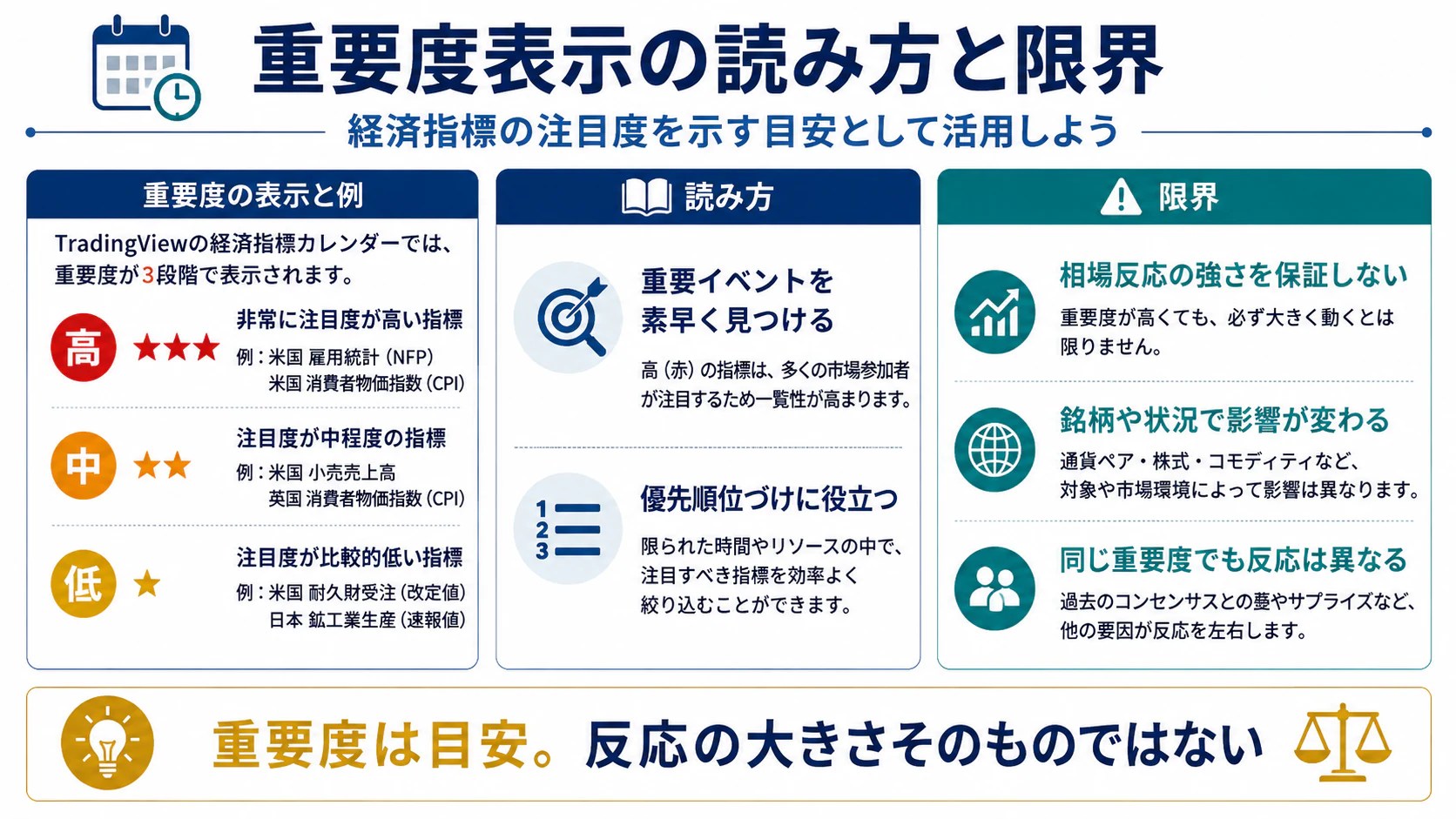
Many calendars have a display indicating the importance of each indicator. As set out in the previous section, this is a classification that the provider of the calendar has set up on its own.
Within the range of information released by the publishing bodies checked for this article (the Cabinet Office, the Statistics Bureau, the Bank of Japan, the Board of Governors of the Federal Reserve System, the European Central Bank and the U.S. Bureau of Economic Analysis), no classification attaching a rank of importance to indicators was found. Nor was any explanation found in the provider’s official help as to the criteria on which the importance is determined, or by whom.
Two points can be read from this.
- The classification and the criteria for importance may differ between services, even for the same indicator
- An importance indicator does not necessarily reflect an official classification laid down by the publishing body
An importance indicator is a classification that the provider of the calendar sets up for the convenience of viewing; it does not indicate how much the value will move at the time of release. It cannot be read as meaning that an indicator displayed as having high importance will move a great deal, or that one displayed as low will not move. The reason is that the size of price movement is not determined by the type of indicator alone.
Points of caution on the time display and time zones
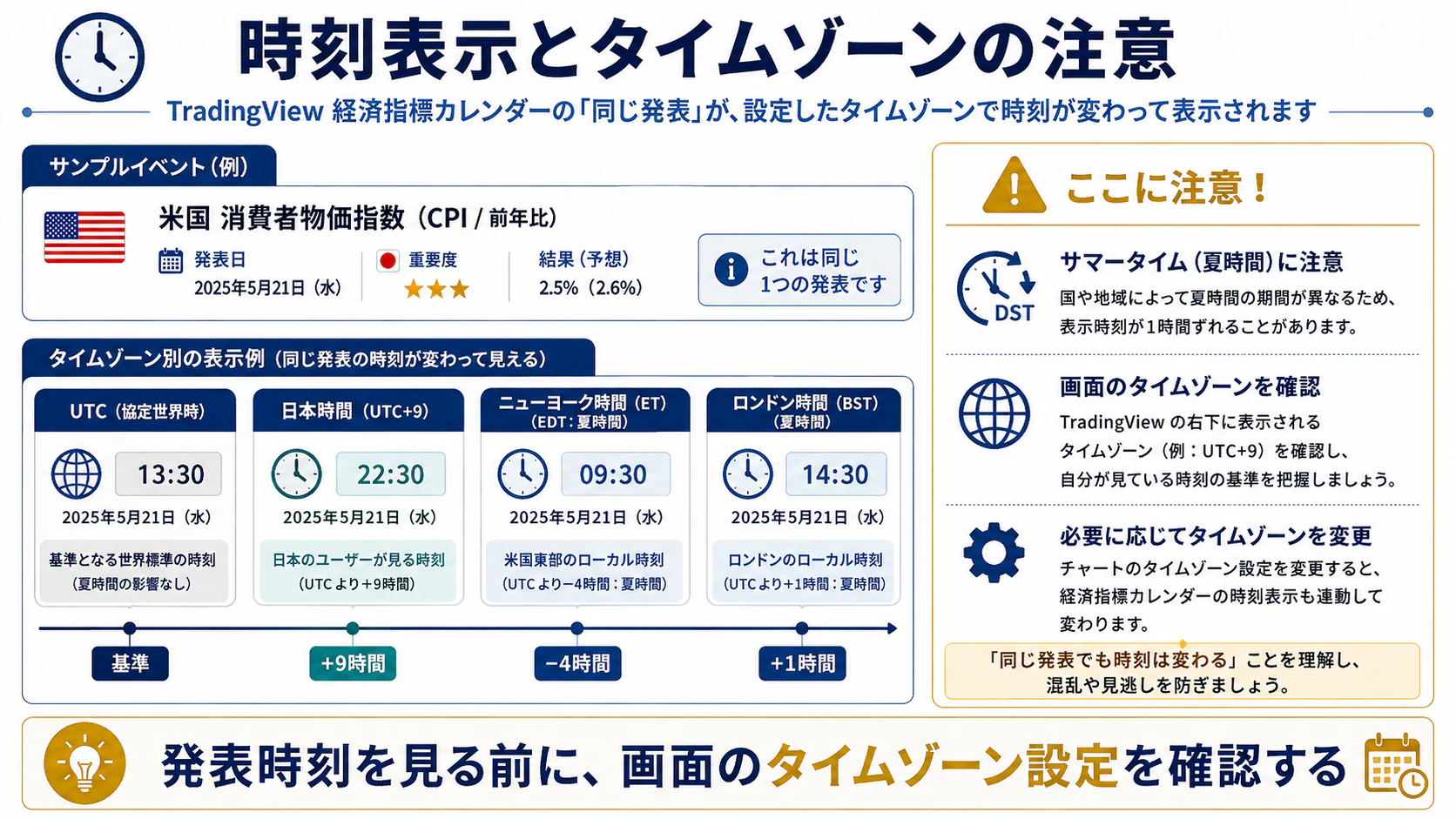
In most cases, the time display in a calendar is set up so that the user can set the time zone in which times are displayed. That is to say, the time appearing on the screen may be displayed as a different time for the same event, depending on the setting.
Publishing bodies set release times in the time that serves as their own standard
The publishing body, on the other hand, sets the release time in the time that serves as its own standard.
- The Statistics Bureau states that, for the Consumer Price Index, the index for the whole of Japan for the previous month is released at 8:30 a.m. (Japan time) on the Friday of the week containing the 19th of each month. The mid-month preliminary figure for the current month for 東京都区部 (the ward area of Tokyo) is stated to be released at 8:30 a.m. (Japan time) on the Friday of the week containing the 26th of each month.
- The European Central Bank (ECB) states that it announces monetary policy decisions by press release at 14:15 CET on the day of the Governing Council’s monetary policy meeting.
- Official US statistics likewise have release times laid down in local time alongside the release date, and these are published in list form in advance. BEA’s release schedule is one example.
In other words, the time shown in a calendar can be organised as the local time laid down by the publishing body, converted into the display time zone set by the user. Knowing what time this corresponds to in Japan time requires adding or subtracting the time difference, and that difference also changes with the season. This article does not give converted Japan-time values for any particular indicator.
For some events the release time is not fixed in advance
It is not the case that the release time is determined in advance for every event. The Bank of Japan, for example, states that it releases the decisions of a Monetary Policy Meeting (金融政策決定会合) immediately after the meeting ends. In this case the timing of the release is tied to the end of the meeting rather than to a time, so the time cannot be fixed in advance. For events of this kind, the time displayed in a calendar may be considered to be placed there as a rough guide.
The switchover dates for daylight saving time do not coincide across countries and regions
The release time as seen in Japan time may change part-way through the year. This is because of the switchover of daylight saving time (夏時間/サマータイム).
What is worth noting here is that the dates of the switchover are not aligned across countries and regions. For the United States, the National Institute of Standards and Technology (NIST) indicates that daylight saving time begins at 2:00 a.m. on the second Sunday in March and ends at 2:00 a.m. on the first Sunday in November. For the EU, Directive 2000/84/EC provides that the summer-time period begins at 1:00 a.m. Greenwich Mean Time on the last Sunday in March and ends at 1:00 a.m. Greenwich Mean Time on the last Sunday in October.
For this reason, the periods in which release times in Japan time shift arrive separately for the United States and for Europe. When following the same indicator over time, the displayed time may appear to have changed either side of a switchover.
The system of daylight saving time itself, and its relationship with the time bands of the markets, are organised in The basics of FX trading hours and markets (the Tokyo, London and New York markets, daylight saving time, weekends and the year-end and New Year period).
The same subject is released in several instalments
Looking through a calendar, the same statistic name or the same meeting name may appear more than once on different days. This is not duplication; it results from a structure in which the releases relating to a single subject are divided into several occasions.
| Subject | How the release is divided | The publishing body of the official information |
|---|---|---|
| Quarterly Estimates of GDP (Japan) | For the same quarter, 「1次速報」 (the first preliminary release) and 「2次速報」 (the second preliminary release) are published on different days. When the second preliminary release is published, material explaining the reasons for the revision is published alongside it. | The Cabinet Office's Economic and Social Research Institute |
| GDP (the United States) | For the same quarter, the release is made in three stages: "Advance Estimate", "Second Estimate" and "Third Estimate". | U.S. Bureau of Economic Analysis |
| The Federal Open Market Committee (FOMC) | The minutes (議事要旨) of a regular meeting are published three weeks after the date of the policy decision. In addition, the materials published differ from meeting to meeting, and a footnote is attached in the schedule of meeting dates for those meetings that are accompanied by a summary of economic projections. | Board of Governors of the Federal Reserve System |
| Monetary Policy Meetings (the Bank of Japan) | Separately from the decisions released immediately after the meeting ends, 「主な意見」 (a summary of the main opinions expressed) is published at a later date. | Bank of Japan |
| The Governing Council (ECB) | The Governing Council usually meets every two weeks, and monetary policy decisions are taken every six weeks. Even among meetings of the same Governing Council, there are those that are accompanied by a monetary policy decision and those that are not. | European Central Bank |
Two practical points of caution for reading a calendar follow from this structure.
One is that, even where events are lined up under the same name, what is released may differ from occasion to occasion. The other is that the figures for a given subject are not necessarily settled by the first release.
Past figures may change later (revisions)
The value appearing in a calendar’s previous-value column may differ from the value one saw earlier. This is not necessarily an error in the display; it may be the result of a revision to the statistic itself.
The Cabinet Office’s Economic and Social Research Institute states, with regard to the Quarterly Estimates of GDP, that because seasonal adjustment is applied afresh each time to the data up to the latest value, the seasonally adjusted series are revised retroactively, in both nominal and real terms, back to the January-March quarter of 1994. The same material also states that the figures in the nominal original series from the January-March quarter of 2024 onwards, and in the real original series from the January-March quarter of 2023 onwards, may have been revised.
In other words, not only the most recent figures but figures going back a considerable way into the past can be subject to revision.
The Consumer Price Index, too, undergoes periodic base revisions (基準改定), in which the items covered and their weights are updated. At the time of a base revision, past data is linked up so that long-term comparison remains possible. When base revisions are carried out, and which base the index currently being published is on, are things to be checked in information released by the Statistics Bureau.
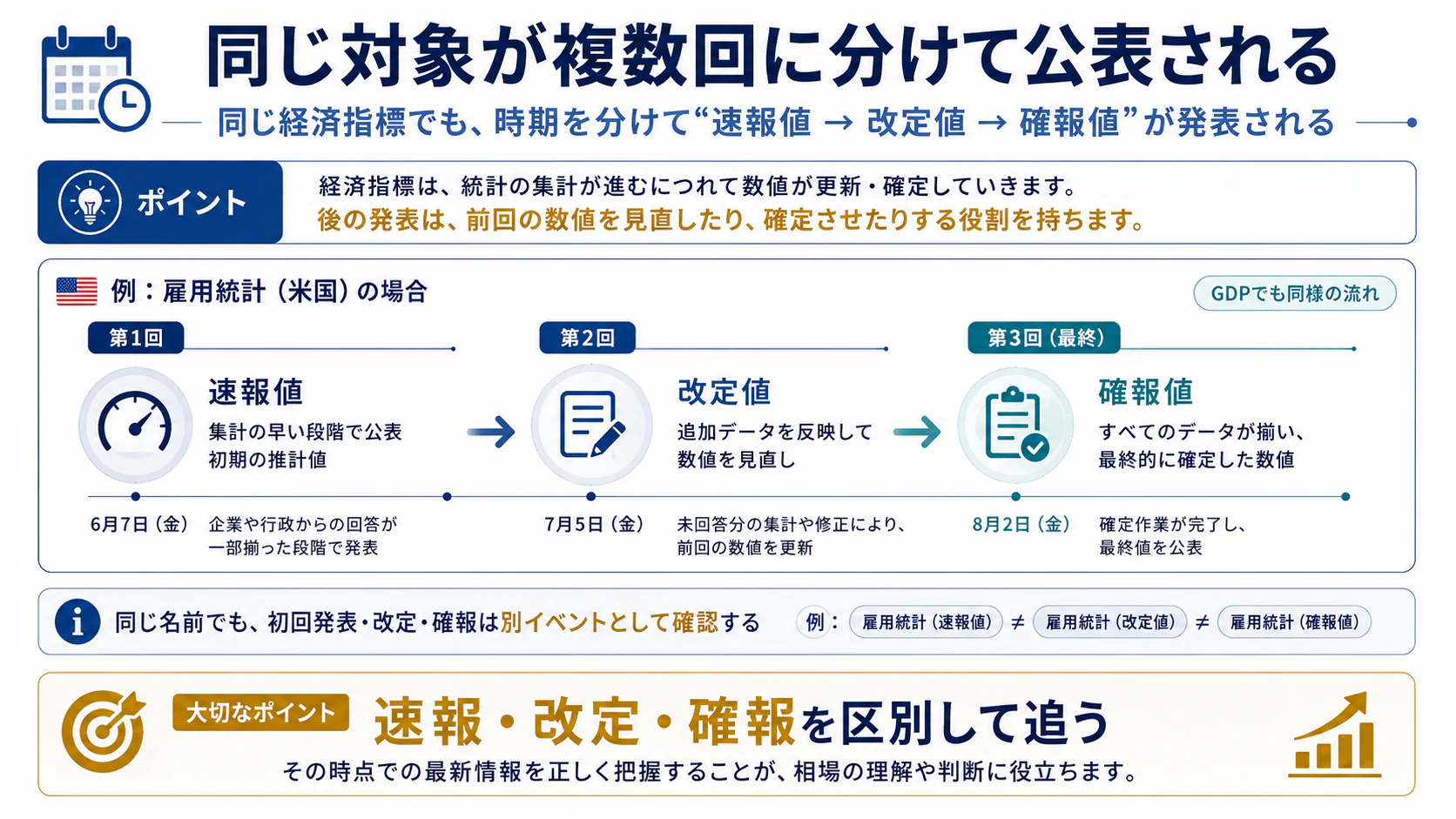
The retroactive revisions (遡及改定) and base revisions mentioned here are procedures built in advance into the way the statistics are produced, and do not mean that the earlier figures were wrong. Nor can the fact that a revision moved a figure up or down be read, in itself, as good news or bad news. The basic approach is to check the reason a figure changed in the materials published by the publishing body.
Viewpoints for checking the calendar
- Which time zone the display is set to (the displayed time changes even for the same event)
- How the filters for country, period, category and importance are set (releases falling outside the conditions are not displayed)
- Whether that date and time is a fixed schedule, or one that may change
- Which classification of the publishing body the name of the indicator refers to
- That the importance indicator is a classification of the provider of the calendar
- That the forecast is not a value released by the publishing body
- Whether the previous value reflects any subsequent revision
- Whether a release relating to the same subject is also scheduled on another day
In every case, the final place to check is official information from each publishing body.
A calendar is a tool for surveying the schedules of several publishing bodies on a single screen. At the same time, the dates and times, classifications and figures displayed there are not necessarily a direct copy of official information from the publishing bodies; in part they involve organisation and additions by the provider. The basic order is to use the dates and figures as a starting point for checking, and to turn to official information from the publishing body when using them in a decision.
Terms organised
Among the terms covered in this article, those worth checking are organised below.
- Economic calendar (経済指標カレンダー): a list, arranged in order of date and time, of such things as the release schedules of each country’s statistics and the meeting dates of central banks. The displayed items and the names used differ depending on the service providing it.
- The release schedule (公表予定): a list of release dates and release times published in advance by the publishing body. It is stated that it may be changed.
- The previous value, the forecast and the result (前回・予想・結果): the three figures lined up in a calendar. The previous value is the value released on the previous occasion for the same statistic, the result is the value actually released, and the forecast is a figure presented as the value expected before the release. The forecast is not something released by the publishing body. In the English-language version they are described as the columns corresponding to Actual, Forecast and Prior.
- Importance (重要度, as displayed in a calendar): a classification that the provider of the calendar has set up on its own. Whether it is something attached by the publishing body could not be confirmed within the range checked for this article.
- Filtering (絞り込み/フィルター): the operation of switching which events are displayed in the list, by conditions such as country, period, category, importance and time zone. It changes the display; it does not change the publishing body’s release schedule itself.
- Revision (改定): the subsequent updating of a figure in a statistic that has once been released.
- Retroactive revision (遡及改定): revision of figures going back into the past, not only of the most recent values. The Cabinet Office states that the seasonally adjusted series are revised retroactively back to the January-March quarter of 1994.
- Seasonal adjustment (季節調整): processing that removes the effect of seasonal variation. The Cabinet Office states that it applies seasonal adjustment afresh each time to the data up to the latest value.
- Base revision (基準改定): the updating of the point in time that serves as the base of a statistic, and of the items covered and their weights. It is carried out periodically for the Consumer Price Index.
- 「1次速報」 and 「2次速報」 (the first and second preliminary releases): the divisions of the stages in which, in Japan’s Quarterly Estimates of GDP, the same quarter is released on two separate occasions.
- “Advance Estimate”, “Second Estimate” and “Third Estimate”: the divisions in which, for US GDP, the same quarter is released in three stages.
- CET: Central European Time. The ECB gives the release time of its monetary policy decisions in this time.
- Daylight saving time (夏時間/サマータイム): a system under which clocks are put forward by one hour for a certain period. The start and end dates differ depending on the country or region.
Frequently checked questions
Is the time displayed in a calendar Japan time?
It depends on the display time zone setting. Most calendars are set up so that the time zone of the display can be selected, and the displayed time changes with the setting even for the same event. The publishing bodies themselves set release times in the time that serves as their own standard. If you want to check what time this corresponds to in Japan time, you will need to check the display setting together with whether the period falls within daylight saving time.
If I set a filter, will some events stop being displayed?
Yes. If you filter by conditions such as country, period, category or importance, events falling outside the conditions stop being displayed on the screen. The fact that something is not displayed does not mean that there is no release scheduled. Filtering by importance in particular is based on a classification set up by the provider of the calendar, so the filtered result also depends on that classification. Whether a release takes place, and its date and time, are to be checked in official information from each publishing body.
Who determines the importance?
It is a classification that the provider of the calendar has set up on its own. Within the range of information released by the publishing bodies checked for this article, no classification attaching a rank of importance to indicators was found. Nor was any explanation of its criteria or of who determines it found in the provider’s official help. The display may therefore differ between services for the same indicator. An importance indicator does not indicate how much the value will move at the time of release.
Is the forecast something released by a public body?
Within the range of official information from public bodies checked for this article, no statement was found that a publishing body releases a forecast value ahead of a release. What publishing bodies release is the release schedule and the result. Nor was any explanation of the source of the value found in the provider’s official help. Note that a central bank may release its own projections, but those differ in character from the figure placed in a calendar’s forecast column.
Why does the previous value now displayed differ from the figure I saw earlier?
The statistic itself may have been revised. The Cabinet Office states, with regard to the Quarterly Estimates of GDP, that the seasonally adjusted series are revised retroactively back to the January-March quarter of 1994, and that the original series may also have been revised. The Consumer Price Index, too, has periodic base revisions. A revision is a procedure built into the way the statistics are produced, and does not mean that the earlier figures were wrong.
Why does information about the same meeting appear several times?
It is because there is more than one thing published in relation to a single meeting, and each is published on a different day. The minutes of the Federal Open Market Committee (FOMC), for example, are stated to be published three weeks after the date of the policy decision. For the Bank of Japan’s Monetary Policy Meetings as well, 「主な意見」 is published at a later date, separately from the decisions released immediately after the meeting ends. The materials published may also differ from meeting to meeting.
Can the dates and times shown in a calendar change?
They can. The Cabinet Office’s release schedule carries a note to the effect that the schedule shown is the schedule as at the present time and may change. The Bank of Japan’s release schedule likewise carries a note to the effect that release dates and release times may be changed. The dates and times in a calendar correspond to the schedules published by the publishing bodies, and are to be checked on the premise that those schedules may themselves change.
Summary
This article has organised the displayed items and the operations of the economic calendar as a screen. It has checked what each of the items lined up in the list — the date and time, the country, the name of the indicator, the importance, and the previous value, the forecast and the result — shows, what filtering by country, period, category, importance and time zone does to the display, and how far the explanations extend when an event is opened.
On that basis, the premise is that, even where items are lined up on the same screen, where they come from differs from item to item. The date and time, the result and the previous value can be traced back to, and checked against, what each publishing body releases, but the importance indicator and the forecast figures are added by the provider of the calendar, and no publication to trace them back to could be found within the range checked for this article. In other words, it is not the case that all of the information appearing in a calendar can be traced back to official information from the publishing body.
In addition, because the displayed time changes with the display time zone setting, and because the switchover dates for daylight saving time do not coincide across countries and regions, the release time as seen in Japan time may change part-way through the year. The division of the releases for the same subject into several occasions, and the retroactive revision of past figures, are also reasons why the figures on the screen may appear to move.
This article has organised how to read a calendar; it does not recommend any particular financial instrument or transaction. Nor does it indicate how to act before or after a release. The premise is that, having checked the dates and figures, the final decision is made by you, after confirming official information from each publishing body.
Official information referred to
- Cabinet Office, Economic and Social Research Institute, 「公表予定」 (its release schedule) https://www.esri.cao.go.jp/jp/sna/kouhyou/kouhyou_top.html
- Cabinet Office, Economic and Social Research Institute, 「統計表一覧(2026年1-3月期2次速報値)」 (its list of statistical tables for the second preliminary release for the January-March quarter of 2026) https://www.esri.cao.go.jp/jp/sna/data/data_list/sokuhou/files/2026/qe261_2/gdemenuja.html
- Cabinet Office, Economic and Social Research Institute, Quarterly Estimates of GDP, 「結果の概要」 (the outline of the results) https://www.esri.cao.go.jp/jp/sna/data/data_list/sokuhou/gaiyou/gaiyou_top.html
- Statistics Bureau, “Q&A about the Consumer Price Index (Answers)” https://www.stat.go.jp/english/data/cpi/1585.html
- Statistics Bureau, 「消費者物価指数(CPI)」 (its Consumer Price Index pages) https://www.stat.go.jp/data/cpi/index.html
- Bank of Japan, 「金融政策決定会合とは何ですか? いつ開催されるのですか?」 (its explanation of what a Monetary Policy Meeting is and when it is held) https://www.boj.or.jp/about/education/oshiete/seisaku/b20.htm
- Bank of Japan, 「公表予定」 (its release schedule) https://www.boj.or.jp/about/calendar/index.htm
- Board of Governors of the Federal Reserve System, “Meeting calendars and information” https://www.federalreserve.gov/monetarypolicy/fomccalendars.htm
- European Central Bank, “Governing Council decisions” https://www.ecb.europa.eu/press/govcdec/html/index.en.html
- U.S. Bureau of Economic Analysis, “Release Schedule” https://www.bea.gov/news/schedule
- National Institute of Standards and Technology, “Daylight Saving Time Rules” https://www.nist.gov/pml/time-and-frequency-division/popular-links/daylight-saving-time-dst
- Directive 2000/84/EC of the European Parliament and of the Council on summer-time arrangements https://eur-lex.europa.eu/legal-content/EN/TXT/?uri=CELEX%3A32000L0084
Of the main text, the description of the items displayed on the screen, the filtering, and the operations available when an event is opened is based on the explanations in the official help pages published by the provider of the calendar concerned. That is a description of the product’s specification, and is not used as the basis for facts such as release dates and times, institutional arrangements or revisions to statistics. Screen specifications may be changed without notice. The pages referred to are listed in the following section.
The content of this article is based on official information from each publishing body as confirmed on 4 August 2026 (only the original text of the EU directive on summer time could not be obtained again on that date). Scheduled release dates and release times may change, and the figures in statistics may also change through subsequent revisions. For actual release dates and times and actual figures, please confirm the latest content in official information from each publishing body.
The provider’s help pages referred to (product specifications)
The description of the screen composition, the displayed items, the filtering and the operations available when an event is selected is based on what was confirmed on the following pages of the TradingView Help Center (both confirmed on 4 August 2026). These are the source for the product specification, and are not used as the basis for the definition of economic indicators themselves, their release times, or revisions.
- TradingView Help Center, 「経済指標カレンダー : マーケットの主要イベントをすべて追跡」 (the Japanese version)
https://jp.tradingview.com/support/solutions/43000759911/ - The English version of the same page (used for checking against the Japanese text)
https://www.tradingview.com/support/solutions/43000759911-economic-calendar-track-all-major-market-events/
Articles to read next
As a reference when going on to check an economic calendar, the following articles may also be consulted.
- The basics of FX and economic indicators (price movement at the time of a release, and points of caution) (what statistic each individual indicator measures, and what may occur before and after a release. Indicators themselves are dealt with there)
- The basics of FX trading hours and markets (the Tokyo, London and New York markets, daylight saving time, weekends and the year-end and New Year period) (the time bands of the markets, and the system of daylight saving time itself)
- How to use TradingView’s stock screener: the meaning of the filter conditions and how to read the displayed data (a different screen within the same service. The function of narrowing down stocks by condition, and the meaning of the terms lined up there)
- How to read the figures in the US stock pre-market (quoted prices, volume and the difference from the previous day’s closing price) (how far the figures displayed before trading hours can be taken as a premise)
Always check the latest trading conditions, fees and campaigns on each company’s official site. The information on this page is as at the time it was written.