
Checking the basics of investing in bonds (Japanese Government Bonds and corporate bonds)
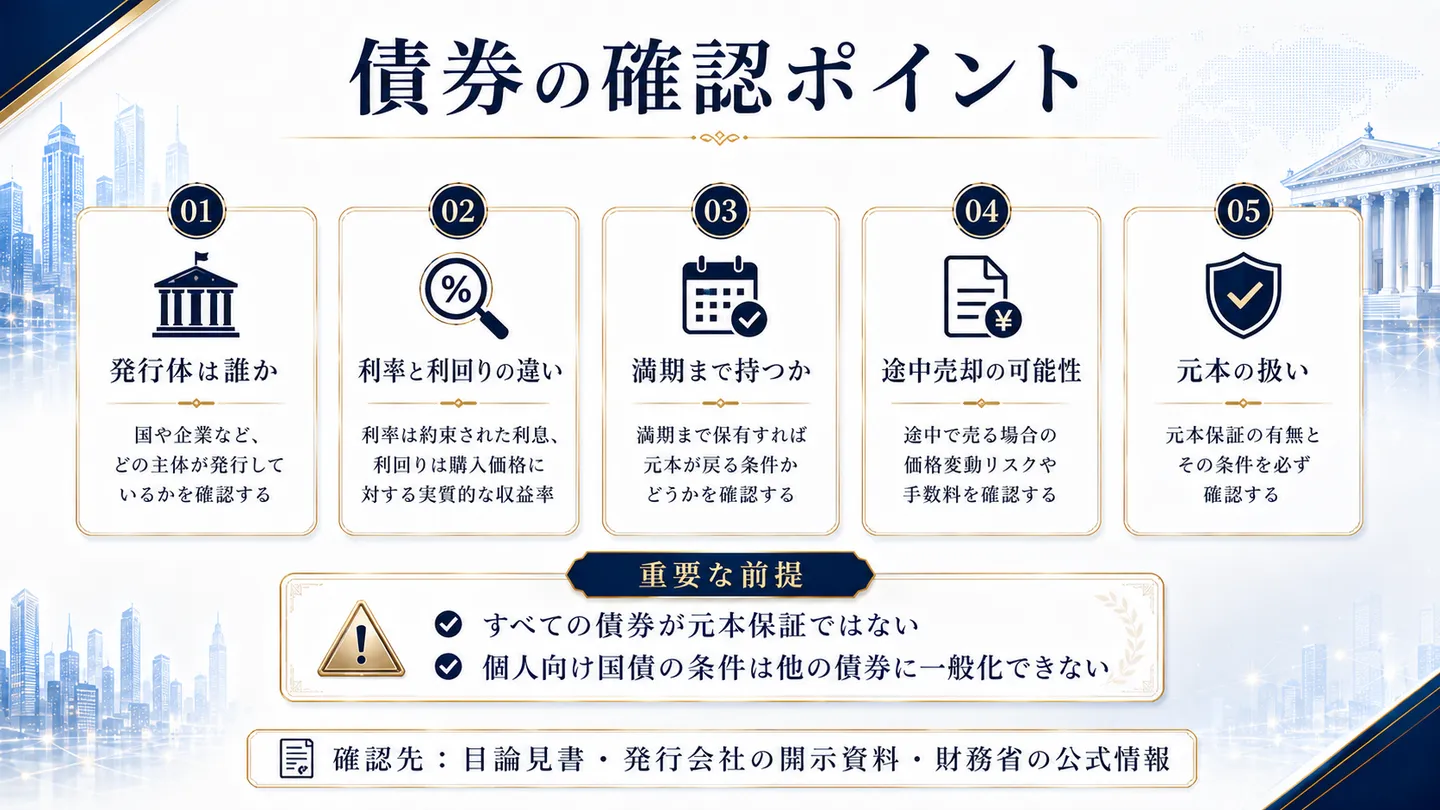
When you first take an interest in bonds, the phrase you are most likely to hear is that bonds are safer than equities. Before accepting that, however, what is worth checking is what kind of product a bond actually is in the way it works, and what risks it involves. If a bond is understood only through the impression of safety, there are several points that are easy to overlook.
This article organises, on the basis of official information, the basic items that are generally checked before starting to invest in bonds. The basic mechanics of face value, the coupon rate, redemption and yield; the differences between Japanese Government Bonds (JGBs, 国債) and corporate bonds (社債); the relationship between interest rates and prices; and matters such as credit risk and price fluctuation risk are set out as an overview for checking, not which bond to buy, but what a bond is and what to look at in checking for oneself. Specific coupon rates, yields and credit ratings differ by issue and by the point in time, so please check the official information and the prospectus (目論見書) of each product.
The risks of securities transactions common to equities, investment trusts and bonds are organised in Checking the risks of securities transactions, and the basics of the investment trust as a product in Basics to check before starting with investment trusts. Taking those as read, this article confines itself to the basics of the bond as a product.
What kind of product is a bond?
A bond is in the nature of a debt certificate — a document evidencing that money has been borrowed — issued when a state, a company or a similar entity borrows funds. Information provided on a site operated by the Japan Financial Literacy and Education Corporation (J-FLEC, 金融経済教育推進機構) explains that bonds are issued with conditions such as when repayment will be made and how much interest will be paid determined in advance. Among these, a bond issued by a company is a corporate bond.
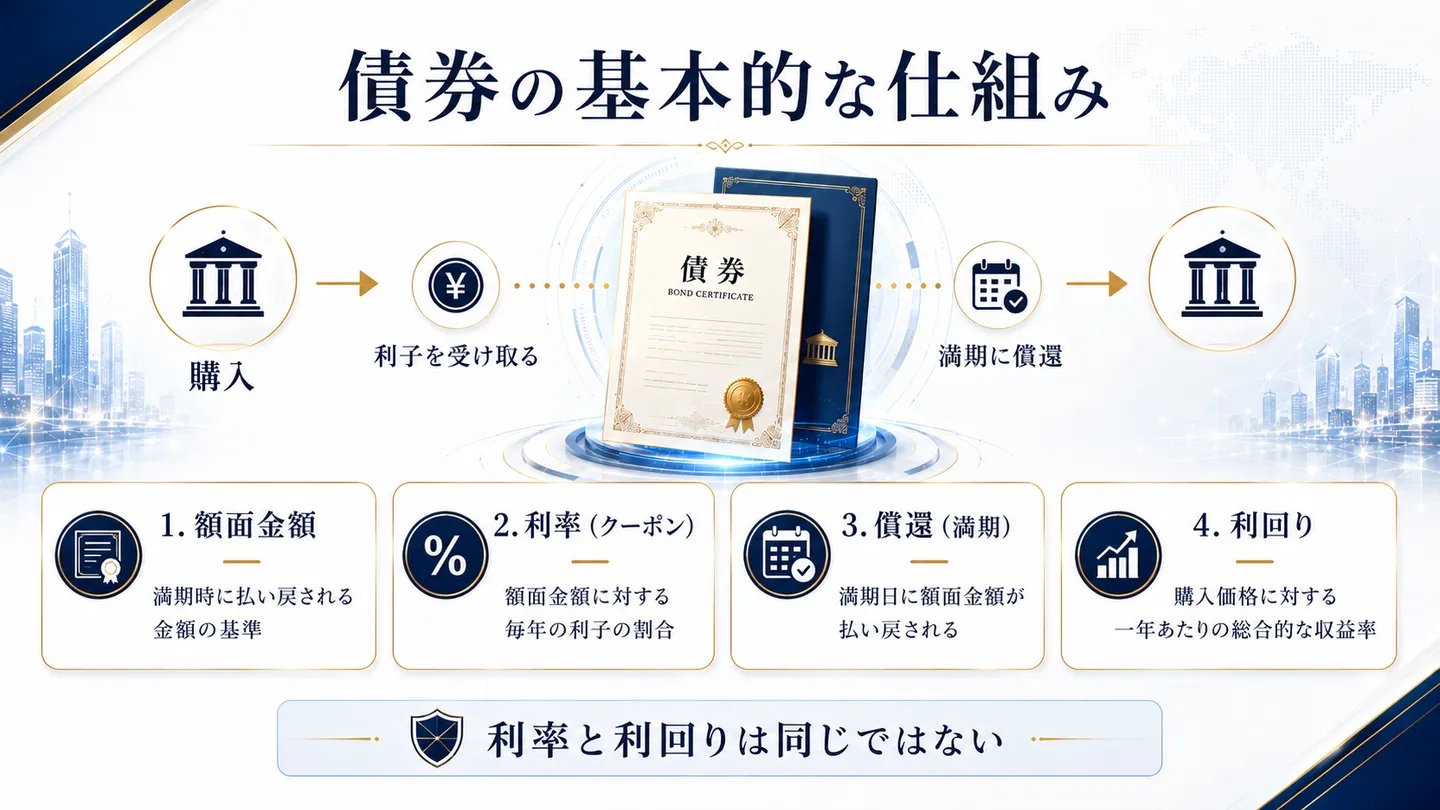
When an investor buys a bond, the arrangement is that, as a general rule, interest is received periodically and, on the day of maturity (redemption), the face value is received as the redemption amount. Unlike equities, bonds are issued with the coupon rate and the maturity date determined in advance, and this is described as a basic characteristic of bonds. That said, this presupposes that the issuer makes the payments as scheduled, and, as set out below, there is a possibility that this premise breaks down (credit risk), a point that calls for care.
Face value, the coupon rate and redemption (maturity)
In understanding bonds, the first three words to grasp are the following.
- Face value: the amount stated on the bond, which forms the basis of the amount repaid at maturity (redemption).
- The coupon rate: the proportion of the face value that is paid as interest each year.
- Redemption (maturity): repayment of the face value by the issuer on the maturity date determined in advance.
That these conditions are determined at the time of issue is explained as a major difference from equities.
What a yield is (how it differs from the coupon rate)
What beginners often confuse is the difference between the coupon rate and the yield. The coupon rate refers to the proportion of the face value that is paid as interest each year. The yield, by contrast, expresses the overall annual rate of return that is expected to be obtained — for instance where the bond is bought and held to maturity — in relation to the purchase price.
The two are not the same. If, for example, a bond can be bought at a price below its face value and is redeemed at face value at maturity, that difference may also become a return in addition to the interest, so the yield takes a different value from the coupon rate. Organising the point that the coupon rate and the yield are separate concepts is the basic step. Specific figures for coupon rates and yields differ by issue and by the time of purchase, so they are to be checked in the official information of each product.
Checking the differences between JGBs and corporate bonds
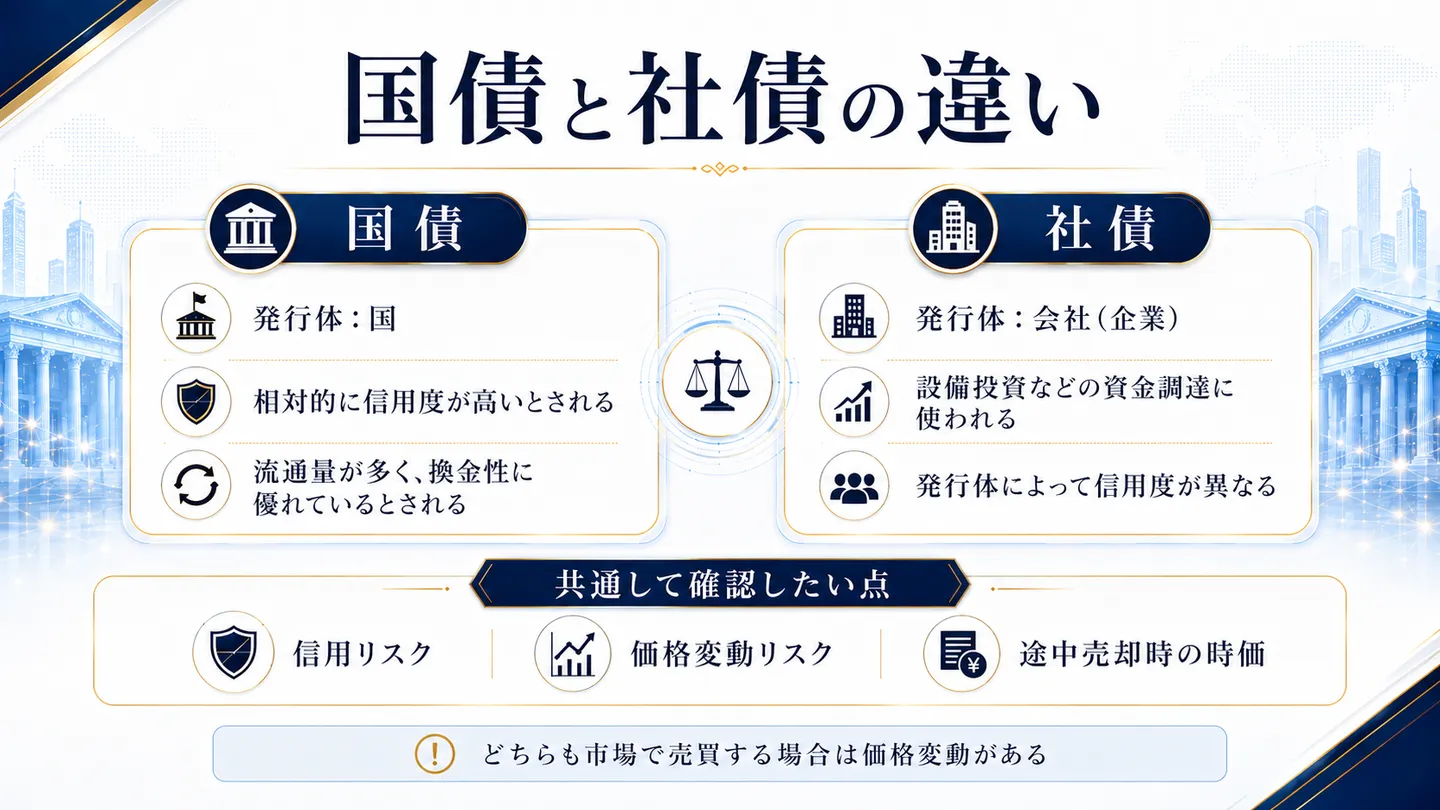
Bonds are called by different names according to who issues them. The representative ones are JGBs, which the state issues, and corporate bonds, which companies issue.
As to JGBs, information published by The Central Council for Financial Services Information (金融広報中央委員会) — a body that was dissolved on 31 October 2024, its activities having been transferred to J-FLEC in August 2024 — described JGBs as the most creditworthy of bonds and stated that, because the volume in circulation is also large, they are readily convertible into cash and can be invested in with peace of mind. That was how that body put it. This article does not follow it that far. What is worth noting is that such a description is a position stated in comparison with other bonds; it does not mean that JGBs are safe because they are JGBs, or that a loss is impossible. Even with JGBs, the price fluctuates where they are bought and sold in the market, and selling before maturity may give rise to a loss.
Corporate bonds, on the other hand, are bonds issued by companies in order to raise business funds, for example for capital investment. According to information published by the Japan Securities Dealers Association, corporate bonds intended for institutional investors have a large minimum purchase unit, while those whose minimum purchase unit has been reduced so that individuals can buy them are called corporate bonds for retail customers (個人向け社債). Another difference worth checking is that the degree of credit risk, discussed below, generally differs between JGBs and corporate bonds.
The three products of JGBs for Retail Investors
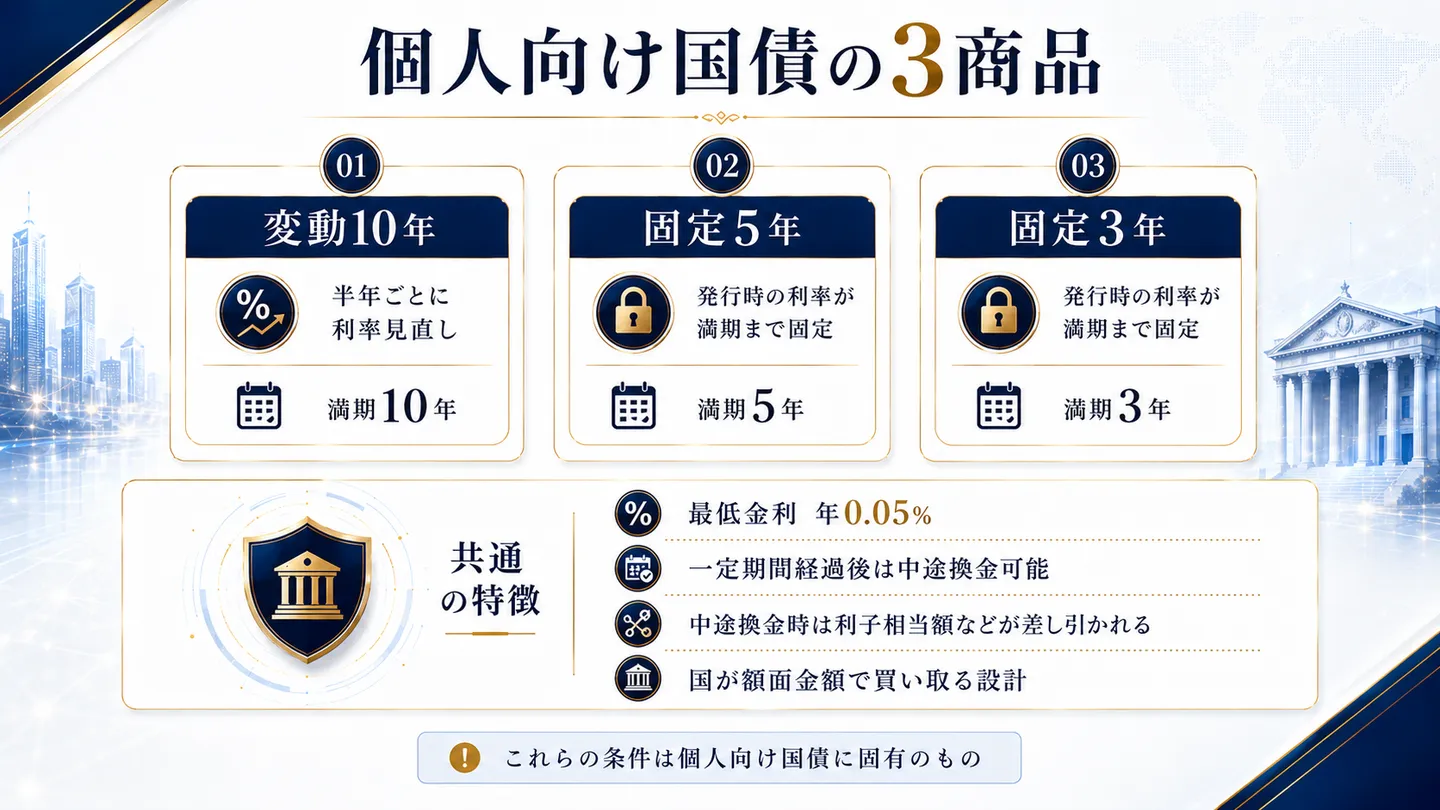
Among the JGBs that the state issues to individuals are JGBs for Retail Investors (個人向け国債), which are handled by Ministry of Finance Japan (財務省). According to information published by the Ministry of Finance, there are the following three products of JGBs for Retail Investors.
- 10-Year Floating-Rate (変動10年): a floating rate, under which the applicable coupon rate is reviewed every six months, with a maturity of 10 years.
- 5-Year Fixed-Rate (固定5年): a fixed rate, under which the coupon rate set at issue does not change until maturity, with a maturity of 5 years.
- 3-Year Fixed-Rate (固定3年): a fixed rate, as with the 5-Year Fixed-Rate type, with a maturity of 3 years.
As a condition said to be common to these three, information published by the Ministry of Finance is described as setting a minimum interest rate of 0.05% per year (年0.05%(年率)). As to cashing in before maturity, it explains that, as a general rule, the bond cannot be cashed in for a certain period after issue, and that it can be cashed in at any time once that period has passed. On cashing in before maturity, an amount equivalent to a given number of the most recent interest payments and the like is deducted; on the other hand, because the state buys the bond back at its face value, the arrangement is described as one in which principal is secured even when the bond is cashed in before maturity.
What matters here is that conditions such as the minimum interest rate and the securing of principal on cashing in before maturity are specific to JGBs for Retail Investors, and do not apply to corporate bonds or to ordinary JGBs bought and sold in the market. It cannot be generalised that principal is secured simply because an instrument is a bond. The level of the minimum interest rate, and the specific conditions for cashing in before maturity (such as the period during which it cannot be cashed in and the method of calculating the amount deducted), are set in ways that depend on the point in time and on the product, so please be sure to check them in the official information on JGBs for Retail Investors (個人向け国債) that the Ministry of Finance publishes in Japanese.
The relationship between bond prices and interest rates
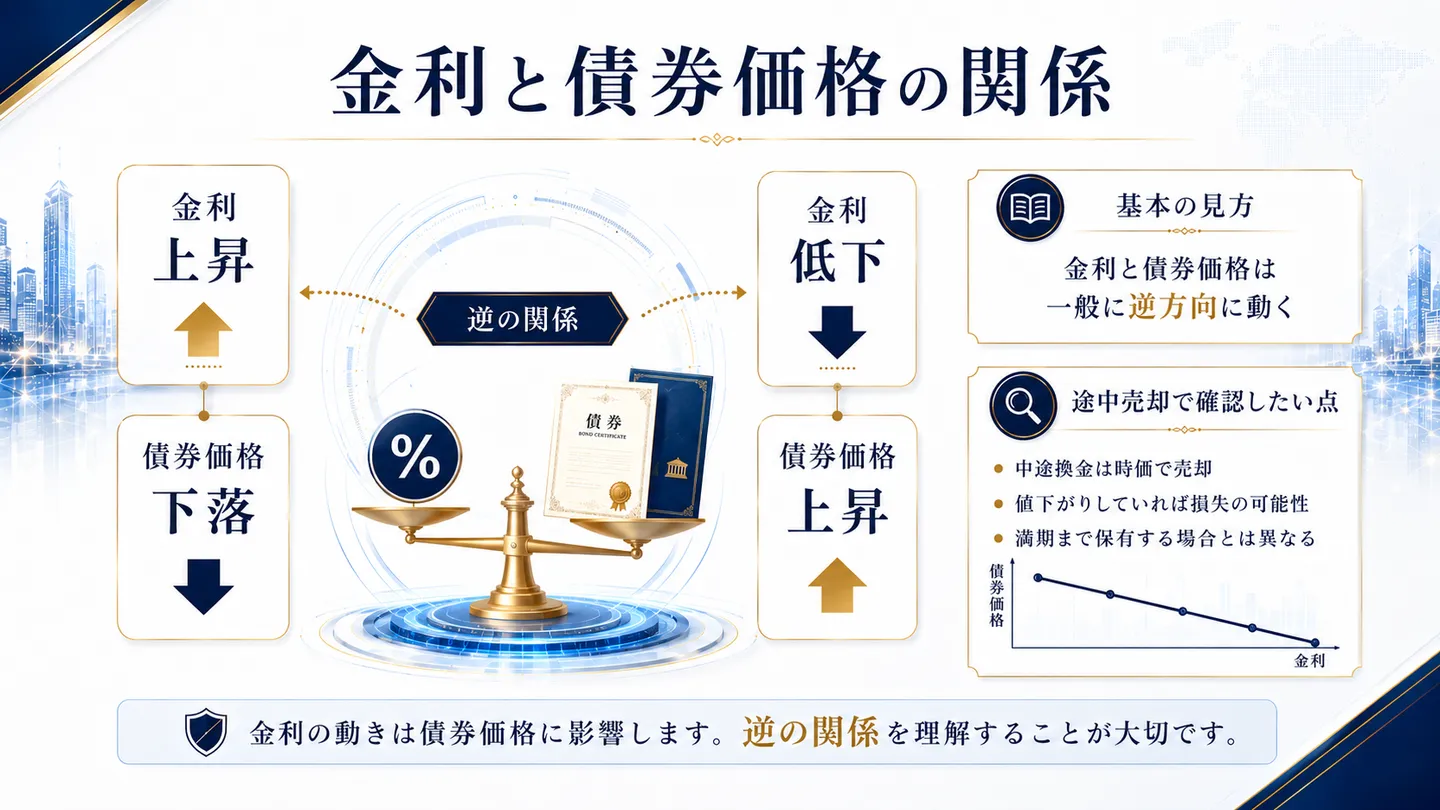
What cannot be left out in understanding bonds is the relationship between a bond’s price and interest rates. According to information published by the Japan Securities Dealers Association, the general relationship is that when interest rates rise the market price of a bond falls, and when interest rates fall the market price of a bond rises. The two are organised as moving in opposite directions, that is, as being inversely correlated.
Because of this relationship, where a bond is not held to maturity but sold partway through, the sale is at the market price at that time, that is, at its current market value. Information published by the Japan Securities Dealers Association likewise explains that, while a bond as a general rule returns its face value if held to maturity (redemption), cashing it in before maturity is a sale at the current market value, so a loss may arise if the price has fallen. The characteristic that a bond returns its face value if held to maturity, and the characteristic that selling partway through exposes the holder to price movements, need to be understood separately.
Checking the risks of bonds
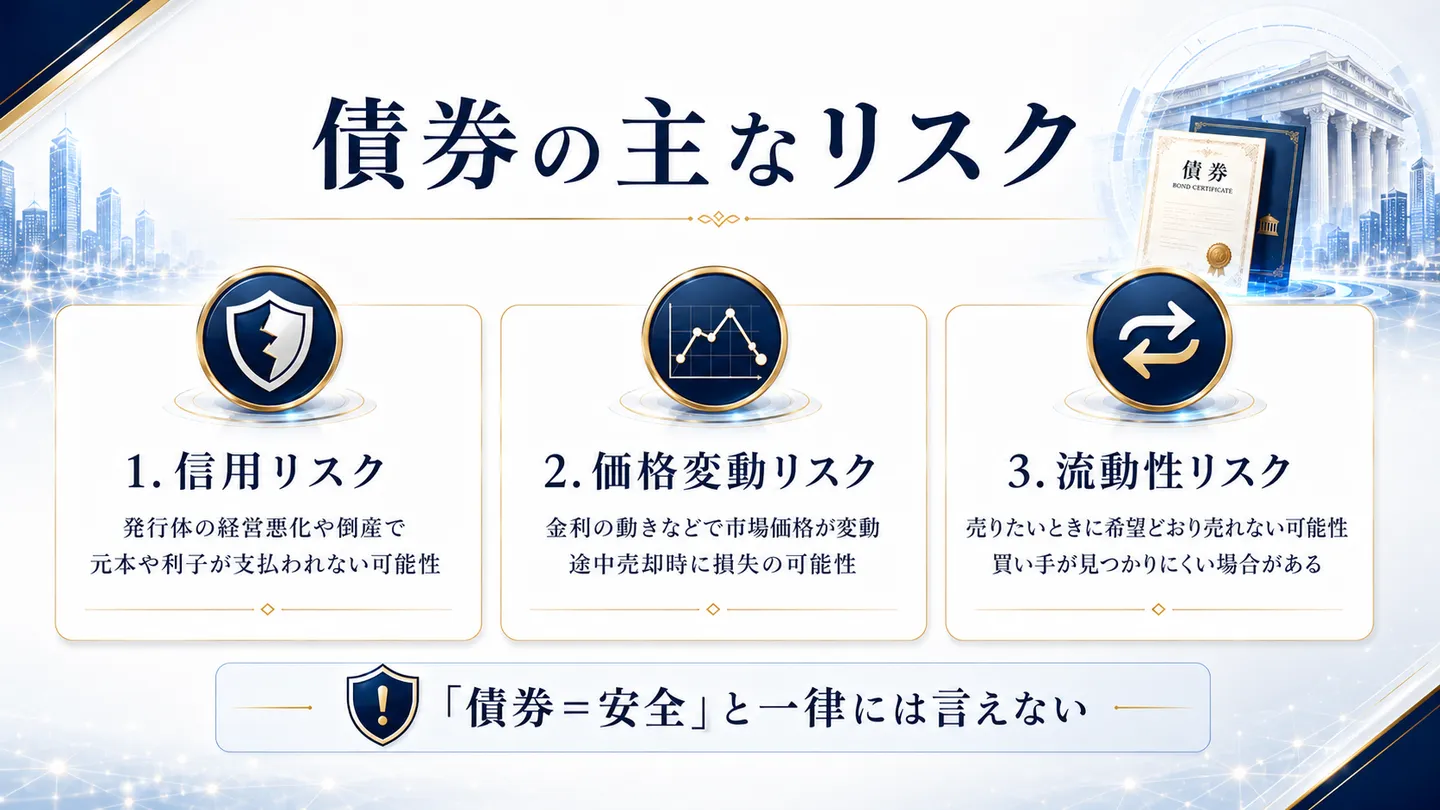
Bonds too carry several representative risks worth checking. Separately from the general impression that bonds are safe, the basic approach is to understand them on the premise that the following risks exist.
Credit risk (issuer risk)
Credit risk is also called issuer risk. According to information published by the Japan Securities Dealers Association, where a company that has issued corporate bonds goes bankrupt, payment of principal and interest may not be made. A bond is an arrangement under which the face value is redeemed at maturity, but that presupposes that the issuer is able to make the payments as scheduled, and there is a possibility that this premise breaks down.
In order to evaluate an issuer’s creditworthiness in this way, credit rating agencies, as third parties, assign credit ratings, by which they are said to evaluate whether the issuer can pay interest and principal as scheduled. Specific rating symbols and levels differ by issue and by the point in time, and what they mean is not uniform either, so this article does not go into any particular rating. Important information on corporate bonds is to be checked in sources such as the prospectus (目論見書), the annual securities report (有価証券報告書) and the disclosure materials of the issuing company.
Price fluctuation risk (selling before maturity)
As already seen, the market price of a bond fluctuates with movements in interest rates and other factors. According to information published by the Japan Securities Dealers Association, the risk that the market price fluctuates in this way is called price fluctuation risk. Unlike holding to maturity, cashing in before maturity means selling at the current market value at that time, so if the price has fallen the amount may fall below the amount paid at purchase and a loss may arise.
Liquidity risk
Liquidity risk refers to the possibility of not being able to cash in or sell as one wishes when one needs to. According to information published by the Japan Securities Dealers Association, while corporate bonds are said to be capable of being cashed in before maturity, depending on market conditions and on the state of the issuer’s credit risk they may become less readily convertible into cash, buyers may be hard to find, and securities companies too may become less willing to buy them back. In such a case, it is explained, a situation may also arise in which a corporate bond that has been bought cannot be sold when one wants to sell it.
In addition, the buying and selling of corporate bonds is often carried out as bilateral transactions (相対取引) between the investor and the securities company, and grasping the level of actual transaction prices is said not to be easy. The Japan Securities Dealers Association publishes 「個人向け社債等の店頭気配情報」 (over-the-counter indicative price information for corporate bonds for retail customers and similar bonds) as reference information, but it is necessary to bear in mind that these are strictly reference values.
How to understand a “guarantee of principal”
Taking together what has been seen so far, this section organises the relationship between bonds and a “guarantee of principal”. A bond is an arrangement under which, as a general rule, the face value is redeemed if it is held to maturity, but this presupposes that the issuer does not go bankrupt. So long as credit risk exists, it cannot uniformly be said of every bond that principal is guaranteed.
There are also products, such as JGBs for Retail Investors, that are described as designed so that the state buys the bond back at face value even when it is cashed in before maturity, so that principal is secured. However, and to repeat, this is a condition specific to JGBs for Retail Investors, and it does not apply to corporate bonds or to ordinary JGBs bought and sold in the market. That it is not appropriate to generalise that bonds are safe, or that principal is protected simply because an instrument is a bond, is the most important premise in understanding bonds.
How each product treats principal, and what conditions apply to cashing in before maturity, differ from product to product. The basic approach is to be sure to check primary information: the prospectus and the disclosure materials of the issuing company in the case of corporate bonds, and the official information of the Ministry of Finance in the case of JGBs for Retail Investors.
Glossary
The following organises the terms used in this article that a first-time reader may wish to check.
- Bond (債券): a financial instrument in the nature of a debt certificate, issued when a state, a company or a similar entity borrows funds. It is issued with the coupon rate and the maturity determined in advance.
- Face value: the amount stated on the bond, which forms the basis of the amount repaid at maturity (redemption).
- The coupon rate: the proportion of the face value that is paid as interest each year.
- Yield: the overall annual rate of return, in relation to the purchase price, that is expected where the bond is bought and held to maturity, for example. It is a different concept from the coupon rate.
- Redemption (maturity): repayment of the face value by the issuer on the maturity date determined in advance.
- Japanese Government Bonds (国債) / corporate bonds (社債): a bond issued by the state is a JGB; a bond issued by a company is a corporate bond.
- Credit risk (issuer risk): the possibility that principal and interest are not paid because of a deterioration in the issuer’s business or its bankruptcy.
- Price fluctuation risk: the possibility that the market price of a bond fluctuates with movements in interest rates and other factors, and that a loss arises when it is cashed in before maturity.
- Liquidity risk: the possibility of not being able to cash in or sell as one wishes when one needs to.
- Credit rating: an evaluation by a credit rating agency of the issuer’s ability to pay interest and principal, that is, of its creditworthiness.
Frequently checked questions
Are bonds a safe product?
It cannot uniformly be said that bonds are safe. Bonds carry credit risk, under which principal and interest are not paid because the issuer goes bankrupt; price fluctuation risk, under which the market price moves with interest rates; and liquidity risk, under which they cannot be sold as one wishes. A bond is an arrangement under which, as a general rule, the face value is redeemed if it is held to maturity, but that presupposes that the issuer does not go bankrupt. Being described in some explanations as having smaller price movements than equities is a different matter from being safe, and bonds need to be checked on the premise that they too carry a corresponding degree of risk.
What happens to bonds when interest rates rise?
In general, the relationship is the opposite one: when interest rates rise the market price of a bond falls, and when interest rates fall the market price rises. Therefore, where a bond is not held to maturity but sold partway through, the sale is at the market price (the current market value) at that time, and a loss may arise if the price has fallen. If, on the other hand, the bond is held to maturity, the face value is as a general rule redeemed unless the issuer goes bankrupt. Care is needed with the point that the exposure to price movements differs between selling partway through and holding to maturity.
Are JGBs for Retail Investors principal-guaranteed?
According to information published by the Ministry of Finance, JGBs for Retail Investors are described as designed so that principal is secured, because the state buys them back at face value even when they are cashed in before maturity. However, this is a condition specific to JGBs for Retail Investors, and it does not apply to corporate bonds or to ordinary JGBs bought and sold in the market. Care is needed with the point that it cannot be generalised that principal is secured simply because an instrument is a bond. Please check the minimum interest rate and the specific conditions for cashing in before maturity in the official information on JGBs for Retail Investors (個人向け国債) that the Ministry of Finance publishes in Japanese.
How do JGBs and corporate bonds differ?
JGBs are bonds issued by the state, and corporate bonds are bonds issued by companies. JGBs are described as the most creditworthy of bonds and, because the volume in circulation is large, as readily convertible into cash, but that description is a position stated in comparison with other bonds. The creditworthiness of corporate bonds differs with each issuing company, and where a company goes bankrupt principal and interest may not be paid. Because the price of both fluctuates where they are bought and sold in the market, the basic approach is to check the degree of credit risk and of price fluctuation risk product by product.
Are the coupon rate and the yield the same thing?
They are not the same. The coupon rate is the proportion of the face value that is paid as interest each year. The yield is the overall annual rate of return, in relation to the purchase price, that is expected where the bond is bought and held to maturity, for example. If, for instance, the bond can be bought below face value, that difference may also become a return in addition to the interest, so the yield takes a different value from the coupon rate. Specific figures differ by issue and by the time of purchase, so they are to be checked in the official information of each product.
Summary
This article has organised the basic items that are generally checked before starting to invest in bonds. A bond is in the nature of a debt certificate issued when a state or a company borrows funds, and it is issued with conditions such as the face value, the coupon rate and redemption (maturity) determined in advance. That the coupon rate and the yield are different concepts, and that there is an inverse relationship under which the market price of a bond falls when interest rates rise, are also basics worth checking.
And the most important point is that it cannot uniformly be said that bonds are safe, or that principal is protected simply because an instrument is a bond. Bonds carry credit risk, price fluctuation risk and liquidity risk, and the redemption of the face value on holding to maturity also presupposes that the issuer does not go bankrupt. There are products, such as JGBs for Retail Investors, that are described as designed so that principal is secured, but that is a condition specific to JGBs for Retail Investors and cannot be generalised to other bonds. The coupon rate of each product, and the conditions attaching to principal and to cashing in before maturity, are basically to be checked in official primary information such as the Japanese-language information of the Ministry of Finance on JGBs for Retail Investors (個人向け国債), the disclosure materials of the issuing company, and the prospectus. We hope you will use this article as an overview for checking the bonds that interest you.
Articles to read next
The following articles may also be of use as a reference when working through checks on bonds and other securities.
- Checking the risks of securities transactions
- Basics to check before starting with investment trusts
Always check the latest trading conditions, fees and campaigns on each company’s official site. The information on this page is as at the time it was written.